What Does Clove Oil Smell Like? Bud vs Leaf
Put clove bud oil and clove leaf oil side by side and the first surprise is that they do not smell the same. Both say clove right away, but one is round and sweetly spiced, the other drier, smokier and a little earthy. Once you know the difference, it is easy to choose between them.
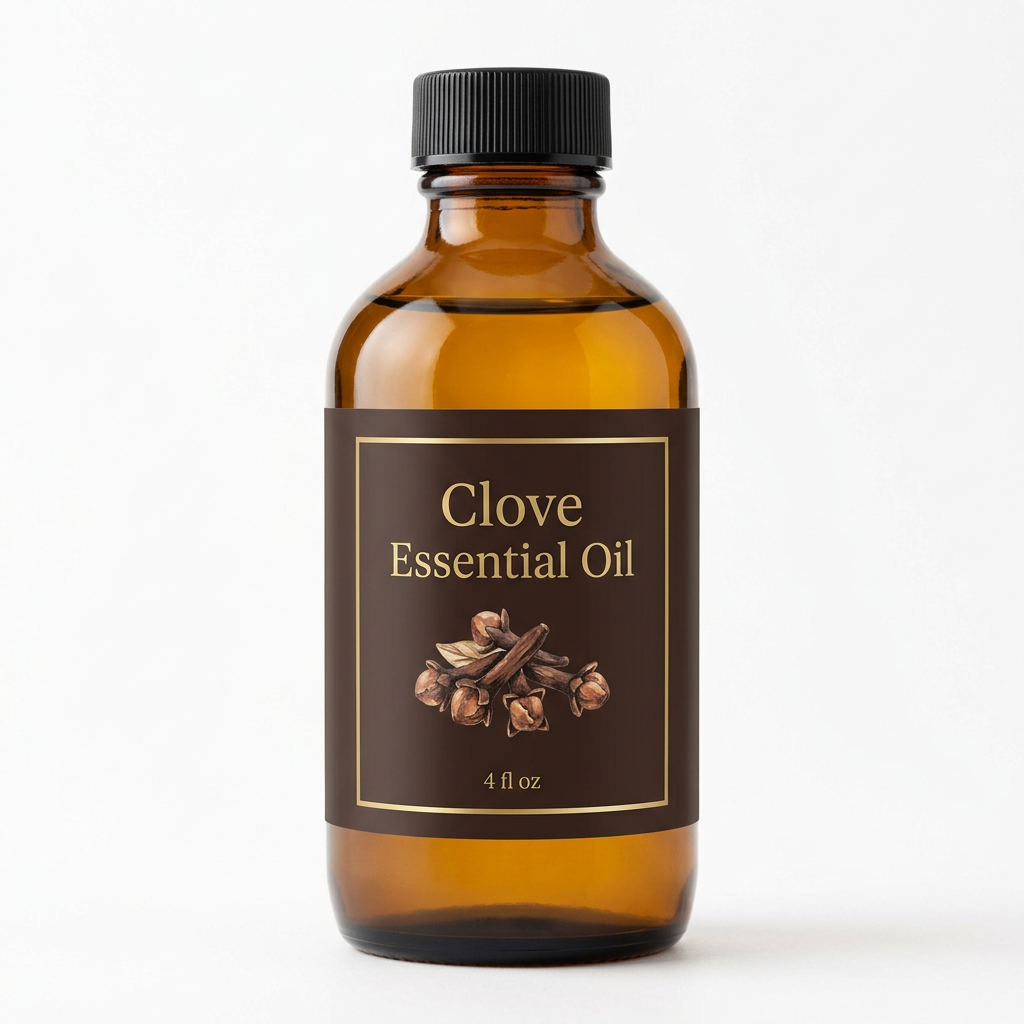
Clove Essential Oil
Our own Clove Essential Oil, in sizes from 0.5 oz to bulk.
From $10.99
Shop Now →Two oils, two personalities
We describe the bud oil as warm, rich and sweetly spicy, with a baking-spice depth that brings to mind mulled cider. The leaf oil is bold, smoky and earthy-spicy, drier and less sweet. In perfumery terms we place both as middle-to-base notes, which means the scent builds after the first moments and lingers rather than flashing off. If you plan to use clove in a candle, a simmer pot or a diffuser, that staying power is a big part of the appeal, and the Certificate of Analysis we publish for one bud batch lists its smell standard as "spicy, woodsy, sweet."
Why it smells like clove
The reason is mostly one molecule. PubChem records eugenol's odor as "odor of cloves" in the Merck Index, and as warm, spicy and floral in Kirk-Othmer. Across the literature, eugenol makes up somewhere between 45 and 90% of clove oil (Kamatou and colleagues, 2012), and the GC-MS report we publish for our bud oil puts it at 73.57% by area. When three-quarters of an oil is the molecule named for the smell, the smell follows.
What shapes the difference between bottles is the rest. The same report lists eugenyl acetate at 12.82% and beta-caryophyllene at 7.95%, among 25 compounds. We cannot tell you which compound is the sweetness and which is the woodiness, since we know of no source that assigns those notes. But it is reasonable to think the smaller components are what separate one bud oil from another. A review table of bud oils (Linan-Atero and colleagues, 2024) shows eugenyl acetate ranging from under 1% to over 16% between samples, so those differences are real.
How to compare them yourself
A blotter strip is the best tool. Dip a strip of plain, unscented blotting paper into each oil, label them, and smell from about ten centimeters away rather than from the bottle neck. Eugenol-rich oils overwhelm the nose up close, and you learn nothing from it. Come back to the strips after ten minutes and again after an hour, and you will notice how the scents settle. Our 0.5 oz sizes make this an easy experiment with both oils.
Matching the smell to the job
- Sweet and cozy: the bud oil, for holiday blends, baking-spice accords and anything meant to feel like mulled cider.
- Dry and smoky: the leaf oil, which is the formulator's pick for soap, candles and cleaning blends where a bolder, less sweet spice works.
Good partners follow the same logic. For the bud oil we suggest orange, cinnamon, cedarwood, frankincense and vanilla, and for the leaf oil sweet orange, cinnamon leaf, cedarwood, patchouli, black pepper and vanilla. Clove leads in any blend, so sweet, resinous and woody partners leave it room to shine. If you are weighing it against other spice oils, clove versus cinnamon and clove versus nutmeg are good reads.
Describing the smell in your own words
It helps to have a few words ready when you smell clove, because the nose is a poor note-taker. Try asking yourself three questions as you hold the strip. Is it sweet or dry? Is it round and cozy, or sharp and smoky? Does it remind you of something specific, like baked apples, a wood fire or a spice cabinet? Jot down what comes to mind for each oil, and you will find the choice between them mostly makes itself.
Smell the strips again the next day, too. Open the sealed jar or envelope you left them in and notice what is still there. Clove tends to leave a quiet trail, and that trail is a good clue to how it will feel in a candle, a soap or a simmer pot.
It also helps to smell something neutral between oils. A sniff of your own sleeve, or a short walk to another room, gives your nose a reset, so the second oil is not judged through the first.
Smell and age
We say the bud oil typically keeps three to five years unopened, and the leaf oil four to five, when stored cool and dark away from light. If an older bottle smells different from a fresh one, trust your nose: compare a strip of each side by side, and ask us about the batch if the difference is clear. Storing clove oil covers keeping a bottle at its best, and clove essential oil versus fragrance oil helps if a bottle smells like clove but a little thin.
One sensible note
A strong smell is not the same as a safe one. Eugenol is a recognised skin sensitiser, and Kamatou and colleagues call it a primary irritant. Enjoy the scent from a strip or a diffuser, and keep the neat oil off your skin: the Tisserand Institute gives 0.5% as its topical maximum for clove bud, and that is the figure we work to. Keep it away from children and pets.
Smell both, pick the one that feels like your kind of spice, and let your nose decide.
Clove Essential Oil
Clove Essential Oil from our own shop, in sizes from 0.5 oz to bulk.
From $10.99
Shop Now →Sources & Further Reading
- PubChem. Eugenol, CID 3314. pubchem.ncbi.nlm.nih.gov/compound/3314
- Kamatou GP, Vermaak I, Viljoen AM, 2012. Eugenol: from the remote Maluku Islands to the international market place. pmc.ncbi.nlm.nih.gov/articles/PMC6268661
- Linan-Atero R et al., 2024. Clove Essential Oil: Chemical Profile, Biological Activities, Encapsulation Strategies, and Food Applications. Antioxidants. pmc.ncbi.nlm.nih.gov/articles/PMC11047511
- Tisserand Institute. Eugenol: Essential Oil Constituents in Food Part 4. tisserandinstitute.org/learn-more/eugenol