Clove Oil for Acne: One Small Trial, Read Closely
The line you will see online is that no one has tested clove oil on acne. That is slightly out of date: a 2025 trial exists. It is also much smaller and stranger than the headlines built on it, and it does not tell you that a drop of clove oil on a pimple is a good idea. We sell clove bud and clove leaf oil for aromatic and cosmetic use, and our position is that neither is an acne product. Here is the trial read closely, the lab data around it, and what dermatologists actually recommend.
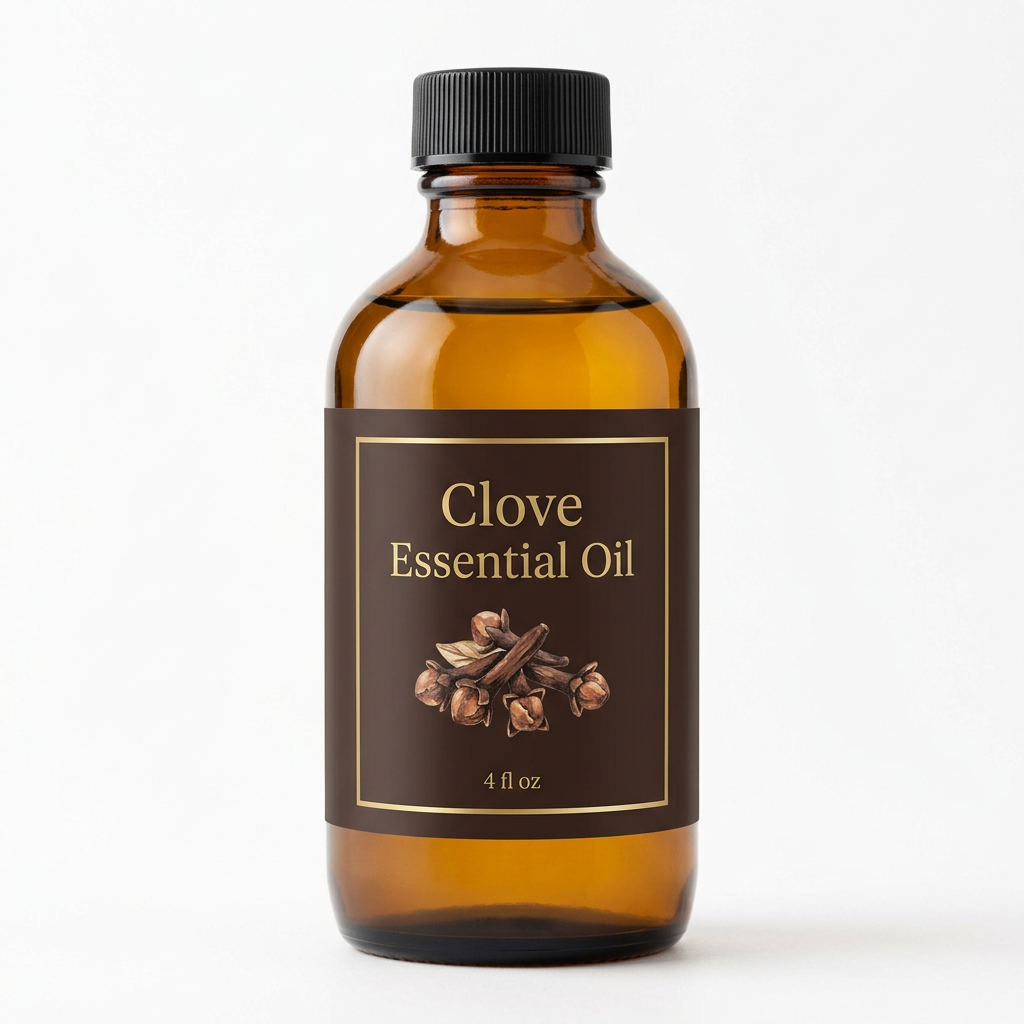
Clove Essential Oil
Our own Clove Essential Oil, in sizes from 0.5 oz to bulk.
From $10.99
Shop Now →The one trial, read the way a skeptic would
Dastgir et al., Advanced Pharmaceutical Bulletin, 2025, from an Iranian university group, made a semi-solid gel containing clove oil and curcumin and compared it with topical clindamycin in people with mild to moderate acne. Details from the abstract:
- Size and design: 31 participants, single-blind, randomized, four weeks.
- The product: a combination of clove oil and curcumin in a formulated gel. The abstract does not state the clove oil concentration, and we have not seen the full text, so we cannot tell you a percentage.
- The comparison: volunteers "applied clindamycin gel in the morning and the clove oil-curcumin gel in the evening, or vice versa."
- The result as reported: comparable reductions in lesions, papules and an acne severity index; no significant difference in comedones; higher satisfaction with the clove gel. The authors declared no conflict of interest.
Reasoning from the abstract's own description, there are limits a reader should hold onto. Each person appears to have used both products, one in the morning and one in the evening, so the lesion counts cannot be assigned cleanly to either gel. There was no vehicle-only or no-treatment arm listed, so it cannot show that the gel beat doing nothing. Curcumin is a second active ingredient, so the clove oil's share of any effect is unknown. And 31 people over four weeks is a pilot. The authors call the findings "promising," which is the appropriate size of claim. None of this says anything about a diluted bottle of plain oil.
The lab data stop at the dish
The same paper measured how much clove oil and curcumin it took to inhibit Propionibacterium acnes (now Cutibacterium acnes) and Staphylococcus epidermidis in culture. Dish results of that kind are easy to produce with strong essential oils. A 2017 review by Orchard and van Vuuren of commercial essential oils for skin infections noted that organisms such as P. acnes have been "sorely neglected" compared with Staphylococcus aureus, so the data we do have are thin for exactly this skin problem. Reasoning from how these assays work: a minimum inhibitory concentration (MIC) is the lowest dose that stops growth in a tube of broth, where nothing else is present. On a face, the oil meets sebum, a carrier, skin cells and sweat, and the dose that reaches bacteria in a follicle is unknown. A dish number says the oil is active against the organism, not that any concentration you could apply to skin does the same job without bothering the skin.
That skin-cell side is where clove oil has a documented problem. The Tisserand Institute lists a topical maximum of 0.5% for clove bud oil and says eugenol "can be a skin irritant or allergen if not used in proper dilutions." The skin around a breakout is already inflamed.
Why a lab number and a face are different problems
Two sentences from the trial paper explain the gap. The authors first measured inhibition of the acne bacterium in culture, then formulated a gel and tested it on people. They tested a formulated gel, not the plain oil, and the abstract does not say why. Reasoning on our own: plain clove oil is volatile and mostly eugenol, the compound the Tisserand Institute flags as an irritant, so a formulated vehicle at a set concentration is a different object from oil dropped from a bottle. The trial's result, whatever it is worth, belongs to the gel.
A second practical point from the AAD guideline's own list: it recommends combining topical therapies with multiple mechanisms of action as a good practice statement. Nothing in a bottle of clove oil is a second mechanism you can safely stack on top without a professional's view of your skin.
What a dermatologist's guideline recommends instead
The American Academy of Dermatology guideline (Reynolds et al., J Am Acad Dermatol, 2024) contains 18 evidence-based recommendations and 5 good practice statements. Strong recommendations cover benzoyl peroxide, topical retinoids, topical antibiotics and oral doxycycline. Oral isotretinoin is strongly recommended for acne that is severe, causes psychosocial burden or scarring, or has failed standard therapy. Conditional recommendations cover clascoterone, salicylic acid and azelaic acid among others. Clove oil is not among them. That is the practical benchmark: when a skin concern is acne, the evidence-backed options are prescription or over-the-counter products with trial data behind each, and a dermatologist or pharmacist can match one to your skin.
Spot-treating with neat oil: a hard no
Our own product pages say never to apply either clove oil undiluted, and to keep it away from eyes. We will not give a spot-treatment instruction here, because the combination of an eugenol-rich oil (73.57% eugenol in our published GC-MS report for the bud oil) and a swollen, possibly broken lesion is, by our reasoning from the Tisserand irritation warning, the situation where the most can go wrong. We also do not give a face recipe. If you want the arithmetic of what 0.5% looks like, the worked numbers are in our skin pillar: about 3 drops in 30 ml of carrier at an assumed 20 drops per ml, which we have not tested on anyone. That number is for understanding what "diluted" means, not an invitation to try it on a blemish.
Who should skip clove oil on breakouts
- Anyone with cystic, painful or scarring acne. That is a dermatologist visit; the guideline's strongest tools are prescription-level.
- Anyone already using a retinoid, benzoyl peroxide or another active. Reasoning from the fact that those products already irritate some users, layering a second irritant is a bad trade. Ask the dermatologist or pharmacist who recommended them.
- Anyone with darker skin who is worried about marks. We have no source quantifying post-inflammatory marks from eugenol, so we will not claim a rate. The reasoning is that irritation adds inflammation, and a dermatologist can tell you how that applies to your skin.
- Teenagers and children. Our safety copy says to keep clove oil away from children. A pediatrician or dermatologist should guide acne in this age group.
If you are choosing between oils anyway
Many readers arrive here comparing clove with tea tree. We do not sell tea tree. That comparison, with composition and the trial record for each, is in clove oil vs tea tree oil. For the general risk list, see clove oil side effects.
If you buy our clove oil, buy it for the scent in a diffuser or a diluted aromatic use, and take a pimple that bothers you to someone whose job is skin.
Clove Essential Oil
Clove Essential Oil from our own shop, in sizes from 0.5 oz to bulk.
From $10.99
Shop Now →Sources & Further Reading
- Dastgir P et al., 2025. Evaluating the Efficacy of a Semi-Solid Formulation with Clove Oil and Curcumin versus Clindamycin in the Treatment of Acne Vulgaris. pubmed.ncbi.nlm.nih.gov/41403734
- Reynolds RV et al., 2024. Guidelines of care for the management of acne vulgaris. pubmed.ncbi.nlm.nih.gov/38300170
- Orchard A, van Vuuren S, 2017. Commercial Essential Oils as Potential Antimicrobials for Skin Diseases. pubmed.ncbi.nlm.nih.gov/28546822
- Tisserand Institute. Eugenol: Essential Oil Constituents in Food Part 4. tisserandinstitute.org/learn-more/eugenol