Clove Oil Side Effects: Skin, Allergy, Blood and Swallowing
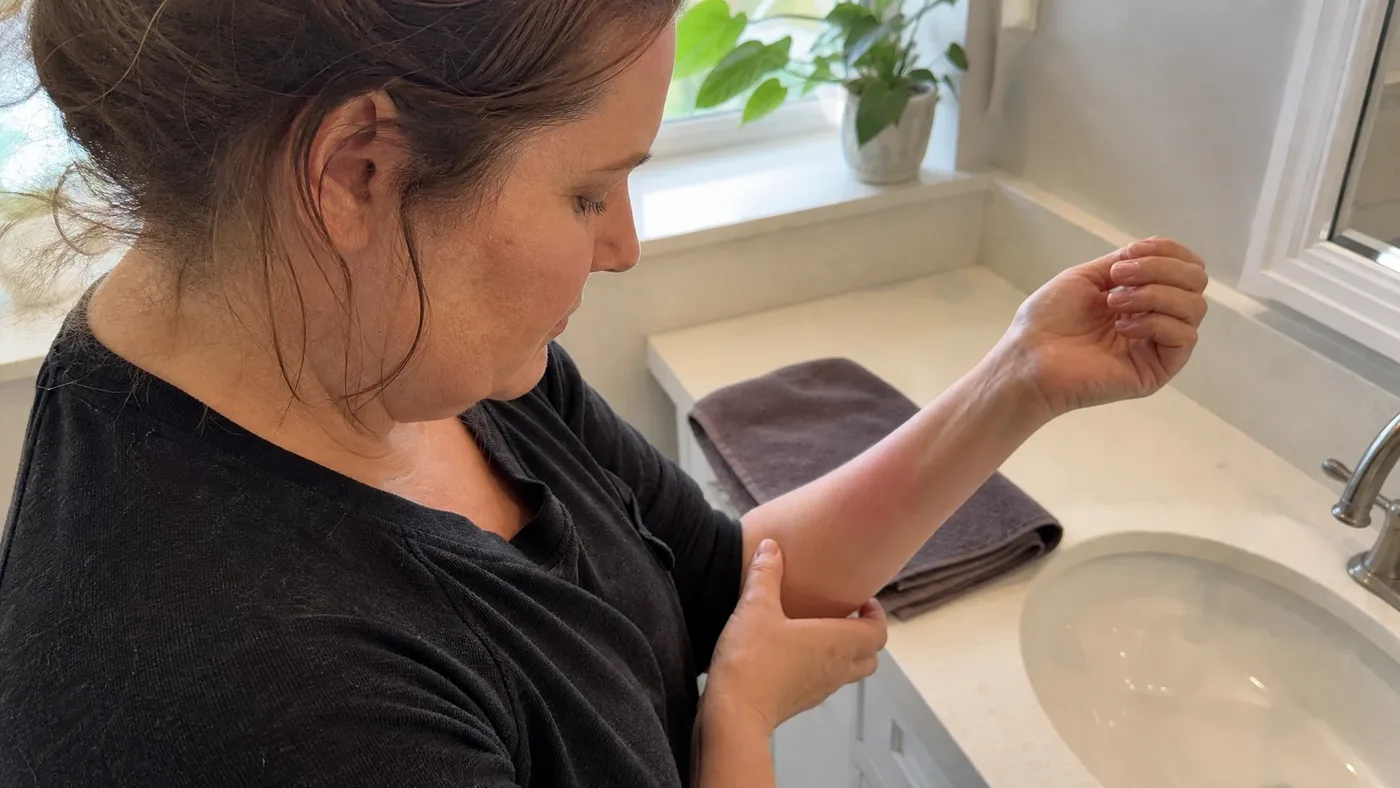
Clove oil does not have one side effect, it has four, and they arrive by different routes: skin, mouth, blood chemistry, and swallowing. Skin irritation and allergy are the ones a hobbyist will actually meet. Swallowing is the one that has put infants in intensive care. Here is each, with what the sources measured, and where our own 0.5% to 2% dilution range sits against the strictest published number.
Clove Essential Oil
Our own Clove Essential Oil, in sizes from 0.5 oz to bulk.
From $10.99
Shop Now →Skin: the common problem, and a number we have to be honest about
Eugenol, the main constituent of both clove bud and clove leaf oil, is a recognised skin irritant and contact allergen. Robert Tisserand's article on eugenol says it "can be a skin irritant or allergen if not used in proper dilutions" and gives a recommended topical maximum for clove bud oil of 0.5%, taken from Essential Oil Safety, 2nd edition (Tisserand Institute, eugenol article). That page gives no figure for clove leaf oil, and we could not verify a leaf-specific maximum from a primary source, so we will not quote one.
Our own pages tell buyers to dilute to 0.5% to 2%. Put those side by side: the bottom of our range equals Tisserand's bud figure, and the top of our range is four times it. Our published GC-MS report for the bud oil lists 73.57% eugenol, so the arithmetic is simple. A 0.5% dilution carries about 0.37% eugenol; a 2% dilution carries about 1.47%. In 30 mL of carrier, 0.5% is 0.15 mL of oil and 2% is 0.6 mL. Reasoning from the Tisserand figure, the practical consequence is that anyone using bud oil on skin should treat 0.5% as the ceiling and 2% as a number we do not recommend you reach for, and anyone with sensitive or previously reactive skin should go lower still or skip it. We have not tested any dilution on skin and make no claim about how it feels or performs.
For the dilution tables, patch-test steps and pet cautions, use our safety basics guide and dilution guide; we will not repeat them here.
Allergy is separate from irritation, and it is measured
Irritation depends on dose and happens to anyone. Allergy is an immune response that, once acquired, can be triggered by much smaller amounts. The best large dataset we found is the IVDK network in Germany: Uter et al., Contact Dermatitis, 2010 reviewed patch tests from 2000 to 2008. Of 84,716 patients consulting the dermatology departments, 15,682 were tested with at least one essential oil and 637 reacted to at least one. Clove oil gave positive tests in 1.5% (a weighted mean), tied with sandalwood oil and behind ylang-ylang (3.1%). Two caveats matter. These were patients already referred to dermatology clinics, so 1.5% is not a rate for the general public. And it is an oil from the clinic's test series, not our oil.
A second finding is more practical. The European Commission's scientific committee, in its note on fragrance allergens, quotes the IVDK work as showing that reactivity between clove oil and its main constituent, synthetic eugenol, was "exceptionally high" (SCCS explanatory note on fragrance allergens, European Commission, 2012). Reasoning from that, someone who has reacted to a eugenol-containing product, a dental material or a fragrance, has a reason to expect the oil to react too, because the oil is mostly eugenol. Our eugenol article covers the chemistry.
Mouth and gums: documented harm, and no home protocol from us
Dentists use eugenol in sealed, controlled products, and even there it is not trouble free. Sarrami et al., British Dental Journal, 2002 wrote that eugenol "is not however, a bio-friendly material when in contact with oral soft tissues", can cause irritative and cytotoxic effects and hypersensitivity, and reported two patients with local reactions to a temporary restorative material and a temporary cement. A 2022 case report in Jurnal Medali described a 30-year-old woman whose mouth ulcers worsened two days after she applied clove oil extract; the authors called it an oral mucosal burn, and she was told to stop using it (Sulaksana and Soegyanto, Jurnal Medali, 2022). One case proves nothing about frequency, but it shows the failure mode.
A UK licensed clove oil dental product (100% clove oil) carries this in its prescribing information: eugenol "may act as an irritant to skin and mucous membranes", it is contraindicated in people with hypersensitivity to clove oil, eugenol or Peru balsam, and it is not recommended under 2 years (Clove Oil BP summary of product characteristics, medicines.org.uk). Our oils are labelled for aromatic and cosmetic use, not for the mouth, so we will not write a method for teeth or gums. A toothache needs a dentist, and a burn or ulcer in the mouth needs a dentist or oral medicine clinic.
Blood: a lab finding, flagged as such
Srivastava, Prostaglandins Leukotrienes and Essential Fatty Acids, 1993 isolated eugenol and acetyl eugenol (also called eugenyl acetate, the second-largest constituent in our bud report at 12.82%) from clove and found they inhibited platelet aggregation in laboratory assays, with IC50 values that made both more potent than aspirin in that test. That is a test-tube result and says nothing about the amount absorbed from a diluted skin product. A pharmacy review, Heck et al., American Journal of Health-System Pharmacy, 2000, lists clove among herbs that may increase bleeding risk or potentiate warfarin, and states that nearly all the information is in vitro data, animal studies or single case reports. The honest reading: the risk from a diluted skin application is unquantified, and a person on warfarin or another anticoagulant, or facing surgery or dental extraction, should ask the prescriber or pharmacist before using clove oil in any form.
Swallowing: the severe end
All three well-known paediatric reports involve ingestion. Janes et al., European Journal of Pediatrics, 2005 described a 15-month-old who swallowed 10 mL and developed fulminant hepatic failure (ALT above 13,000 U/L at 24 hours) that improved after intravenous N-acetylcysteine. Eisen et al., Journal of Toxicology: Clinical Toxicology, 2004 described a 3-month-old who swallowed less than 8 mL, developed fulminant hepatic failure and recovered fully. Hartnoll et al., Archives of Disease in Childhood, 1993 reported coma, fits, coagulopathy and acute liver damage. These are case reports, not incidence figures. Our ingestion article goes through them and the food-flavouring status of clove.
Who should ask a professional first
- Anyone pregnant or breastfeeding: see our pregnancy article, then ask your midwife, OB-GYN or pharmacist.
- Anyone with a baby or toddler in the home: see teething and children; ask a paediatrician.
- Anyone on blood thinners, or with surgery or a tooth extraction coming: ask the prescriber, pharmacist or dentist.
- Anyone who has had a reaction to a dental material, a fragrance or a eugenol product: ask a dermatologist or allergist about testing.
- Anyone with eczema, a skin barrier problem or broken skin: ask a dermatologist before putting any clove oil near it.
If a child or adult swallows clove oil, call Poison Control at 1-800-222-1222 in the US (free, 24 hours, per Poison Control's essential oils page), or local emergency services; do not wait for symptoms. We sell the two oils (our bud oil page says to keep it away from children and pets); we are not a source of medical advice.
Our position is narrow: clove bud and clove leaf oil are aromatic oils for diffusing and for diluted cosmetic use, with 0.5% as the number to start from and the patch test as a requirement, not a courtesy.
Clove Essential Oil
Clove Essential Oil from our own shop, in sizes from 0.5 oz to bulk.
From $10.99
Shop Now →Sources & Further Reading
- Tisserand Institute. Eugenol: Essential Oil Constituents in Food Part 4. tisserandinstitute.org/?p=5551
- Uter W et al., 2010. Contact allergy to essential oils: current patch test results (2000-2008) from the IVDK. PubMed 20946456
- European Commission, SCCS, 2012. Explanatory note on the final opinion on fragrance allergens in cosmetic products. health.ec.europa.eu
- Sarrami N et al., 2002. Adverse reactions associated with the use of eugenol in dentistry. PubMed 12353045
- Sulaksana SD, Soegyanto AI, 2022. Oral mucosal burn caused by the topical application of a clove oil concentrate. jurnal.unissula.ac.id/18635
- Thornton & Ross. Clove Oil BP, summary of product characteristics. medicines.org.uk/emc/product/4817
- Srivastava KC, 1993. Antiplatelet principles from a food spice clove. PubMed 8321872
- Heck AM et al., 2000. Potential interactions between alternative therapies and warfarin. PubMed 10902065
- Janes SE et al., 2005. Essential oil poisoning: N-acetylcysteine for eugenol-induced hepatic failure. PubMed 15895251
- Eisen JS et al., 2004. N-acetylcysteine for the treatment of clove oil-induced fulminant hepatic failure. PubMed 15083943
- Hartnoll G et al., 1993. Near fatal ingestion of oil of cloves. PubMed 8215554
- Poison Control. Essential oils. poison.org/articles/essential-oils