
Clove Oil in Pregnancy: What Sources Say and Questions to Ask
We cannot tell you clove oil is fine in pregnancy, and we could not find an authority that does. What exists is a gap: no trial of clove essential oil in pregnant women that we could locate, a licensed clove oil product whose own label says safety in pregnancy and breastfeeding "has not been established", and general NHS advice to tell your midwife about any aromatherapy product. This page lays out what that means and what to ask the person looking after you.
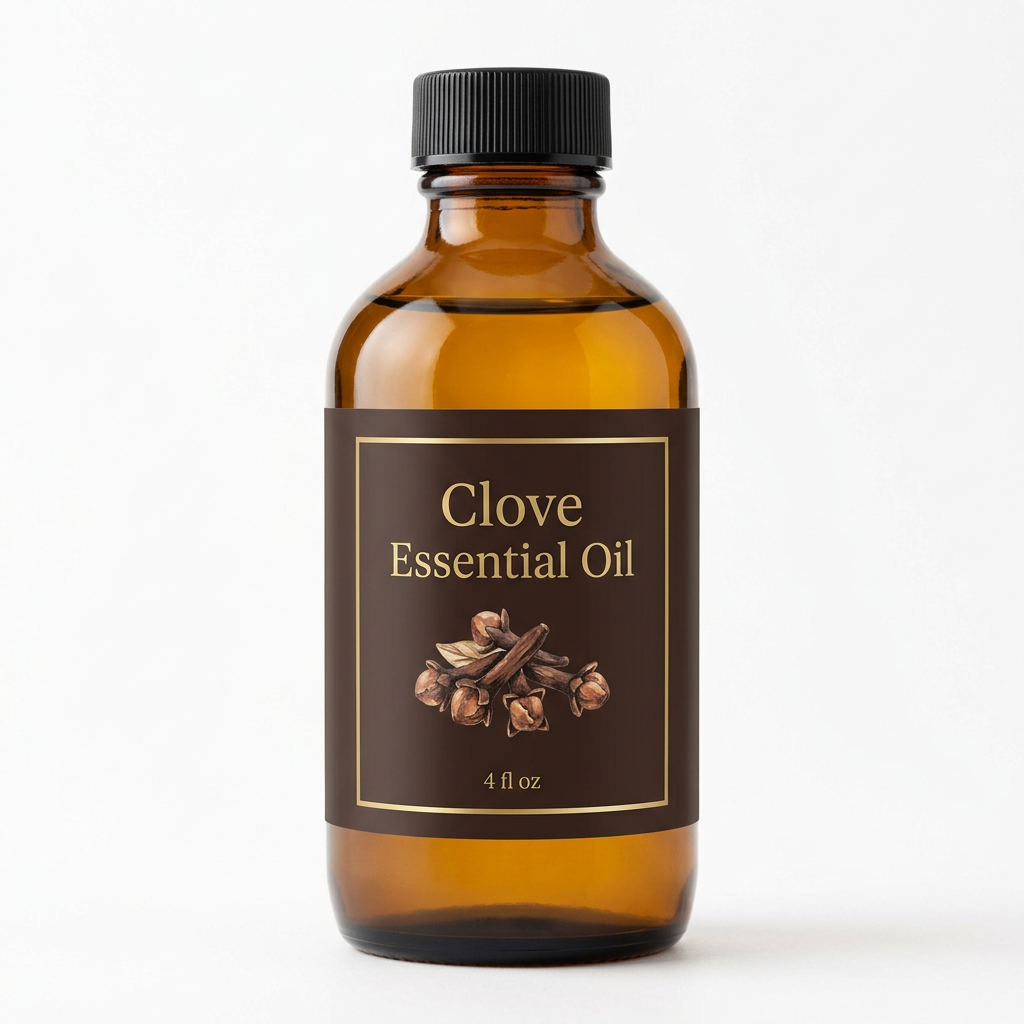
Clove Essential Oil
Our own Clove Essential Oil, in sizes from 0.5 oz to bulk.
From $10.99
Shop Now →What the sources actually say, and do not say
The NHS pregnancy medicines page says "Not all 'natural' remedies or complementary therapies are safe in pregnancy", tells you to inform your midwife, doctor or pharmacist if you use "herbal, homeopathic or aromatherapy remedies or therapies", and says that if you do, you should consult a qualified practitioner (NHS, Medicines in pregnancy). It does not name clove. It is a general rule, and we are reporting it as one.
The most specific document we found is the prescribing information for a UK general-sale clove oil dental product (100% clove oil). Under pregnancy and lactation it says: "Safety during pregnancy and lactation has not been established" and use is not recommended without sufficient data. The same document lists eugenol as a potential irritant to skin and mucous membranes and hypersensitivity to clove oil, eugenol or Peru balsam as a contraindication (Clove Oil BP summary of product characteristics, medicines.org.uk). That is a statement about a missing evidence base, not a finding of harm, and it is about a dental product, not about diffusing.
The Tisserand Institute's article on eugenol, which gives the topical maximum of 0.5% for clove bud oil, does not discuss pregnancy (Tisserand Institute, eugenol article). We searched the NCBI lactation database for a clove or eugenol record and did not find one, and we found no ACOG statement on clove oil. Where an authority is silent, this site will say it is silent rather than guess in either direction. Several animal studies of eugenol-related compounds exist, but the one reproductive study we read was on isoeugenol, a different compound, so we have not used it.
Food amounts and the bottle are different quantities
Many readers ask whether the cloves in a recipe are the same question. They are not. In the US, clove and its oils are listed in 21 CFR 184.1257 as flavouring agents "used in food at levels not to exceed good manufacturing practice" (eCFR, 21 CFR 184.1257). That is a statement about food use by manufacturers; it contains no pregnancy provision and no dose. Our bud oil's published GC-MS report lists 73.57% eugenol, which is the concentration of the compound in the bottle. Whatever one concludes about a few cloves in a casserole, it does not transfer to the oil, and we would not claim it does. Swallowing the oil is also a separate hazard in anyone: see our ingestion article.
Three routes, three levels of evidence
- Swallowing the oil. Not something we advise for anyone; our pages say never internal use. In pregnancy there is the added problem that a poisoning would be an emergency for two people.
- On the skin, diluted. Clove is a documented skin irritant and sensitiser; clove oil was positive in 1.5% of patients patch tested in a German dermatology network (Uter et al., Contact Dermatitis, 2010, a clinic population, not pregnant women specifically). We found no data on skin absorption of clove oil in pregnancy. Reasoning from this, the first question is skin tolerance, and the second is a pregnancy question that someone with a licence has to answer. Our side effects guide has the dilution comparison against Tisserand's figure.
- Diffusing. We found no study of inhaled clove oil in pregnancy, so there is nothing to report. Reasoning from the NHS advice above, treat it as an "ask your midwife" item, and remember a diffuser exposes everyone in the room, including children (see our children and teething article).
Dental products with eugenol are a dentist-and-OB decision
Dentists use eugenol-containing materials, and toothache is common in pregnancy. We will not give a method for putting our oil on teeth or gums, and it is not labelled for the mouth. Eugenol is not a trouble-free material even in dentistry: Sarrami et al., British Dental Journal, 2002 describe irritative and cytotoxic effects on oral soft tissue and hypersensitivity, with two clinical cases. If you are pregnant and have tooth pain, see a dentist and tell them you are pregnant; they can coordinate with your OB-GYN or midwife about materials and timing.
A possible bleeding question, labelled as reasoning
In a laboratory study, eugenol and acetyl eugenol (eugenyl acetate, 12.82% of our bud oil per our published report) inhibited platelet aggregation, more potently than aspirin by IC50 (Srivastava, Prostaglandins Leukotrienes and Essential Fatty Acids, 1993). A pharmacy review lists clove among herbs that may increase bleeding risk, but says nearly all the evidence is in vitro, animal or case reports (Heck et al., American Journal of Health-System Pharmacy, 2000). Neither studied pregnancy or skin use. Reasoning from them, it is a reasonable thing to mention if you are on blood thinners or have a delivery or dental procedure coming up; we are not claiming a clinical effect.
Why "no data" is not a green light
The absence of pregnancy studies does not make an oil acceptable by default; it means the default label wording applies, which for the one licensed clove product we found is "not established". There is also no deadline on the purchase. Our stated shelf life for the bud oil is typically 3 to 5 years unopened and for the leaf oil 4 to 5 years, in a cool dark place, so waiting for your next appointment costs the bottle nothing. We would rather you ask a midwife first than read a blog, including ours.
Questions to take to an appointment
- (OB-GYN or midwife) I own clove bud or clove leaf oil. Is diffusing it acceptable for me at my stage of pregnancy, given what we have used so far?
- (OB-GYN or midwife) If I want to use a very dilute skin product containing clove oil, is there a reason to avoid it, and does my skin history (eczema, past fragrance reactions) change that?
- (Pharmacist) Do any of my medicines or supplements, especially blood thinners or aspirin, make eugenol a concern?
- (Dentist) we are pregnant; which materials are you using, are any eugenol-based, and should my OB-GYN weigh in?
- (Whoever is caring for you) For breastfeeding: is there anything in the oils I diffuse or wear that we should avoid near the baby?
Where we stand
We sell clove bud and clove leaf oil for aroma and diluted cosmetic use, not for pregnancy or breastfeeding wellness, and nothing here is medical advice. If you are pregnant or nursing, the plain position is to ask first and to keep the bottle where children cannot reach it. If a swallow happens, call Poison Control on 1-800-222-1222 (US).
Clove Essential Oil
Clove Essential Oil from our own shop, in sizes from 0.5 oz to bulk.
From $10.99
Shop Now →Sources & Further Reading
- NHS. Medicines in pregnancy. nhs.uk/pregnancy/keeping-well/medicines
- Thornton & Ross. Clove Oil BP, summary of product characteristics. medicines.org.uk/emc/product/4817
- Tisserand Institute. Eugenol: Essential Oil Constituents in Food Part 4. tisserandinstitute.org/?p=5551
- US eCFR. 21 CFR 184.1257, Clove and its derivatives. ecfr.gov/184.1257
- Uter W et al., 2010. Contact allergy to essential oils (IVDK, 2000-2008). PubMed 20946456
- Sarrami N et al., 2002. Adverse reactions associated with the use of eugenol in dentistry. PubMed 12353045
- Srivastava KC, 1993. Antiplatelet principles from a food spice clove. PubMed 8321872
- Heck AM et al., 2000. Potential interactions between alternative therapies and warfarin. PubMed 10902065