Clove Oil vs Tea Tree Oil: Composition, Evidence, Skin Risk
Clove oil and tea tree oil are not rivals for the same job, and the comparison is lopsided in one respect that matters to a buyer: tea tree has human trials on skin, and clove oil, as far as the sources we read show, has none worth leaning on. We sell clove bud oil and clove leaf oil for aroma and cosmetic use. We do not sell tea tree, so nothing below is a pitch against it.
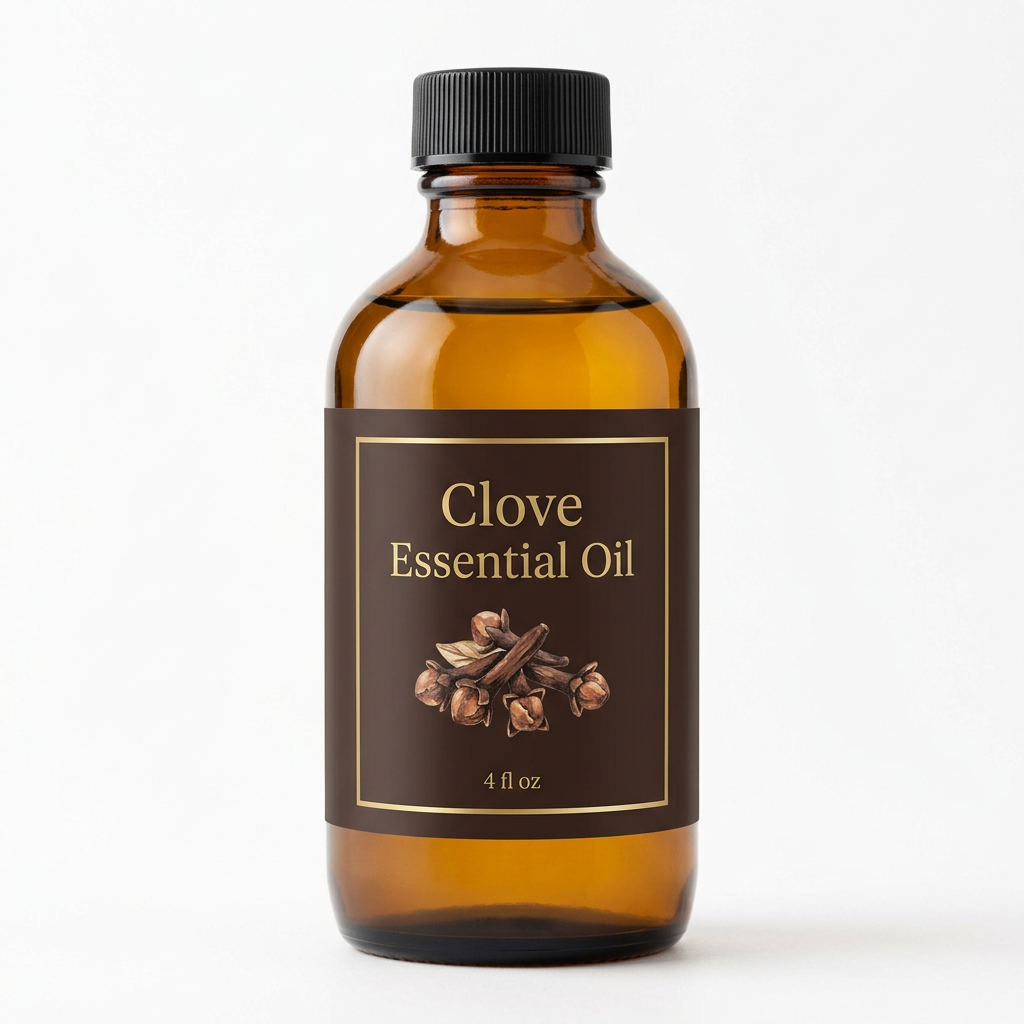
Clove Essential Oil
Our own Clove Essential Oil, in sizes from 0.5 oz to bulk.
From $10.99
Shop Now →What the two bottles contain
The names of the main compounds already tell you the oils behave differently. Tea tree is a terpinen-4-ol oil. A 2006 review in Clinical Microbiology Reviews by Carson, Hammer and Riley described the ISO 4730 standard for tea tree as setting a minimum of 30% terpinen-4-ol, with a typical analysed sample at 40.1% (Carson et al., Clin Microbiol Rev, 2006). Standards get revised, so treat the number as that review's description, not today's specification sheet.
Clove is a eugenol oil, and a heavy one. Our published GC-MS report for the bud oil says it identifies 98.68% of the composition, led by 73.57% eugenol and 12.82% eugenyl acetate. That is one batch report for one of our two oils, not a range for all clove oil. (For how to read such a report, see our GC-MS guide.) The practical consequence of a 70-plus percent single phenol is that clove oil behaves on skin like a concentrated eugenol solution, which is why the next section matters more than the chemistry tables.
Skin evidence: one oil has trials, the other has a gap
The same 2006 review summarises two randomised trials of tea tree that are worth knowing by their numbers:
- Acne (Bassett and colleagues, 1990): 124 patients, investigator-blinded, three months, 5% tea tree gel against 5% benzoyl peroxide. Both groups had fewer inflamed lesions; benzoyl peroxide did better (P < 0.05). So even the favourable tea tree trial was a comparison against a standard product that came out ahead.
- Toenail onychomycosis (Buck and colleagues, 1994): 117 patients, double-blind, twice daily for six months, 100% tea tree oil (64 patients) against 1% clotrimazole solution (53). Full or partial resolution was 60% and 61%, not significantly different. Note the preparation: neat tea tree oil, for six months, under trial supervision. That is not a licence for anyone to do the same at home with a different oil.
Those are the review's figures; we did not read the original trial papers, and the review itself contains small internal mismatches in one table, so quote them as "as summarised by the 2006 review."
For clove oil on acne or nail fungus, the sources we read contained no comparable trial. There is in vitro work (clove oil inhibiting fungi and bacteria in dishes), but a dish result is not a skin result. To say it plainly: no trial we found tested clove essential oil on acne or on nails. If you have either condition, a dermatologist is the person to see, and tea tree having more data does not mean it replaces that visit.
The risk side: both are sensitisers, for different reasons
Tea tree's problem is largely storage. Hausen, Reichling and Harkenthal (American Journal of Contact Dermatitis, 1999) reported more than 30 sensitisation cases since 1991 and tested the oil in guinea pigs: fresh oil was a weak sensitiser, oxidised oil about three times stronger. In 11 tea-tree-allergic patients, reactions were strongest to alpha-terpinene, terpinolene and ascaridole, which form as the oil ages; p-cymene in their stored oil rose from about 2% to 11.5% (Hausen et al., 1999). The Tisserand Institute's Q&A says the more tea tree oil oxidises the less safe it is for the skin, that p-cymene around 6% or more on a lab report may indicate an oxidised oil (2% to 4% is typical when fresh), and that tea tree should be refrigerated and used within one to two years (Tisserand Institute).
Clove's problem is built in rather than acquired. The Tisserand Institute gives a recommended topical maximum for clove bud oil of 0.5% (citing Essential Oil Safety, 2nd edition) and says eugenol can be an irritant or allergen when not properly diluted (Tisserand Institute, eugenol). The European Commission's summary of the 2012 SCCS opinion lists eugenol in the group of fragrance chemicals most frequently reported as consumer allergens (European Commission, perfume allergies). Those are authority statements about eugenol and clove bud oil; we did not find one for clove leaf oil, which also carries eugenol.
The conflict in our own numbers
Our product pages tell you to dilute to 0.5% to 2% in a carrier oil and to patch test. Tisserand's figure for clove bud is the bottom of that range, 0.5%. These do not match, and we would rather say so than smooth it over. Reasoning from the two figures, the sensible reading is that 0.5% is the ceiling an authority names for clove bud and 2% is the top of our label range, so if you use clove on skin at all, start at the low end and patch test first. The arithmetic is simple: 0.5% in 30 ml of carrier is 0.15 ml of oil; 2% is 0.6 ml. That is four times the exposure, and it is where the disagreement bites. Our dilution guide walks through the maths in more detail (how to dilute clove oil).
Tea tree is typically discussed at much higher strengths (the trials above used 5% and 100%), and that is a real asymmetry. Reasoning from those numbers, you cannot transfer a tea tree concentration to clove oil. A strength reported for one oil says nothing about the other.
Which do you actually need?
- You want something for a skin or nail problem. See a dermatologist or pharmacist. If tea tree is discussed, buy it from a reputable supplier with a dated bottle and a batch report; we do not sell it, and clove is not a substitute for it.
- You want a warm, spicy aroma. That is where clove bud oil (sweetly spicy) or clove leaf oil (bolder, smokier, drier) belong. See bud versus leaf. Tea tree has a camphor-like, green character, so the aroma choice is not close.
- You are weighing clove for acne or nail fungus. Read our acne piece and our nail fungus piece, then see a professional. Those pieces report the evidence; they do not make a claim for our oil.
Who should skip clove on skin
Anyone with a known eugenol or fragrance allergy, anyone with eczema or broken skin, and anyone who has reacted to a spice-oil product before. Keep both oils away from eyes, children and pets; our own copy says so, and for a pet that has been exposed to any essential oil the call is to a veterinarian or an animal poison hotline.
The short verdict: tea tree has more skin trial data and a storage problem; clove has almost none and a built-in irritation and allergy profile. Choose clove for how it smells, and let a clinician choose what goes on a skin problem.
Clove Essential Oil
Clove Essential Oil from our own shop, in sizes from 0.5 oz to bulk.
From $10.99
Shop Now →Sources & Further Reading
- Carson CF, Hammer KA, Riley TV, 2006. Melaleuca alternifolia (tea tree) oil: a review of antimicrobial and other medicinal properties. pubmed.ncbi.nlm.nih.gov/16418522
- Hausen BM, Reichling J, Harkenthal M, 1999. Degradation products of monoterpenes are the sensitizing agents in tea tree oil. pubmed.ncbi.nlm.nih.gov/10357714
- Tisserand Institute. Tea tree oxidation and safety (Q&A). tisserandinstitute.org
- Tisserand Institute. Eugenol: essential oil constituents in food, part 4. tisserandinstitute.org/learn-more/eugenol
- European Commission, 2012. Perfume allergies (summary of the SCCS opinion), introduction. ec.europa.eu