Clove Oil for Skin: The Risks Come First, Then the Evidence
For skin, clove oil is mostly a fragrance ingredient and a known irritant, not a skincare ingredient with a track record. We sell two clove oils, bud and leaf, and we would rather you read the risks before the benefits, because the risks are the part with sources behind them. This article lays out the documented skin hazards, the lab research that gets quoted online, and what a diluted use would look like in numbers if you decide to go ahead anyway.
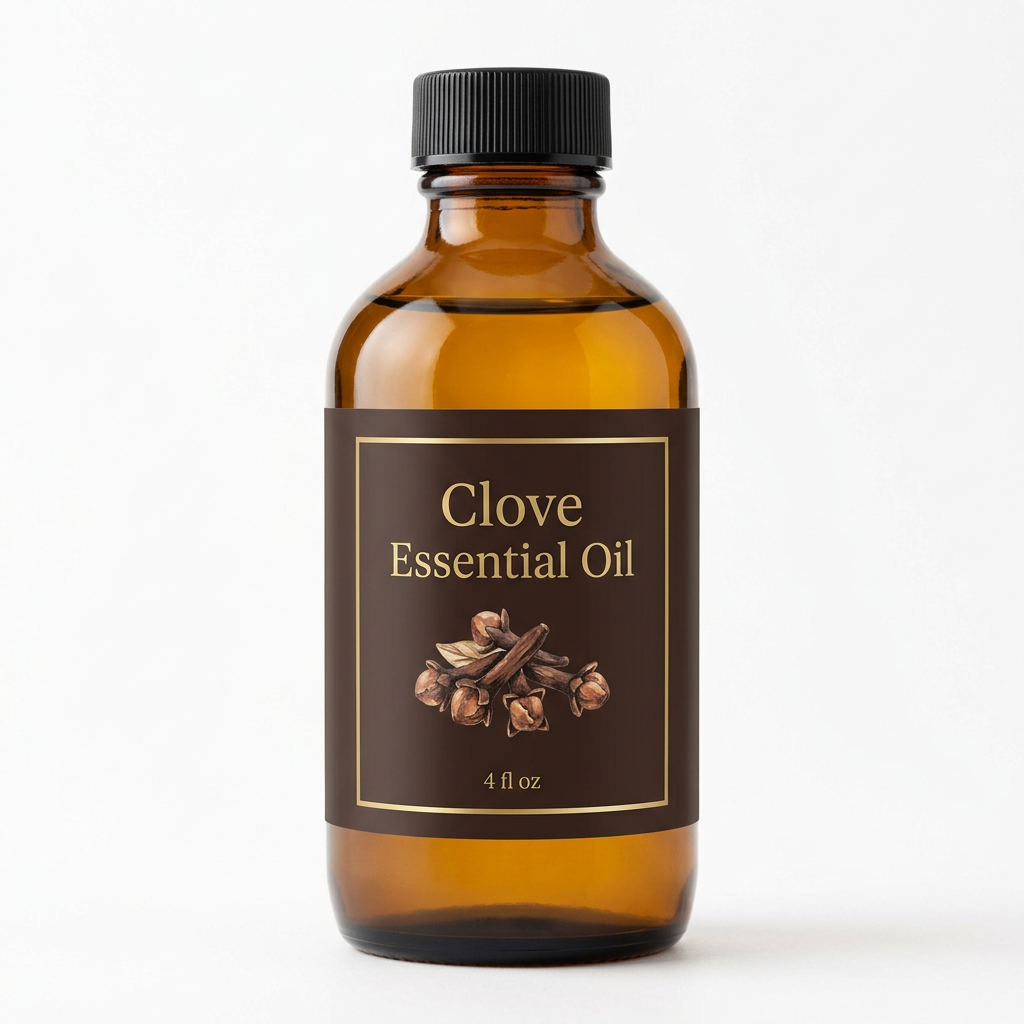
Clove Essential Oil
Our own Clove Essential Oil, in sizes from 0.5 oz to bulk.
From $10.99
Shop Now →The hazard comes first, and it is the compound that makes clove smell like clove
Eugenol is the headline molecule in clove oil. Our own published GC-MS report for the bud oil lists 73.57% eugenol and 12.82% eugenyl acetate, so roughly 86% of the bottle is eugenol or its acetate ester. The Tisserand Institute's eugenol article says eugenol "can be a skin irritant or allergen if not used in proper dilutions" and, citing Tisserand and Young's Essential Oil Safety (2nd edition), lists a topical maximum of 0.5% for clove bud oil. The same page gives no figure for clove leaf oil, so we cannot tell you a sourced leaf number. Reasoning from the shared chemistry (leaf oil is also eugenol-led), the careful assumption is that leaf oil needs the same caution until a source says otherwise. That is an inference, not a published limit.
A 2012 review by Kamatou et al., Molecules, 2012 covers eugenol broadly and flags toxicity "with special reference to contact dermatitis." It also notes that eugenol has been shown to enhance skin permeation of various drugs. Read that second point carefully: a compound that helps other substances cross the skin is not obviously one you want to apply more of. A fragrance-industry safety assessment, Api et al., Food and Chemical Toxicology, 2016 (RIFM, an industry-funded body), calculated eugenol's margin of exposure assuming 22.6% absorption through skin. That is eugenol alone, not clove oil, and it is a modelling assumption, but it shows that regulators and the fragrance industry do not treat eugenol as skin-inert.
Our label says 0.5% to 2%, and the sourced figure is 0.5%
Our bud and leaf product pages both say to dilute to 0.5% to 2% in a carrier oil and to patch test. The Tisserand figure for bud oil is the bottom of that range. We are flagging the gap rather than smoothing it over: if you want the cautious reading, use 0.5% or less, and regard 2% as the ceiling of our label rather than a target. Here is the arithmetic, using an assumed 20 drops per ml (drop size varies by bottle, so measure with a pipette if you can):
- 30 ml of carrier at 0.5%: 0.15 ml of clove oil, about 3 drops. With our bud oil's 73.57% eugenol, that is about 0.37% eugenol in the finished blend.
- 30 ml at 2%: 0.6 ml, about 12 drops, and about 1.47% eugenol. That is four times the exposure.
We have not tested any blend at these strengths and have no outcomes to report. The numbers are ordinary arithmetic from the figures above. Our carrier oils are not for sale (we sell only the two clove oils), so any carrier comes from elsewhere. If you need the mechanics of measuring, see how to dilute clove oil.
What the "benefits" evidence actually is
The popular claims for clove oil on skin (antibacterial, antifungal, antioxidant) come overwhelmingly from three kinds of work, none of which is a skincare trial:
- Test-tube antimicrobial assays. Pinto et al., Journal of Medical Microbiology, 2009 tested a commercial clove oil (85.3% eugenol) and eugenol against Candida, Aspergillus and dermatophyte strains in dishes and reported inhibition of all strains tested. A dish of fungus is not skin.
- Reviews that pool those assays. Maggini et al., Molecules, 2024 reviews clove oil against drug-resistant microbes and says it "might orient clinical researchers." That is the review's own wording about where the field stands: a pointer for future studies.
- Studies of a formulated product. The one human acne trial we found used a pharmaceutical gel, which is an engineered preparation, not a drop of oil in a carrier.
A 2017 review by Orchard and van Vuuren of commercial essential oils for skin infections makes a related point: the organisms that matter in dermatology, including the acne bacterium, have been "sorely neglected" in the test-tube literature. So even the dish evidence has gaps for skin.
There is one small human trial in acne with a clove oil product, covered in our acne article. It tested a combination gel, not clove oil alone, and does not generalise to a bottle of undiluted oil.
The cosmetic versus drug line affects what we can say
The US FDA states that whether something is a cosmetic or a drug "is determined by a product's intended use," and that labeling, advertising and online claims can establish that intent. Its example is a fragrance marketed with aromatherapy claims, which can meet the definition of a drug. This is why our product pages describe the oils as aromatic and cosmetic, why this article reports studies instead of promising results, and why you will not find us saying clove oil does anything for a skin condition. Source: FDA, Is It a Cosmetic, a Drug, or Both?
Who should skip this, and where the better evidence is
- Anyone with a skin condition you want to change. Acne, nail or foot fungus, persistent rashes and wounds all have established options a dermatologist or pharmacist can discuss. The acne guideline from the American Academy of Dermatology (Reynolds et al., 2024) makes strong recommendations for benzoyl peroxide, topical retinoids, topical antibiotics and oral doxycycline, and clove oil appears in none of its recommendations.
- Broken, inflamed, shaved or sunburned skin, and the face and eye area. Reasoning from the irritant and permeation findings above, these are the worst places for an eugenol-rich oil.
- People who have reacted to fragrance, balsam, cinnamon or dental eugenol products. We cannot assess cross-reactions; an allergist or dermatologist can patch test properly.
- Children and pets. Our own safety copy says to keep clove oil away from both. Ask a pediatrician or veterinarian.
If you use it anyway: the minimum
Patch test a diluted blend on a small patch of forearm skin and wait a full day before using more, as the instructions on our product pages say. Stop at redness, itching, or burning. Keep it off the face, mucous membranes and eyes. If a reaction appears and does not fade quickly, a pharmacist or physician is the right next call, not another oil. For fragrance uses where the oil never touches skin, such as diffusing, see clove oil at home; for the broader risk list see clove oil side effects.
Our position is simple: clove oil earns its place in a home for its smell, and on skin it should be handled as a strong ingredient at low dilution or left alone. For skin problems, the people to ask are dermatologists, not a bottle label.
Clove Essential Oil
Clove Essential Oil from our own shop, in sizes from 0.5 oz to bulk.
From $10.99
Shop Now →Sources & Further Reading
- Tisserand Institute. Eugenol: Essential Oil Constituents in Food Part 4. tisserandinstitute.org/learn-more/eugenol
- Kamatou GP, Vermaak I, Viljoen AM, 2012. Eugenol: from the remote Maluku Islands to the international market place. pubmed.ncbi.nlm.nih.gov/22728369
- Api AM et al., 2016. RIFM fragrance ingredient safety assessment, Eugenol. pubmed.ncbi.nlm.nih.gov/26702986
- Pinto E et al., 2009. Antifungal activity of the clove essential oil from Syzygium aromaticum on Candida, Aspergillus and dermatophyte species. pubmed.ncbi.nlm.nih.gov/19589904
- Maggini V et al., 2024. Antimicrobial Activity of Syzygium aromaticum Essential Oil in Human Health. pubmed.ncbi.nlm.nih.gov/38474510
- Orchard A, van Vuuren S, 2017. Commercial Essential Oils as Potential Antimicrobials for Skin Diseases. pubmed.ncbi.nlm.nih.gov/28546822
- Reynolds RV et al., 2024. Guidelines of care for the management of acne vulgaris. pubmed.ncbi.nlm.nih.gov/38300170
- US FDA. Is It a Cosmetic, a Drug, or Both? (Or Is It Soap?) fda.gov