Clove Essential Oil vs Fragrance Oil: Know the Difference
Most people assume the difference between real and fake clove is the smell. It is not, because the molecule that makes clove smell like clove can be made in a factory and is chemically identical to the one in the plant. What actually separates the two bottles is what else is inside, what the label calls it, and what paperwork stands behind it.
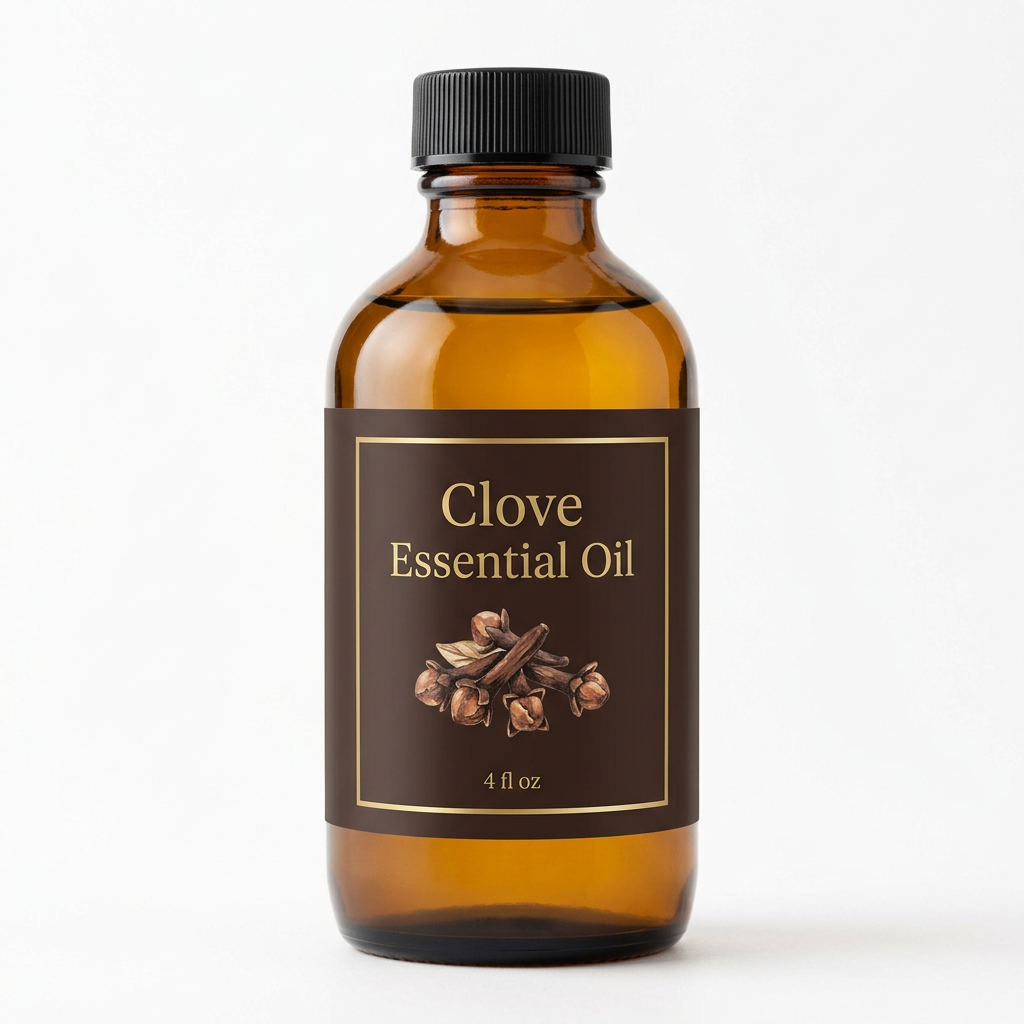
Clove Essential Oil
Our own Clove Essential Oil, in sizes from 0.5 oz to bulk.
From $10.99
Shop Now →Clove oil is not just eugenol
Eugenol dominates the aroma, so it is easy to picture clove oil as eugenol in a spice-themed bottle. It is more layered than that. The GC-MS report we publish for our bud oil lists 25 compounds: eugenol at 73.57% of peak area, eugenyl acetate at 12.82%, beta-caryophyllene at 7.95%, and a tail of smaller components such as limonene and alpha-humulene. A 2021 review (Haro-Gonzalez et al., Molecules, 2021) names eugenyl acetate, beta-caryophyllene and alpha-humulene as most of what remains after eugenol. Those supporting notes are what give the oil its rounder, sweeter character. A product built on isolated eugenol would reasonably lack that supporting cast.
Why the source does not change the molecule
Kamatou, Vermaak and Viljoen, Molecules, 2012 describe two commercial routes to eugenol. One isolates it from clove bud or leaf oil, cinnamon leaf oil or basil oil by washing the oil with dilute alkali, separating the non-phenol part, acidifying and distilling. The other builds it chemically from guaiacol and allyl chloride. Both routes end at the same compound.
That has two practical consequences. First, your nose will not settle the question on the dominant note alone, because eugenol smells like eugenol. Second, words like "natural" and "nature identical" are claims to question rather than measurements, and we are not aware of a single regulatory definition for them that a shopper can rely on.
Safety follows the molecule, not the marketing
Eugenol is the part that can irritate and sensitise skin, however it was made. It is one of the 26 fragrance allergens that EU rules require to be named on cosmetic labels (Sukakul, Bruze and Svedman, Acta Dermato-Venereologica, 2024), and EFSA FEEDAP, EFSA Journal, 2023 advises treating clove bud and leaf oils as irritants to skin, eyes and airways and as skin sensitisers. A "fragrance oil" label is therefore not a safety statement in either direction. Our side-effects post covers the skin side in more detail.
A short label checklist
- A botanical name and plant part. A genuine clove essential oil should say Syzygium aromaticum and whether it is bud or leaf. Ours do.
- The words "essential oil". "Fragrance oil", "scent" and "flavor" describe a different category, made to a recipe that may be partly or wholly synthetic.
- A document you can read. For our bud oil we publish a Certificate of Analysis and a GC-MS report, each for one batch. A fragrance maker can usually supply a safety data sheet, so ask for it. If you need paperwork for a particular lot of ours, ask us in writing through the contact page.
- A believable eugenol share. The EFSA specification for clove bud oil runs from 67% to 85% eugenol. A report far outside that is a question to ask rather than proof of anything, since the literature in the 2021 review reaches as high as 88.80%.
Even a good report only describes the sample that was sent in, so read documents as a description of one batch rather than a promise about every bottle. Our home-testing post explains what kitchen checks can and cannot show, and the GC-MS guide goes through the numbers line by line.
What to look for at the shelf
Reading a bottle takes less than a minute once you know what you are looking at. A good label tells you what is inside and who made it. Tilt the bottle and look for a clear name on the front, then check the back for the plant, the part used and the size. If the label talks about a "fragrance" or a "scent" with no plant name, take that as a hint that it is a different kind of product. Neither kind is wrong, but they are not interchangeable, and it helps to know which one you picked up.
A small experiment on a paper strip
If you ever have the two types in hand, smelling them side by side on paper strips is a nice way to spend ten minutes. Write the name of each on the strip in pencil. Smell right away, then again after a few minutes, then after an hour. Some people find that one reads flatter or sharper over time, others cannot tell a difference at all. Neither result is a verdict. It is simply a way to get familiar with how a bottle behaves, and that familiarity is worth more than a rule of thumb.
When each makes sense
An essential oil suits a project where the plant itself is the point, such as a diffuser blend, a stovetop simmer, a soap or a candle where you want the sweet note of bud or leaf. If you need a ready-engineered spice base with published usage rates for a specific wax or soap, a fragrance supplier whose spec sheet covers that may suit better, and we are happy to say so.
The same question helps with any oil on any shelf, and once you start asking it you will find it hard to stop.
Whatever you buy, the useful question is simple: what is it called, and who will show you what is in it?
Clove Essential Oil
Clove Essential Oil from our own shop, in sizes from 0.5 oz to bulk.
From $10.99
Shop Now →Sources & Further Reading
- Kamatou, Vermaak and Viljoen, Molecules, 2012: routes to commercial eugenol
- Haro-Gonzalez et al., Molecules, 2021: clove oil composition
- EFSA FEEDAP, EFSA Journal, 2023: clove bud and leaf oil specifications and hazards
- Sukakul et al., Acta Dermato-Venereologica, 2024: eugenol among EU-labelled fragrance allergens