How to Read a Clove Oil GC-MS Report
Most of a clove oil GC-MS report is a list of small compounds you have never heard of, and one big number at the top. The big number is eugenol, and it is the least interesting part. The more revealing line is the one just below it. Here is how to read the report we publish for our clove bud oil, using it as the worked example.
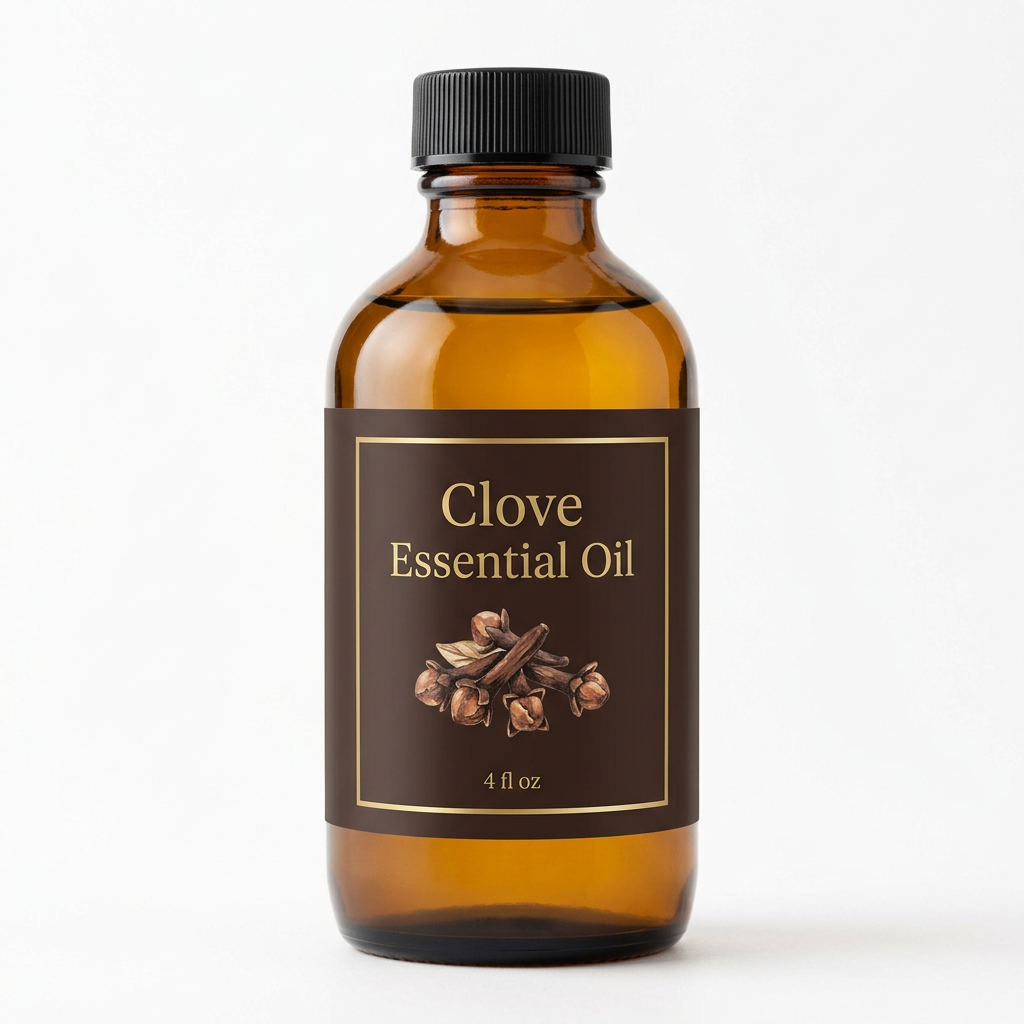
Clove Essential Oil
Our own Clove Essential Oil, in sizes from 0.5 oz to bulk.
From $10.99
Shop Now →Start with the header
Before any number, read what the document says it is. Ours is titled Clove Bud Essential Oil (Syzygium aromaticum), gives Indonesia as the origin, names the method as qualitative GC-MS run by an independent ISO-accredited essential-oil laboratory, and records the verdict "APPROVED, meets expected profile," with 98.68% of the oil identified. It describes the bud oil; we do not publish an equivalent for the leaf oil. A profile like this tells you what clove bud oil of this kind looks like. If you need paperwork tied to a specific lot, ask us in writing through the contact page before you order, and we will tell you what is available.
The three compounds that define bud oil
Clove bud oil is built on three compounds. In our report, eugenol is 73.57%, eugenyl acetate 12.82% and beta-caryophyllene 7.95%, all as percentages of peak area. EFSA's 2023 review of clove oils as feed additives worked from a bud-oil specification of 67 to 85% eugenol, 5 to 15% eugenyl acetate and 2 to 16% beta-caryophyllene, adapted from the ISO standard for clove bud oil, and our figures sit inside all three ranges (EFSA FEEDAP, 2023).
Now the clever part. Leaf oil is also mostly eugenol (EFSA's six leaf batches ran from 78.68 to 86.01%), so eugenol alone cannot tell bud from leaf. Eugenyl acetate can. The leaf specification allows 1% or less, and EFSA's leaf batches measured 0.02 to 1.47%. A bud oil carries meaningfully more. So when you open a report for a bottle labelled bud and eugenyl acetate is close to nothing, you have learned something. Our bud versus leaf article shows how that difference carries through to scent.
The long tail
After the big three come the minor compounds, 25 in all: limonene 1.56, alpha-humulene 1.08, caryophyllene oxide 0.55, methyl salicylate 0.18, chavicol 0.16, methyl eugenol 0.08, isoeugenol 0.08, myrcene 0.03, linalool 0.02 and a few at or below 0.07. They are small, but they are the supporting cast that makes the oil look like clove: a 2021 review names alpha-humulene and beta-caryophyllene alongside eugenol and eugenyl acetate as most of the remainder (Haro-Gonzalez et al., Molecules, 2021).
The report then groups everything into families: phenols 73.89, esters 13.03, sesquiterpenes 9.49, monoterpenes 1.59, ethers 0.55 and other 1.35. Add those up and you land at about 99.9, a handy sanity check that the groups account for the whole sample, with small gaps explained by rounding and unidentified peaks.
A note on what the percentages mean
GC-MS percentages are shares of peak area, and different compounds do not respond to the detector in exactly the same way, so area is close to, but not the same as, weight. A qualitative run like ours is built to identify what is present, not to deliver calibrated weights. That is why it is best used as an identity check: right plant part, right family of compounds, nothing unexpected. It is a poor tool for ranking two good clove oils by a point or two of eugenol, and we would not use it that way.
The most useful habit is to read a report once, slowly, with the bottle in your other hand. Smell the oil, read the header, find the three big names, and see whether the story the numbers tell matches the story your nose tells. That small ritual teaches you more than any rule of thumb.
It is also worth knowing that eugenol made from other sources is the same molecule as eugenol from clove; commercial eugenol can come from clove, cinnamon leaf or basil oils, or be made synthetically (Kamatou, Vermaak and Viljoen, Molecules, 2012). A profile report on its own cannot separate them, which is why it reads best alongside the physical constants on a Certificate of Analysis. The one we publish for a bud batch gives a relative density of 1.054, a refractive index of 1.535 and an optical rotation of minus 0.68 degrees, each within the standards stated on it. Our home checks article explains what those numbers mean in a kitchen.
It can help to think of the report as a recipe card for the smell. The big three are the main ingredients, and the long tail is the pinch of this and that that stops it tasting flat. You will not smell individual peaks, but you will notice the overall character: a warm, rich oil that opens spicy and settles sweet.
Five questions for any clove report
- Does it name the species and the plant part, and does the profile fit (eugenyl acetate present for bud)?
- Does it say which lot it describes?
- Is the laboratory named, or available on request?
- Is the method stated, and is it qualitative or quantitative?
- Do the physical constants on the certificate agree with the profile?
Those are good questions for any supplier, and we are happy to be asked them. A report is also not a safety clearance: both clove oils are skin and eye irritants and sensitisers according to EFSA's panel, so read our safety guide before skin use. To see where the oil in that sample comes from, there is how clove oil is made.
A GC-MS report is at its best when you treat it as a fingerprint: a few big peaks, a recognisable supporting cast, and no surprises.
Clove Essential Oil
Clove Essential Oil from our own shop, in sizes from 0.5 oz to bulk.
From $10.99
Shop Now →