
Clove Oil for Gums: What the Studies Show and Where It Stops
Searching "clove oil for gums" usually means one of two situations: gums that bleed or look swollen, or gum pain that is really a tooth problem. We sell clove bud oil and clove leaf oil labelled for aromatic and cosmetic use, never for the mouth, so this page will not give you a home protocol for gums. What it will give you is what gum disease is, what the clove research did and did not test, and the documented harms that make us say no.
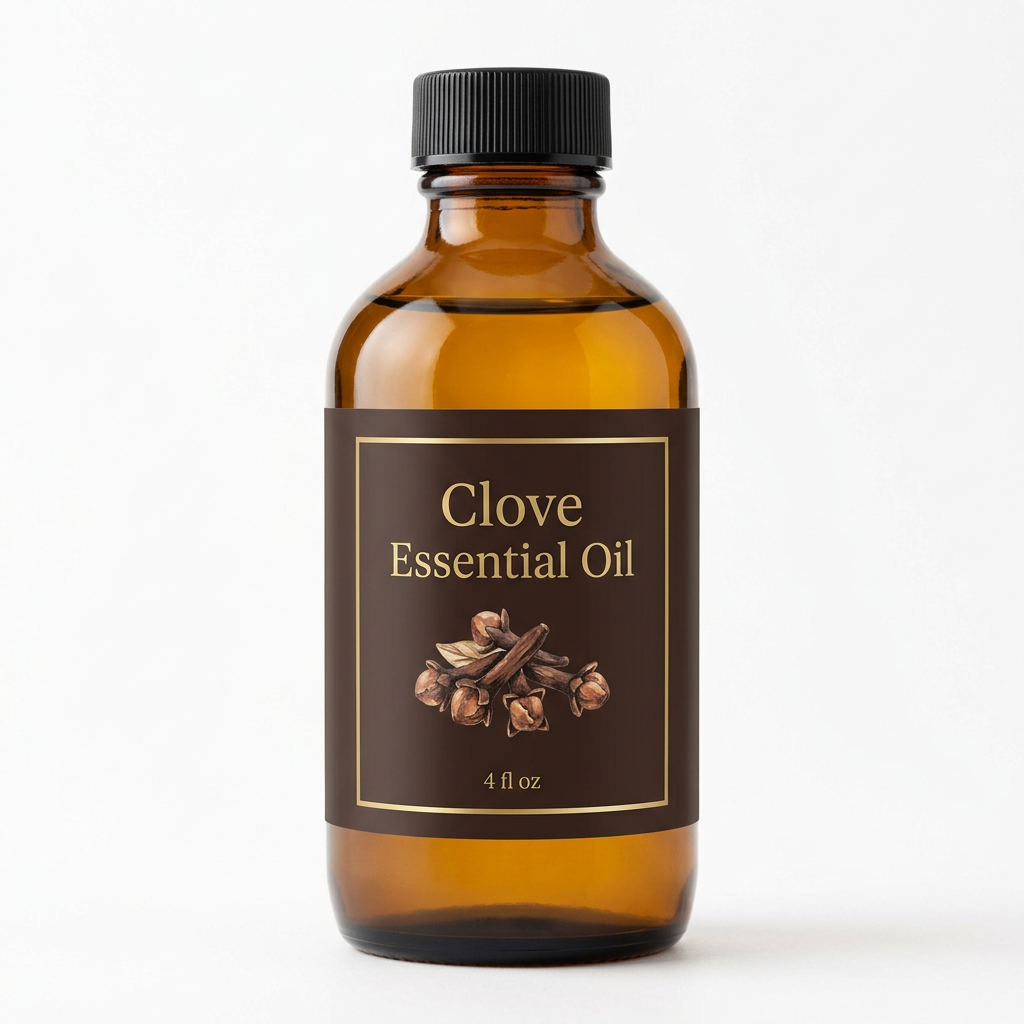
Clove Essential Oil
Our own Clove Essential Oil, in sizes from 0.5 oz to bulk.
From $10.99
Shop Now →First, which problem do you have?
The American Academy of Periodontology describes gingivitis as the mildest form of periodontal disease: gums that are red, swollen and bleed easily, usually with little or no discomfort. Bacteria in plaque release toxins that irritate the gums, and the Academy says gingivitis is reversible with professional treatment plus good home care. If it goes unchecked, periodontitis follows: gums pull away from the teeth, pockets form, and bone and supporting tissue are destroyed over time, so that teeth can loosen or need removal.
Two things follow from that description, and they matter more than any oil. First, gingivitis often does not hurt, so a product that is chosen for "gum pain" is aimed at the wrong symptom. Second, the thing that reverses gingivitis is removing plaque, including the hardened plaque (calculus) that only a dental professional can scrape away. Reasoning from the Academy's description, a rinse or gel that is not removing plaque is not addressing the cause, whatever else it does.
If your gums bleed when you brush, are swollen, or you have a persistent bad taste, the person to see is a dentist, and a periodontist if you have pockets or loosening. If the pain is deep, throbbing or tied to one tooth, that is a different question, covered in our toothache article.
What the clove research actually tested
The lab results are real but narrow. In a 2017 study in Microbial Pathogenesis, Zhang et al. tested eugenol taken from clove leaf oil (the oil was 90.84% eugenol) against Porphyromonas gingivalis, a bacterium linked to periodontitis. They reported growth-inhibiting activity at 31.25 micromolar, membrane damage visible under the microscope, and reduced biofilm. That was bacteria in dishes. It was not a person, a gum, or a mouth with saliva that dilutes and washes everything away.
A 2026 paper by Gupta et al., Natural Product Research, reported a clove oil nanoemulsion (droplets about 44 nanometres) with a minimum inhibitory concentration of 0.4 mg/mL against Streptococcus mutans, and minimal toxicity to human oral cells. Again in vitro, and again an engineered nanoemulsion, not the oil in a bottle. Reasoning from these two papers, the practical consequence is that "slows a gum bacterium in a dish" tells you clove chemistry is biologically active, not that any oil you can buy will help a gum.
The nearest thing to a clinical result in this area concerns a different question. Alqareer, Alyahya and Andersson (Journal of Dentistry, 2006) randomized 73 adult volunteers and applied a homemade clove gel (concentration not stated), a 20% benzocaine gel or a placebo to the buccal mucosa for five minutes before two needle sticks. Pain scores on a 100 mm scale were lower for both active gels than for placebo, with no significant difference between clove and benzocaine. That study measured needle pain on healthy cheek tissue. It did not test gums with gingivitis, and it says nothing about gum disease.
We also ran a title search on Europe PMC on 23 October 2026 for clove combined with gingivitis, periodontal or plaque. It returned laboratory studies, an animal study, drug-delivery films and reviews, and no randomized human trial of clove oil as a gingivitis product. A search of that kind can miss papers, so read it as "we did not find one", not "none exists".
The essential-oil rinse studies are not clove studies
You may see a meta-analysis cited as proof that "essential oil mouthwash works". Stoeken, Paraskevas and van der Weijden (Journal of Periodontology, 2007) pooled 11 publications on an essential-oil rinse used alongside daily toothbrushing and reported a greater gingivitis reduction than control (weighted mean difference -0.32 on the index scale), with very high heterogeneity (I-squared about 93 to 97%). The abstract does not name the oils or concentrations, so the review cannot be read as evidence for clove. It is also a finished, standardized rinse, which is a different thing from a bottle of undiluted oil.
The harms are documented, and this is why we say no
A 2022 case report in Jurnal Medali by Sulaksana and Soegyanto described a 30-year-old woman whose mouth ulcers worsened within two days of applying a clove oil concentrate. Her dental team found shallow ulcers with surrounding redness on the cheek lining, soft palate and tongue, and recorded an oral mucosal burn. Her clinicians stopped the clove oil and used a chlorhexidine rinse and petroleum jelly. One case proves little about frequency, but it shows the mechanism: undiluted clove oil is strong enough to injure the lining of the mouth.
The Tisserand Institute, which publishes aromatherapy safety figures, gives a topical maximum of 0.5% for clove bud oil (citing Essential Oil Safety, 2nd edition) and warns that eugenol can be a skin irritant or allergen if not used in proper dilutions. Our bud oil's published GC-MS report lists 73.57% eugenol. Note that our own product page gives a skin range of 0.5% to 2%; for bud oil the cautious reading is the bottom of that range, and the Tisserand figure is the stricter of the two published numbers. Skin is also much more tolerant than gum tissue, so a skin figure is not a mouth figure.
Swallowing is a separate and more serious risk. Janes, Price and Thomas (European Journal of Pediatrics, 2005) reported a 15-month-old who swallowed 10 ml of clove oil and developed fulminant liver failure (ALT above 13,000 U/L at 24 hours); Hartnoll, Moore and Douek (Archives of Disease in Childhood, 1993) described a child with coma, seizures, a bleeding disorder and liver damage after ingestion. A mouth product is a product that gets swallowed, and a bottle that is open on a bathroom shelf is within reach of a toddler. If a child has swallowed any, call your local poison control center or emergency services.
What we do, and what we suggest you do
- We sell two oils, clove bud and clove leaf, for scent and cosmetic use, sold undiluted with nothing added. The product pages say to keep them away from children and pets and to avoid internal use.
- We will not write a gum routine with drops, dilutions or frequencies, and we do not sell a mouthwash, gel or any dental product.
- For bleeding or swollen gums, book a dental exam and ask about a cleaning and home-care plan. For an immediate ache while you wait, a pharmacist can talk through over-the-counter products made for the mouth; for pockets, a periodontist.
- If you have already used clove oil in your mouth and have burning, white patches, blisters or swelling, stop and see a dentist or physician.
The honest summary is that clove chemistry is interesting to dentistry, which is why eugenol shows up in professional products, but "interesting in a dish" and "right for your gums" are separated by trials that, as far as we could find, have not been done. For a wider view of how oils and mouths interact, see our oral health overview, and for the burn risk in more detail, the clove oil burn article.
Clove Essential Oil
Clove Essential Oil from our own shop, in sizes from 0.5 oz to bulk.
From $10.99
Shop Now →Sources & Further Reading
- American Academy of Periodontology. Gum disease information. perio.org
- Zhang Y et al., 2017. Antibacterial and antibiofilm activities of eugenol from clove leaf oil against Porphyromonas gingivalis. pubmed.ncbi.nlm.nih.gov/29101062
- Gupta AD et al., 2026. Clove oil nanoemulsion against Streptococcus mutans. pubmed.ncbi.nlm.nih.gov/42228993
- Alqareer A, Alyahya A, Andersson L, 2006. The effect of clove and benzocaine versus placebo as topical anesthetics. pubmed.ncbi.nlm.nih.gov/16530911
- Stoeken JE, Paraskevas S, van der Weijden GA, 2007. Long-term effect of a mouthrinse containing essential oils on plaque and gingivitis. pubmed.ncbi.nlm.nih.gov/17608576
- Sulaksana SD, Soegyanto AI, 2022. Oral mucosal burn caused by topical application of a clove oil concentrate. jurnal.unissula.ac.id/18635
- Tisserand Institute. Eugenol: essential oil constituents in food, part 4. tisserandinstitute.org/learn-more/eugenol
- Janes SE, Price CS, Thomas D, 2005. Essential oil poisoning: N-acetylcysteine for eugenol-induced hepatic failure. pubmed.ncbi.nlm.nih.gov/15895251
- Hartnoll G, Moore D, Douek D, 1993. Near fatal ingestion of oil of cloves. pmc.ncbi.nlm.nih.gov/PMC1029532