Clove Oil Burn: First Aid Sources and When to Get Care
Clove oil can burn skin and the lining of the mouth, and the usual cause is using it at full strength. Both our clove bud oil and clove leaf oil are sold undiluted, which is why our pages say never to apply them neat and to dilute to 0.5% to 2% in a carrier oil with a patch test first. This page is a short question-and-answer for the moment after something has gone wrong: what the first-aid sources say, which signs mean "stop reading and get care," and what we will not give you.
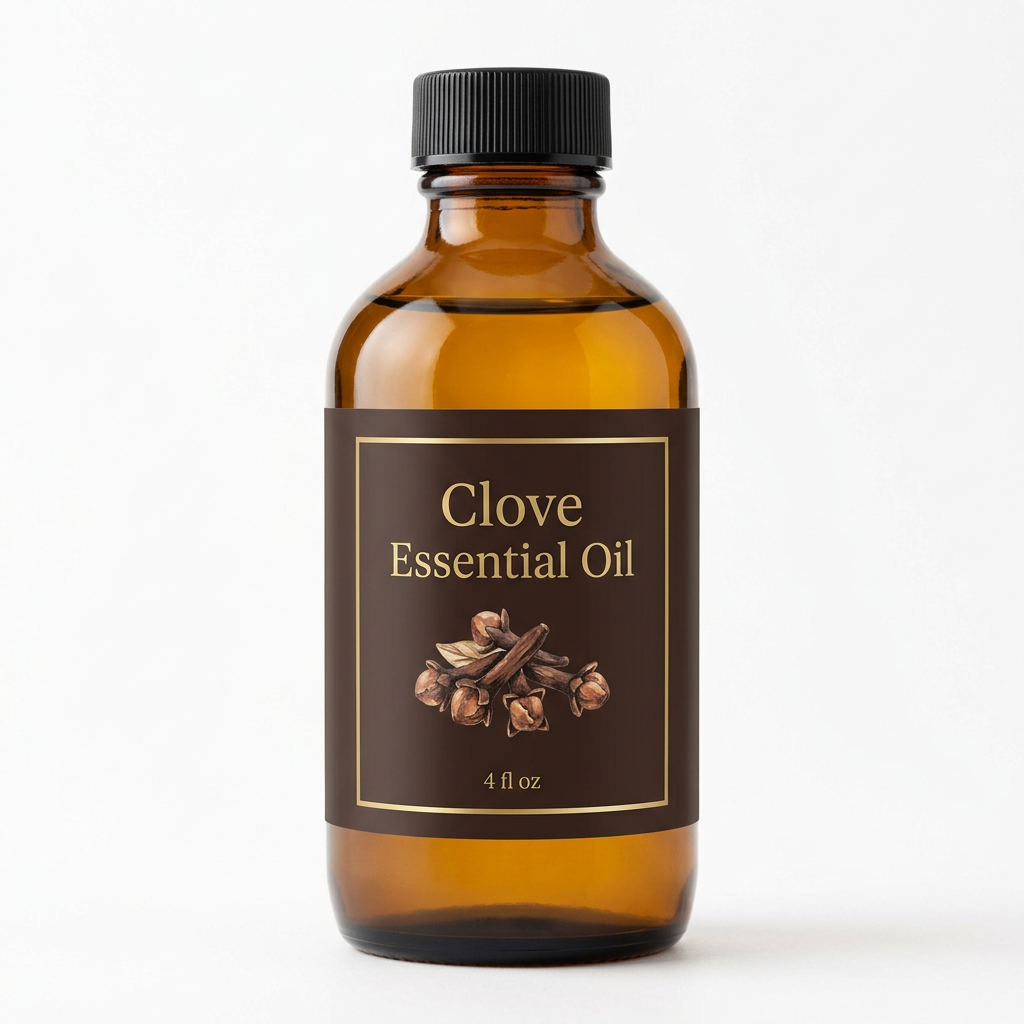
Clove Essential Oil
Our own Clove Essential Oil, in sizes from 0.5 oz to bulk.
From $10.99
Shop Now →Is this a burn or an allergy?
Often it is hard to tell at home, and the treatment differs, so a clinician should decide. Two different things can happen:
- Irritant reaction. Direct tissue damage from the chemical. It appears where the oil touched, can come on within hours, and does not need prior exposure. Eugenol, the main component of both oils (our published bud report lists 73.57%), is a documented skin irritant and allergen according to the Tisserand Institute (Tisserand, undated).
- Allergic contact dermatitis. An immune reaction that needs prior sensitisation and can flare later and spread past the contact area. A 1999 report in Contact Dermatitis (Sanchez-Perez and Garcia-Diez) described occupational allergic contact dermatitis from eugenol, cinnamon oil and clove oil in a physiotherapist. A 2026 comparison of sensitisation test methods (Dawson et al., Toxics) included clove bud oil among eight essential oils; its authors say the sample was small and the results descriptive, so we cite it only to show that clove bud oil was one of the eight oils researchers chose to test, not for a potency number.
A dermatologist is the right person for a rash that lingers or returns, since the cause may be the oil, a different product on the same skin, or something else. A rash you get again on re-exposure is a reason to stop using the oil, not to test it again.
Skin: what the first-aid sources say
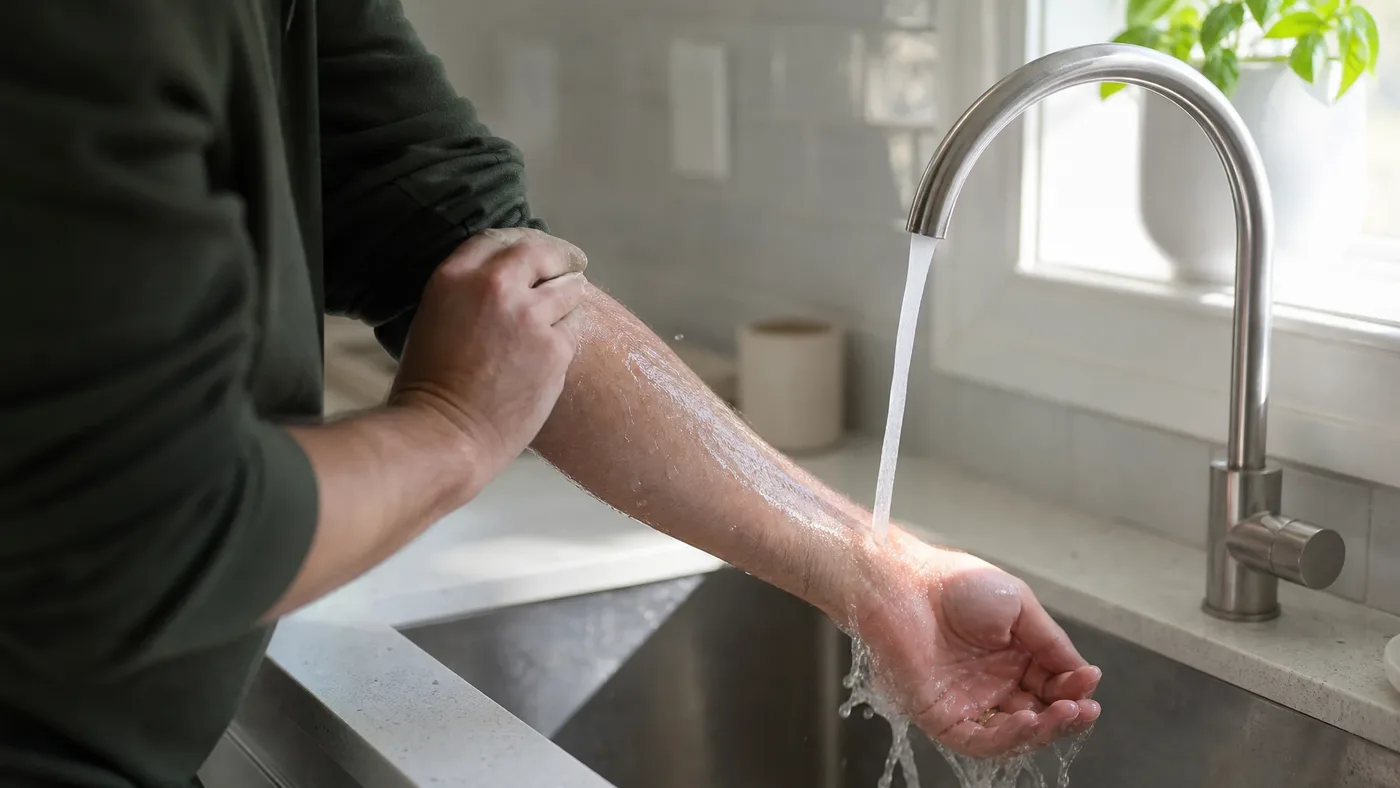
We can only report what we found and read; we are not a clinician and neither is anyone on our staff. The MedlinePlus entry "Chemical burn or reaction" (reviewed October 2025) says to move away from the chemical, remove contaminated clothing and jewelry, and flush the skin with cool running water for at least 15 minutes. It says to cover the area with a dry sterile dressing or clean cloth, and not to apply ointments or salves, pop blisters, or try to neutralise the chemical without advice from Poison Control or a health care provider. It says to get medical help right away for a second- or third-degree burn or any whole-body reaction.
The Tisserand Institute's adverse-reaction page gives a compatible, essential-oil-specific version for the skin: stop applying the oil, wash gently with preferably unperfumed soap and water for at least 10 minutes, and seek medical attention if irritation persists. Note the two sources give different durations (15 minutes of flushing versus 10 minutes of washing). When sources differ, the longer figure is the conservative one, but a Poison Control call will give you advice for your specific exposure.
Eyes
MedlinePlus says to flush the eyes with running water right away, for at least 15 minutes, and get medical help immediately. Tisserand's page says 15 to 30 minutes of water and to remove contact lenses after the first 5 minutes. Both say water, not oil. Eye contact with undiluted clove oil is a case for an emergency department or an ophthalmologist, not for waiting to see.
Mouth and swallowing: why there is no home protocol here
Clove oil and eugenol are real dental ingredients, but dentists use specific products in controlled ways. We will not give you drops, dilutions or methods for putting clove oil in or on the mouth, because our oils are labelled for aromatic and cosmetic use only, and the documented harms are real:
- A 2022 case report (Sulaksana and Soegyanto, Media Dental Intelektual) described a 30-year-old woman with recurrent canker sores who applied clove oil extract to her mouth; she presented with multiple shallow ulcers on the cheek, soft palate and tongue and was diagnosed with an oral mucosal burn. She was told to stop the oil and was prescribed a chlorhexidine mouthwash; the report does not describe her follow-up. One case cannot give a rate, but it shows the mechanism.
- A 1993 case in Archives of Disease in Childhood (Hartnoll et al.) described ingestion of oil of cloves that led to coma, fits, a coagulopathy and acute liver damage.
- A 1983 Lancet report (Isaacs) is titled "Permanent local anaesthesia and anhidrosis after clove oil spillage," a skin outcome long after the exposure.
If clove oil was swallowed or got into the mouth and caused distress, call Poison Control in the US at 1-800-222-1222 (MedlinePlus lists this number for swallowed or inhaled chemicals) or emergency services if there is trouble breathing, seizures or unconsciousness. The Tisserand page adds that when young children swallow any amount, medical attention should be sought urgently. For ongoing mouth or gum pain, the person to see is a dentist. Our oral health article covers what the evidence says without a protocol.
When to stop and get care
- Blistering, broken skin, skin that looks grey, white or charred, or a burn larger than a small spot.
- Any exposure to eyes.
- Swallowing, or any exposure in a child.
- Swelling of lips, tongue or throat, trouble breathing, faintness (Tisserand lists these as possible anaphylaxis).
- Pain that is increasing, or a rash that spreads or returns.
Tell the clinician which oil it was (Syzygium aromaticum, bud or leaf) and bring the bottle. The arithmetic below is why: at our top label dilution of 2%, a 30 ml bottle of carrier oil holds 0.6 ml of clove oil, while the neat oil is 100%, fifty times stronger than 2% and two hundred times stronger than the 0.5% the Tisserand Institute gives as the clove bud maximum. Our product pages say 0.5% to 2% and the Tisserand Institute says 0.5% for bud oil, so they disagree at the top of our range. Reasoning from that, if you use our oil on skin at all, 0.5% is the defensible starting point: 0.15 ml in 30 ml of carrier oil. We have not tested any formulation.
For related reading, see clove oil side effects, dilution limits and patch tests, and how to dilute clove oil.
Clove Essential Oil
Clove Essential Oil from our own shop, in sizes from 0.5 oz to bulk.
From $10.99
Shop Now →Sources & Further Reading
- MedlinePlus, 2025. Chemical burn or reaction. medlineplus.gov/ency/article/000059
- Tisserand Institute. What to do in case of an adverse reaction. tisserandinstitute.org
- Tisserand R. Eugenol: essential oil constituents in food, part 4 (Tisserand Institute, undated). tisserandinstitute.org/?p=5551
- Sanchez-Perez J, Garcia-Diez A, 1999. Occupational allergic contact dermatitis from eugenol, oil of cinnamon and oil of cloves in a physiotherapist. Contact Dermatitis. PMID 10617221
- Dawson JT et al., 2026. Comparative analysis of test methods for predicting dermal sensitization potency in essential oils. Toxics. PMID 42797719
- Sulaksana SD, Soegyanto AI, 2022. Oral mucosal burn caused by the topical application of a clove oil concentrate. Media Dental Intelektual (Medali). jurnal.unissula.ac.id/medali/18635
- Hartnoll G, Moore D, Douek D, 1993. Near fatal ingestion of oil of cloves. Arch Dis Child. PMID 8215554
- Isaacs G, 1983. Permanent local anaesthesia and anhidrosis after clove oil spillage. Lancet. PMID 6132216