
Clove Oil and Oral Health: What Dentists Use vs What We Sell
Eugenol, the main compound in clove oil, is a real dental ingredient, and that is exactly why the bottle on our shop page is not a dental product. Dentists use eugenol in controlled forms for narrow jobs. Our clove bud oil and clove leaf oil are labelled for aromatic and cosmetic use only, never internal use, so we will not write a mouth protocol for either one. Here is what dentistry does with eugenol, what the trials tested, what has gone wrong when people improvised, and who to see instead.
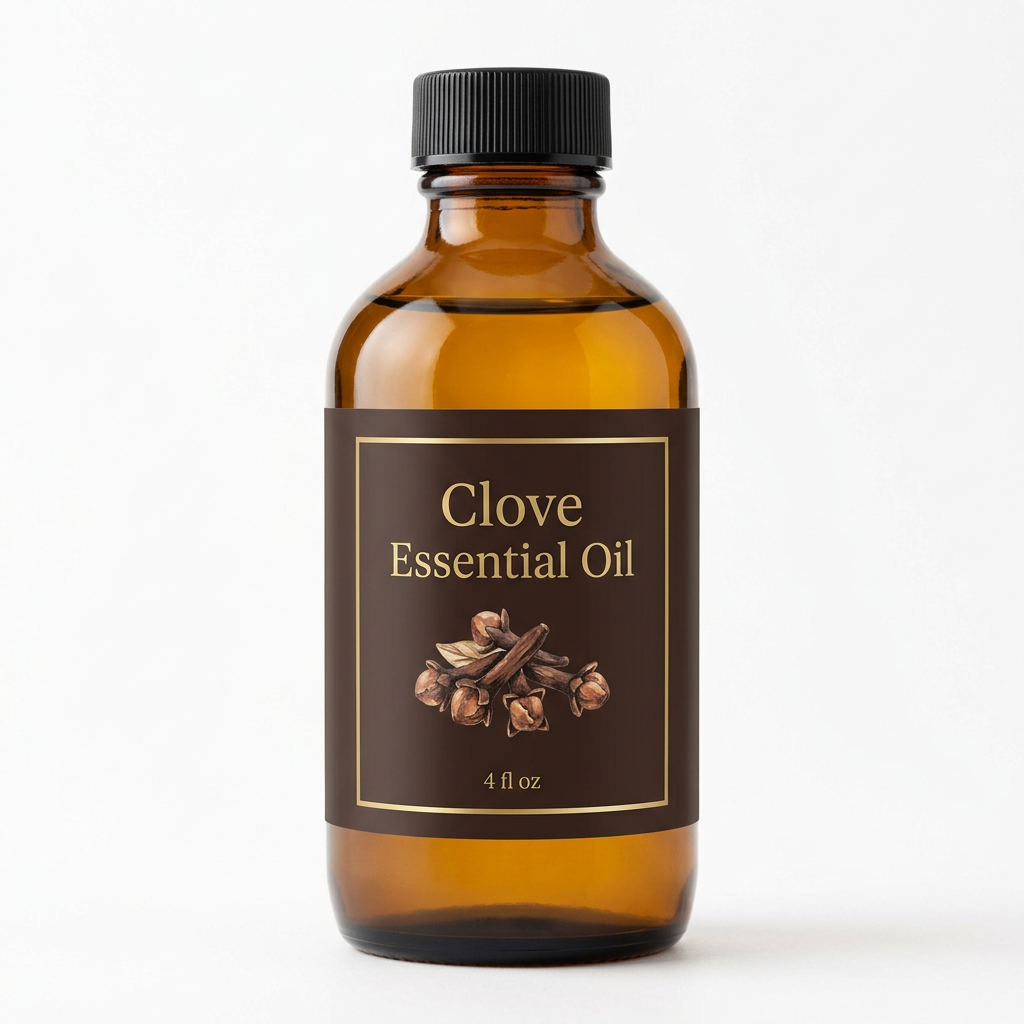
Clove Essential Oil
Our own Clove Essential Oil, in sizes from 0.5 oz to bulk.
From $10.99
Shop Now →Where eugenol really sits in dentistry
A 2006 paper on how eugenol numbs nerves opens by calling it widely used in dentistry (Park et al., Journal of Dental Research, 2006). In that study, run on isolated rat tooth-nerve cells in a dish, eugenol blocked sodium currents, which is one plausible mechanism for a numbing effect. A cell-culture result in rats is a mechanism, not a clinical outcome, and it says nothing about a bottle of essential oil.
The clinical uses are dentist-controlled: eugenol-containing materials are used in endodontic (root canal) work, a use the authors of a 2011 cell study refer to directly (Anpo et al., Odontology, 2011). The point of that setting is not the molecule alone. It is a trained person choosing a tooth, a material, a placement and a follow-up.
The regulatory fact most clove-for-teeth pages skip
In 1982 an FDA advisory Dental Panel put eugenol at 65 to 87 percent in Category I (safe and effective) for throbbing, persistent toothache. In 1991 FDA disagreed and moved it to Category III (data insufficient). The agency's stated reason was that eugenol is irritating and potentially harmful to viable dental pulp, the living tissue inside a tooth, so it should only go on a tooth with irreversible damage (FDA, Federal Register, 24 September 1991, 56 FR 48302). That is a named disagreement between an expert panel and the regulator, and it is about the ingredient itself, not about a fringe use.
We did not find a final rule in the documents we read. What a current label shows is the same caution: one US eugenol toothache product listed on DailyMed is 85 percent eugenol, marketed as "OTC monograph not final", labelled only for throbbing toothache due to a cavity, with "Visit Dentist within 48 hours of use" and an allergy alert for people allergic to eugenol (clove oil) (NLM DailyMed label). Notice what that label is: one indication, one cause, and a built-in instruction to go to a dentist.
Same molecule, different proposition: the arithmetic
Our published GC-MS report for the bud oil says 73.57% eugenol. The DailyMed product above is 85%. The ratio is 85 divided by 73.57, about 1.16. Reasoning from those two numbers, the undiluted bud oil is in the same strength class as a dental eugenol product, not a milder cousin of it. Our own pages tell you to dilute to 0.5% to 2% in a carrier oil for skin, which is a skin guideline and not a mouth figure. We have no basis for translating it to teeth or gums, and we will not pretend otherwise.
What the bottle lacks is everything around the dental product: a cavity-only indication, a labelled age limit, a standard concentration, and a dentist at the other end. Our leaf oil has no published composition report on its product page, so we do not state its eugenol share here.
What the clove trials actually did
- Alqareer, Alyahya and Andersson, 2006. A randomised, subject-blinded trial of 73 adult volunteers. A homemade clove gel, a 20% benzocaine gel and two placebos were tested on healthy cheek-side (buccal) mucosa before needle sticks, with pain scored on a 100 mm scale. Both active gels beat placebo (p=0.005) and did not differ from each other. The authors said clove "might possess a potential" to replace benzocaine. This was healthy tissue and a needle stick, not a painful tooth, and the PubMed record does not state funding (Alqareer et al., Journal of Dentistry, 2006).
- Reddy et al., 2025. A systematic review of 21 studies of plant-based agents for dental pain. Its abstract names clove oil (eugenol), turmeric and capsaicin as the most promising, but reports no effect sizes, and the authors themselves call for standardised preparations, larger trials, and data on dosing and long-term safety (Reddy et al., International Journal of Dentistry, 2025).
- Barrera et al., 2024. A review of 62 randomised trials of herbal extracts across orofacial pain types. Clove is one of nine extracts the abstract lists as pain-lowering, but the abstract gives no clove-specific figure, and several pooled intervals are wide (Barrera et al., Scientific Reports, 2024).
Our reading: the evidence is thin, the preparations differ from trial to trial, and none of it tested an aromatic essential oil bought in a bottle. Applying it to our oils would be an inference we are not willing to make.
What goes wrong
- Tissue damage. In a 2011 cell study on human dental pulp cells, eugenol reduced cell growth and collagen synthesis in a concentration-dependent way. The authors suggested eugenol may be cytotoxic to normal pulp and ligament stem-cell function (Anpo et al., Odontology, 2011). It is an in vitro result, which is why we call it a warning sign rather than a measured injury rate.
- Allergy. In a German dermatology-clinic database, 10,930 patients were patch tested with 12 essential oils and 908 (8.3%) reacted to at least one; clove oil was positive in 1.6% (Geier et al., Contact Dermatitis, 2022). Those were people already referred for dermatitis, so it is not a population rate, and it was skin testing, not the mouth. See our side-effects article for the skin picture.
- Swallowing. A 15-month-old boy developed fulminant liver failure after swallowing 10 ml of clove oil and recovered after intravenous N-acetylcysteine (Janes et al., European Journal of Pediatrics, 2005). A 7-month-old developed central nervous system depression and acidosis after accidental ingestion and recovered with supportive care (Lane et al., Human & Experimental Toxicology, 1991). These are case reports, not rates. They are why our bottles say keep away from children and avoid internal use. For the longer discussion see can you ingest clove oil.
- Masking a cause. This one is reasoning, not a study: pain that stops mattering for an hour does not tell you whether the cause is a cavity, a cracked tooth or an abscess. The NHS lists all of those, plus infection around a partly erupted wisdom tooth, as toothache causes (NHS, Toothache).
What we will and will not say
We will not give a drop count, a dilution, a frequency or a method for putting any essential oil on teeth, gums or into a socket, and we will not tell you our oil relieves a toothache. That is not hedging for its own sake. The strongest source in this article, the FDA record, is about how cautious regulators are with eugenol even when it is a labelled, single-purpose dental product. If you want the aroma, our clove bud oil (warm and sweetly spicy) and clove leaf oil (bolder and smokier) are sold undiluted for diffusing and diluted skin use, and the dilution maths there is yours to do from our label.
Who to see, for what
- A dentist, if toothache lasts more than 2 days, does not ease with painkillers, or comes with a high temperature, pain on biting, red gums, a bad taste or a swollen cheek or jaw (NHS, above).
- Emergency care, if swelling around the eye or neck makes it hard to breathe, swallow or speak (NHS, above).
- A pharmacist, for over-the-counter pain medicine choices. The ADA's guideline favours NSAIDs such as ibuprofen or naproxen, alone or with acetaminophen, for toothache when dental care is not immediately available (ADA living guideline). It does not mention clove or eugenol.
- Poison control or a doctor straight away if a child has swallowed any clove oil.
The specific situations have their own pages: toothache, dry socket, wisdom tooth pain, and how clove compares with a pharmacy product in clove oil vs benzocaine. For the chemistry, see what eugenol is.
In short: clove is a legitimate dental ingredient in a dentist's hands and an aroma oil in ours. We would rather be clear about that line than blur it to sell a bottle.
Clove Essential Oil
Clove Essential Oil from our own shop, in sizes from 0.5 oz to bulk.
From $10.99
Shop Now →Sources & Further Reading
- Park C-K et al., 2006. Eugenol inhibits sodium currents in dental afferent neurons. PubMed 16998128
- Anpo M, Shirayama K, Tsutsui T, 2011. Cytotoxic effect of eugenol on osteogenic differentiation markers in human dental pulp cells. PubMed 21706355
- US FDA, 1991. Oral Health Care Drug Products for OTC Human Use; Amendment to Tentative Final Monograph to Include OTC Relief of Oral Discomfort Drug Products, 56 FR 48302. govinfo.gov FR-1991-09-24
- NLM DailyMed. Eugenol toothache product label (eugenol 85%). dailymed.nlm.nih.gov
- Alqareer A, Alyahya A, Andersson L, 2006. The effect of clove and benzocaine versus placebo as topical anesthetics. PubMed 16530911
- Reddy MS et al., 2025. Analgesic efficacy of phytotherapeutic agents in dental pain management: a systematic review. PubMed 41322706
- Barrera SD et al., 2024. Herbal extracts in orofacial pain: a systematic review and meta-analysis. PubMed 39609444
- Geier J et al., 2022. Contact sensitization to essential oils: IVDK data of the years 2010-2019. PubMed 35417610
- Janes SEJ, Price CSG, Thomas D, 2005. Essential oil poisoning: N-acetylcysteine for eugenol-induced hepatic failure. PubMed 15895251
- Lane BW et al., 1991. Clove oil ingestion in an infant. PubMed 1679654
- NHS. Toothache. nhs.uk/conditions/toothache
- American Dental Association. Adult/adolescent acute dental pain management for toothaches (living guideline). ada.org