Does Clove Oil Sink? Simple Checks to Do at Home
Here is a small kitchen fact that surprises people: most essential oils float on water, but clove oil sinks. It is a fun thing to see, and it is also one of the few home checks that rests on real numbers. This page is about what a kitchen can and cannot tell you about a bottle of clove oil, so you get the pleasure of the check without mistaking it for a laboratory.
Clove Essential Oil
Our own Clove Essential Oil, in sizes from 0.5 oz to bulk.
From $10.99
Shop Now →Look and smell first
The Certificate of Analysis we publish for one bud batch lists the appearance as a yellow liquid and the smell as spicy, woody and sweet, and records both as complying. So a bud oil that is water-clear or smells of something other than clove deserves a second look. Treat that as a first screen, because colour and scent vary between honest lots. Smell it from a little distance, not with your nose in the open bottle, since clove oil is a skin, eye and respiratory irritant according to the EFSA panel that reviewed it (EFSA FEEDAP, 2023).
The sink test
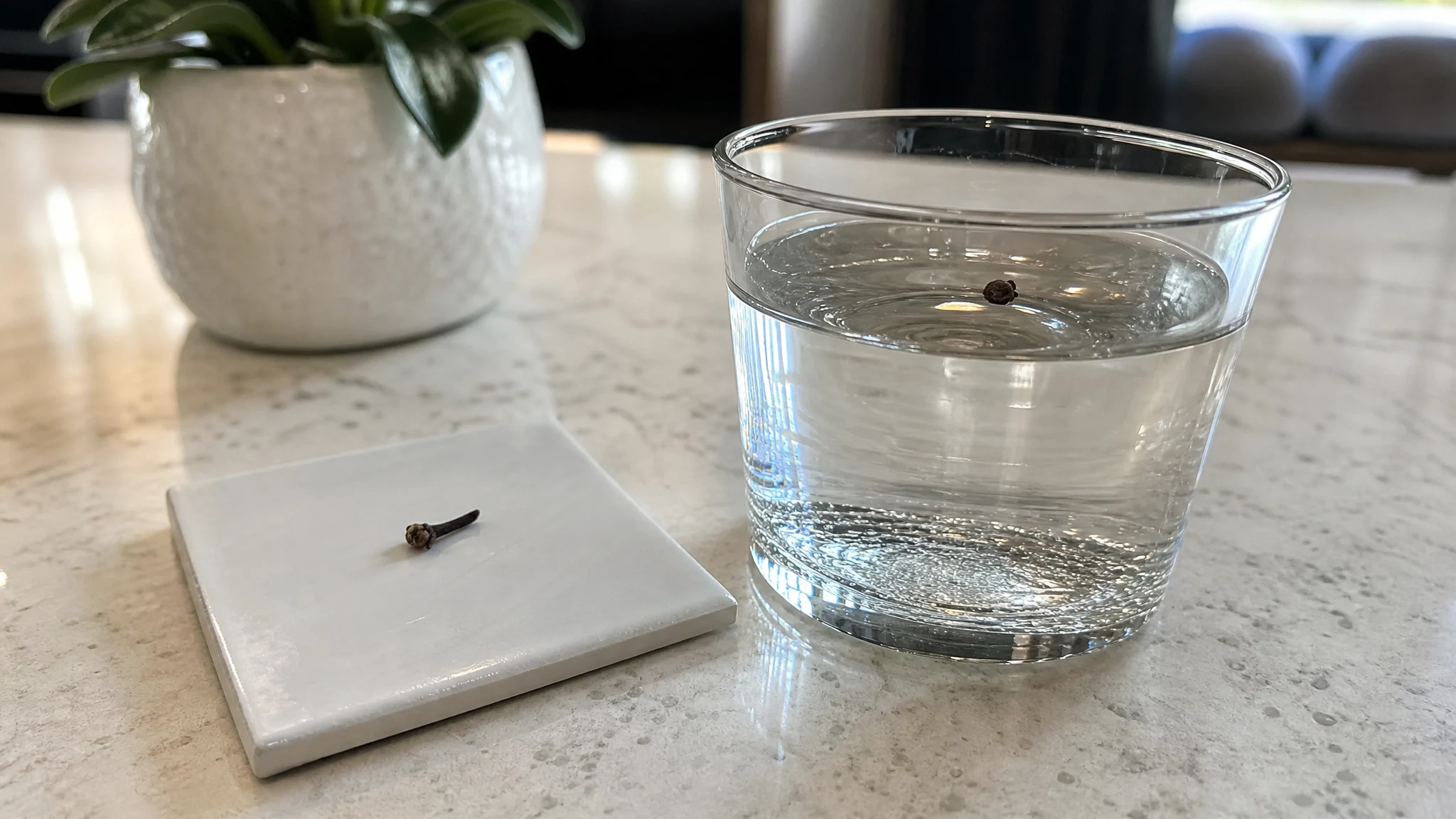
The relative density on our published COA is 1.054, and the bud batches EFSA reviewed ran from 1.0559 to 1.0593. Water is 1.000, so a drop of clove bud oil should sink through a glass of water, not spread into a floating film. If it floats and skates across the surface, something much lighter is in the bottle, or it is not clove.
It helps to know the check's limits. It can reveal a large amount of a light liquid, but not a small amount, and not a heavier addition. And because eugenol made industrially is the same molecule as eugenol from clove (Kamatou et al., Molecules, 2012), no sink test can separate the two.
Make it a little experiment
Fill a clear glass with plain water and let it settle. Hold the bottle's dropper tip close to the surface and let one drop fall. Watch what it does: you should see it sink, perhaps trailing a thin streak, rather than spreading into a shining film. It is a small thing, but it makes the idea of density feel real. Wipe up any spill, wash the glass well and do not drink from it afterward.
Weigh a sample
If you own a kitchen scale accurate to 0.01 g and a syringe or graduated pipette, you can estimate density: weigh 5 ml and divide by 5. A density of 1.054 means about 5.27 g. The arithmetic shows how narrow the margin is. Suppose a tenth of the volume were replaced by a liquid with a density of 0.90, a made-up figure for illustration. The mixture would read about 1.039, just under the 1.040 to 1.060 standard on our COA. But a scale that reads to 0.1 g, or a syringe that is out by half a millilitre, produces an error of that size. So weighing is good for a gross surprise and not for a subtle one.
What needs an instrument
Refractive index is a standard check in the clove specifications. Our COA gives 1.535 against a stated range of 1.530 to 1.542, and EFSA's bud batches sat between 1.534 and 1.537 while its leaf batches read 1.5315 to 1.5323. The gap between bud and leaf is about 0.003, which takes a temperature-controlled instrument reading to three or four decimal places. Optical rotation, minus 0.68 degrees on our batch against a stated range of minus 2 to 0, is the same story. Those are laboratory jobs.
The same goes for confirming plant part. Bud and leaf oils overlap on eugenol (EFSA's bud batches ran 81.78 to 84.00%, leaf 78.68 to 86.01%) and differ mainly in eugenyl acetate, which only a GC run reveals. Our walkthrough, reading a clove oil GC-MS report, explains how.
Skip the skin and taste tests
Some guides suggest rubbing a drop of neat oil on your wrist to see whether it "feels right." We would not. Eugenol is a primary irritant and sensitiser and one of the most frequently reported consumer allergens in the EU (Kamatou et al., 2012), and our guidance for any skin use is to dilute to 0.5% or less. Our safety guide explains why. For the same reason, do not taste it; see our ingestion article.
Keep notes on your bottles
Whatever you are checking, write it down. Note the date you opened each bottle, where you keep it, and how it smells now. Clove tends to be a steady oil, but a note beside a bottle opened last year makes it easy to see if something has changed. If two bottles ever smell different to you, the notes will tell you when you first noticed it.
The best check is a document
A useful report names the plant part, the method, the lot, the laboratory and the date. We publish a Certificate of Analysis and a qualitative GC-MS report for our bud oil, and if you want lot-specific paperwork for your own order you can ask us in writing through the contact page before you buy. Compare any numbers you are given with the ranges above. A supplier who cannot produce a document for your lot is asking you to take it on trust.
When you are comparing bottles, the simplest approach is the smallest size from each, smelled side by side, plus a drop in a glass of water. Then you decide whom you trust with the next order.
Clove Essential Oil
Clove Essential Oil from our own shop, in sizes from 0.5 oz to bulk.
From $10.99
Shop Now →