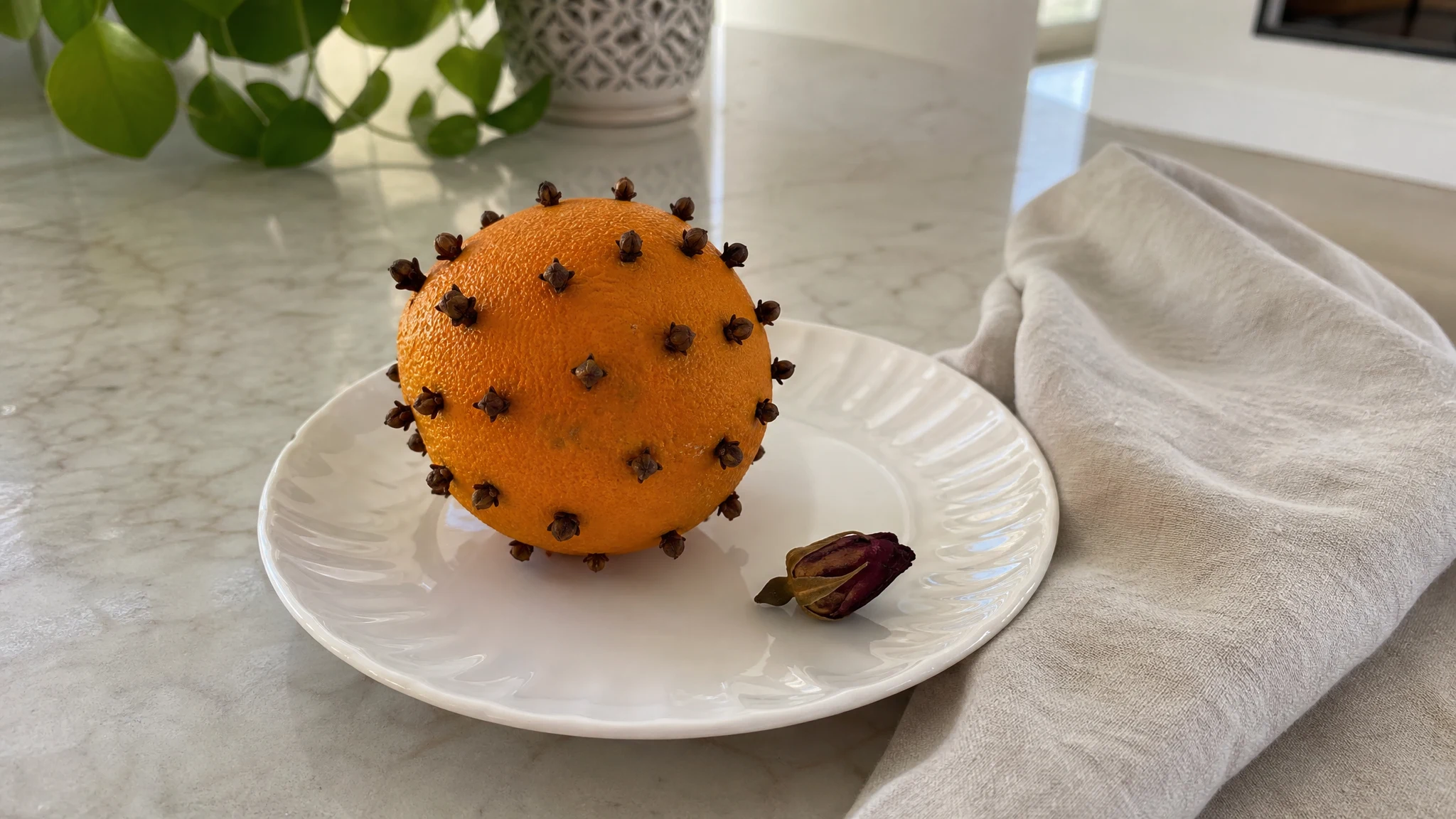
Clove Orange Pomander: What the Sources Really Say
The clove-studded orange is usually described as an ancient object that medieval households made by the dozen. The sources we can open tell a different and rather nicer story: the first pomanders were not fruit at all, and the orange version arrives later, with a name borrowed from something far grander.
Clove Essential Oil
Our own Clove Essential Oil, in sizes from 0.5 oz to bulk.
From $10.99
Shop Now →An apple of amber
The 1911 Encyclopaedia Britannica entry for pomander defines it as a ball of perfumes such as ambergris, musk and civet, carried in a perforated case. The name is French, pomme d'ambre, apple of amber. The cases were often gold or silver and hung from a chain or belt, sometimes with separate compartments for different scents. It names two survivors: an early Spanish example set with emeralds, and a sixteenth-century one recovered from the Thames, now in the British Museum.
Linda Dyett's survey in Metalsmith (2003) fills in the timeline. Aromatics reached the West in force with the crusaders, and the first pomanders were small ambergris paste balls in Germany, Italy and France. By the fourteenth century the word covered both the scent and its container, and by the seventeenth century pomanders had fallen from favor because musk and ambergris were thought overpowering. The contents she lists for the compartmented vessels are musk, civet, sandalwood, nutmeg, angelica, labdanum and castoreum. Cloves are not on the list.
Where the cloves come in
Cloves do appear in some recipes for the paste. A summary of a 1586 recipe by John Partridge, reported on Wikipedia, combines resins such as benzoin, labdanum and storax with rose water, spices and musks, and lists cloves among the spices a pomander might hold. That is a secondary source, so we hold it lightly. If it is right, cloves were one note in a complicated blend, not the whole object.
Then came the orange
The earliest orange-and-clove reference we can trace to a text is in Isabella Beeton's Book of Household Management (1861), in a short entry called "Orange and cloves." She writes that it was formerly the custom in England to give oranges stuck full of cloves as New Year's presents, and she quotes Ben Jonson's masque for a line about an orange and rosemary with no clove to stick in it. Jonson's line is a joke about something missing, which suggests that orange, rosemary and clove made a familiar New Year trio. Beeton's word "formerly" tells us the custom was already fading by her day.
So the sequence the sources support runs like this: a perfumed ball in a precious case, then spiced pastes that sometimes included cloves, then a New Year orange studded with cloves, and finally a modern craft that borrowed the old name. We found nothing that ties the four into one unbroken tradition, which is what the popular version asserts. The link looks like a name and a shape: a scented sphere you keep close. A fair way to put it is that the clove orange is a modern descendant of the pomander in name. For what Victorian households did with cloves, our Victorian kitchen post has more.
What it was for
People once believed a pomander could guard against disease and evil, and the Britannica entry says they were carried during epidemics. Those are reports of belief about the ambergris and musk ball, and neither source gives cloves a protective role. We make no such claim for cloves or for clove oil. Reasoning from the Britannica wording, the plainest job of a pomander was to make the air around you smell better.
Making one today
The craft version is wonderfully simple: a whole orange, whole dried cloves pressed into the peel, and a spot to hang or display it. A few practical points follow from what we know of the ingredients:
- Use whole cloves on the fruit, not oil. We do not sell whole cloves, so a grocery store is the place to look. Concentrated oil on a peel puts eugenol, a recognised skin irritant and sensitiser, where hands will touch it, and it adds little the cloves do not already give.
- Keep it out of reach of pets and small children. Whole cloves are small enough to swallow, and our guidance for the oil is to keep it away from children and pets.
- Treat it as decoration. A fruit that has been handled and left out is not for eating.
A few craft tips
Choose an orange with a thick, firm skin, since a thin skin tears as the cloves go in. Press a toothpick into the peel to make a starter hole, then push each clove in by its round head, which saves your thumb and keeps the stems from bending. You can pack the cloves tightly for an all-over look, or leave gaps and follow a pattern, such as rings around the middle or a spiral from top to bottom. Tie a ribbon around it before you hang it, and you will have a decoration that looks as good as it smells. Over a few weeks you will notice the orange shrinking and firming, and the colors darkening, which is part of its charm.
If you want clove scent without the fruit, our clove and orange spray works from the oil, with its own dilution notes, and the simmer pot recipes put whole cloves on the stove. Skin contact with the oil itself is worth reading about in our safety basics.
A clove orange on a windowsill is a small, cheerful thing, and it does not need a thousand-year pedigree to earn its place.
Clove Essential Oil
Clove Essential Oil from our own shop, in sizes from 0.5 oz to bulk.
From $10.99
Shop Now →Sources & Further Reading
- Encyclopaedia Britannica, 11th ed., 1911. Pomander. en.wikisource.org
- Dyett L, 2003. Small Wonders: Aromatic Adornments. Metalsmith. ganoksin.com
- Wikipedia. Pomander (summarising Partridge, 1586). en.wikipedia.org/wiki/Pomander
- Beeton I, 1861. The Book of Household Management. Project Gutenberg eBook 10136. gutenberg.org/ebooks/10136