Clove Oil and Teeth: Why Eugenol Stays at the Dentist
Walk into a dental surgery and you may well smell cloves. Eugenol, the main compound in clove oil, is a long-standing dental ingredient, and that leads many people to wonder whether the bottle on the shelf at home can do the same job. It cannot, and the reasons are more interesting than a simple warning.
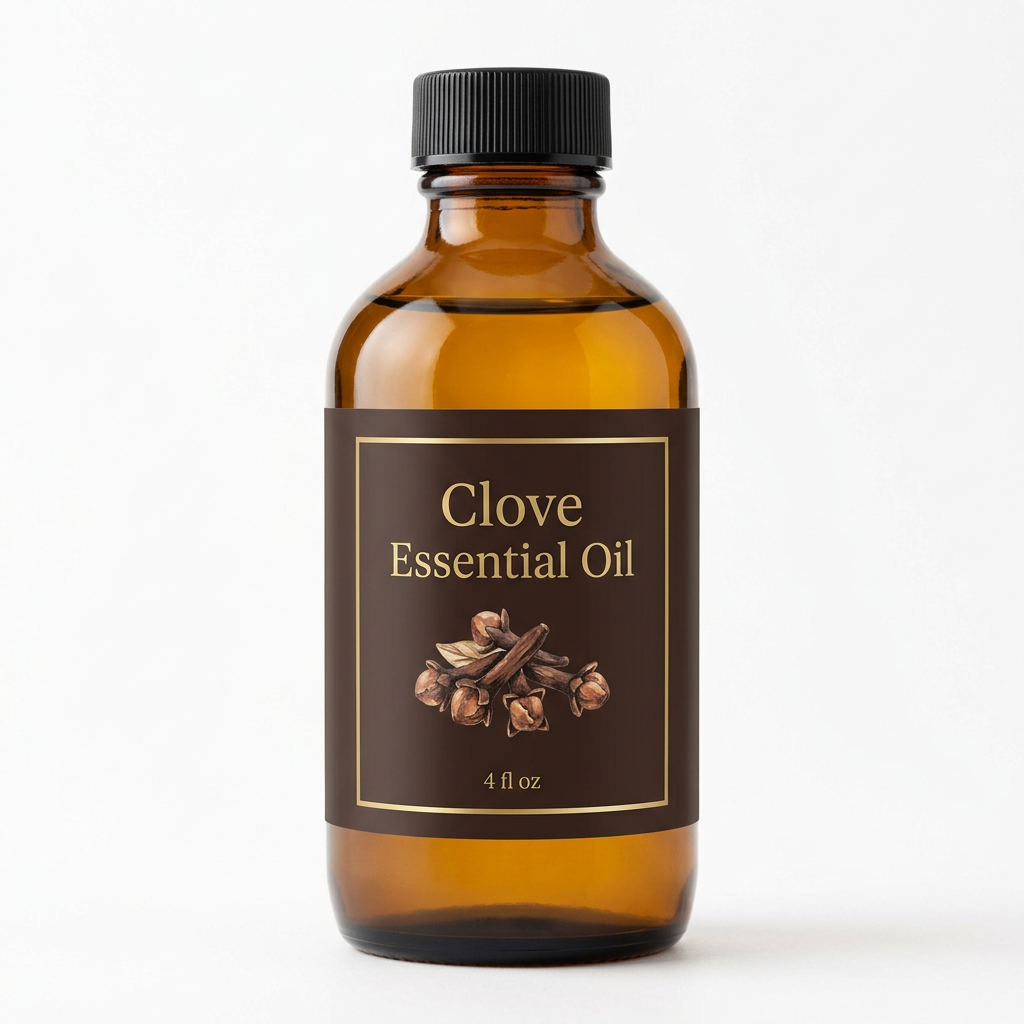
Clove Essential Oil
Our own Clove Essential Oil, in sizes from 0.5 oz to bulk.
From $10.99
Shop Now →What the dental connection really is
Eugenol turns up in dentistry in controlled, purpose-made materials. One reason researchers study it is its effect on nerves: a 2006 study on isolated rat tooth-nerve cells found that eugenol blocked sodium currents in the cells, which is one plausible route to a numbing effect. That is a result from cells in a dish. It describes a mechanism, not what happens when someone dabs essential oil on a tooth.
The same compound is also tough on living tissue. In a laboratory study on human dental pulp cells, Anpo and colleagues found that eugenol reduced cell growth and survival in a concentration-dependent way. Dentists weigh exactly this kind of trade-off when they choose a material, a placement and a follow-up. A bottle of oil has none of that thought built in.
What the clove trials looked at
The best-known clove study, Alqareer, Alyahya and Andersson (2006), recruited 73 adult volunteers. A homemade clove gel, a 20% benzocaine gel and two placebos were each put on the cheek-side gum of a healthy upper tooth for five minutes before two needle sticks. Both active gels scored lower for pain than the placebos, and they did not differ from each other. It is a neat piece of work, and it is also worth reading for what it did not involve: a painful tooth, an essential oil from a bottle, or anyone choosing their own amount. Our comparison with benzocaine goes further into that.
Why we keep our oils out of the mouth
Our clove bud and clove leaf oils are sold undiluted for aromatic and cosmetic use, never for internal use, and we do not suggest putting them on teeth, gums or into a socket. That is partly about strength. Our bud GC-MS report lists eugenol at 73.57%, so undiluted oil is a concentrated material. It is also about the documented trouble. A report in the British Dental Journal describes eugenol as not a bio-friendly material in contact with the soft tissues of the mouth, able to cause irritation, cell damage and hypersensitivity, and shares two cases of local reactions to dental materials that contained it.
Swallowing is the more serious end. Case reports describe a 15-month-old who developed liver failure after swallowing 10 ml of clove oil and recovered with treatment, and a 7-month-old who became drowsy and acidotic after accidental ingestion and also recovered. Case reports are not rates, but they are the reason we ask everyone to keep every bottle well away from children. If a child swallows any, call poison control or a doctor straight away.
Questions worth bringing to the dentist
If clove has you curious, a dental visit is a great place to ask. You might ask why dentists use eugenol in certain materials, what to expect after a procedure, and what to do between visits. A dentist can explain things far better than a search result, and they can look at your actual teeth. It is a friendlier conversation than most people expect, and the scent in the office will probably make more sense by the end.
A sore tooth is a job for a dentist
Pain from a tooth has many possible causes, from a cavity or cracked tooth to an infection, and only an examination tells them apart. That is the best argument for a dental visit rather than a home remedy: relief for an hour would not tell you which one you are dealing with. If a tooth hurts, is swollen, or comes with fever, please see a dentist, and ask a pharmacist about pain medicine that suits you. If swelling makes it hard to breathe or swallow, that is an emergency.
The specific situations have their own pages: toothache, dry socket and wisdom tooth discomfort. For the chemistry, see what eugenol is, and for skin and allergy, clove oil side effects.
The smell that follows people home
Many people link clove with a dentist because the smell is so distinctive. It is a sharp, sweet, slightly medicinal scent that lingers in memory. That association is strong enough that some people love clove in a candle or a holiday pot, while others take one sniff and feel their shoulders tighten. Both reactions are completely normal. If you are in the second group, a gentler partner like orange or vanilla can soften the scent, and a very small amount in a room goes a long way.
What our bottles are for
Clove bud oil is warm, rich and sweetly spicy, and clove leaf oil is bolder, smokier and earthier. Both belong in the diffuser, the simmer pot, the candle pour and the soap pot, which is where we would send your clove enthusiasm.
Eugenol is a dental ingredient in a dentist's hands and an aroma in ours, and we like being clear about which is which.
Clove Essential Oil
Clove Essential Oil from our own shop, in sizes from 0.5 oz to bulk.
From $10.99
Shop Now →Sources & Further Reading
- Park C-K et al., 2006. Eugenol inhibits sodium currents in dental afferent neurons. PubMed 16998128
- Anpo M, Shirayama K, Tsutsui T, 2011. Cytotoxic effect of eugenol on the expression of molecular markers related to the osteogenic differentiation of human dental pulp cells. PubMed 21706355
- Alqareer A, Alyahya A, Andersson L, 2006. The effect of clove and benzocaine versus placebo as topical anesthetics. PubMed 16530911
- Sarrami N et al., 2002. Adverse reactions associated with the use of eugenol in dentistry. PubMed 12353045
- Janes SEJ, Price CSG, Thomas D, 2005. Essential oil poisoning: N-acetylcysteine for eugenol-induced hepatic failure. PubMed 15895251
- Lane BW et al., 1991. Clove oil ingestion in an infant. PubMed 1679654