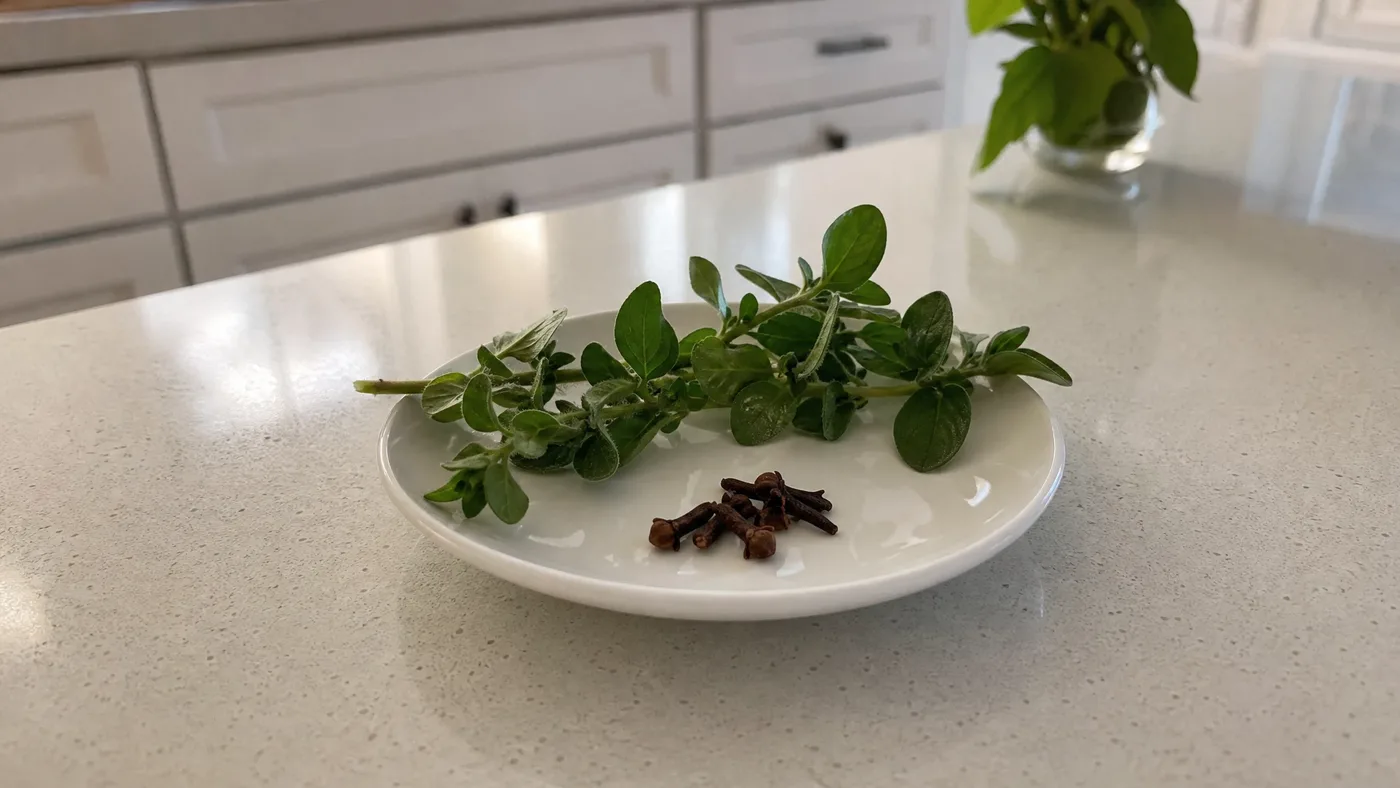
Clove Oil vs Oregano Oil: Two Phenol-Heavy Oils, Compared
The question "clove oil or oregano oil?" usually hides a bigger question: are you shopping for an aromatic essential oil or for something you swallow? Both oils are dominated by one strong phenol (eugenol in clove, carvacrol in oregano), both are strong skin irritants, and neither has a trustworthy head-to-head contest that would let anyone name a winner. We sell clove bud oil and clove leaf oil for aromatic and cosmetic use only. We do not sell oregano, and we will not rank the two on infection claims.
Clove Essential Oil
Our own Clove Essential Oil, in sizes from 0.5 oz to bulk.
From $10.99
Shop Now →Start with the label, because "oregano oil" means two products
A bottle of oregano essential oil is a distilled aromatic material. A capsule or tincture sold as "oregano oil" is a dietary supplement, often a diluted extract in a carrier. They are different products with different rules, and mixing them up is how people end up reading a supplement study and applying it to a bottle of undiluted oil. The FDA's consumer page on supplements states that FDA is not authorized to approve dietary supplements for safety and effectiveness before they are marketed (FDA, dietary supplements). That is the supplement side of the shelf; it says nothing in favour of swallowing an essential oil, and neither does anything we sell: both our clove oils are labelled never for internal use. If you are weighing a supplement, a pharmacist or physician is the right person, especially with medications, pregnancy or breastfeeding.
What is in each bottle
Reasoning from the compound names alone, the two oils belong to the same family of aromatic phenols. In a 2017 study of an oregano oil that was manufactured and funded by its own seller, carvacrol was 78% of the oil by GC-MS (Han and Parker, Biochimie Open, 2017). That is one vendor's oil, not a universal figure; oregano species and chemotypes vary. Our published GC-MS report for the clove bud oil says 73.57% eugenol and 12.82% eugenyl acetate, 98.68% of the oil identified. So both are roughly three-quarters one phenol. You can read how that works in our eugenol guide.
A phenol at that proportion is why both oils sting and sensitise. It is also why dilution arithmetic matters more than the oil's reputation.
The lab evidence: what exists and what does not
This is the part where most comparison pages overreach, so here is exactly what we read.
- Hammer, Carson and Riley (Journal of Applied Microbiology, 1999) tested 52 plant oils and extracts by agar dilution against 10 organisms. Oregano, lemongrass and bay were the most broadly active, inhibiting all organisms at 2.0% (v/v) or less. The abstract does not report clove. The lowest MICs in the later broth test were thyme and vetiver oils, not oregano (Hammer et al., 1999). This was a laboratory dish test, not a test on people.
- Burt (International Journal of Food Microbiology, 2004) is a review of essential oils against foodborne bacteria. It names carvacrol, thymol, eugenol and cinnamaldehyde as effective antibacterial compounds, gives carvacrol MICs of roughly 0.05 to 5 microlitres per millilitre, and notes that higher concentrations are needed in food than in laboratory media (Burt, 2004). The abstract we read does not rank the two oils against each other.
So, from sources we read: both phenols show antimicrobial activity in dishes, oregano is among the broadly active oils in one large screen, and no source we read compares clove and oregano oil under identical conditions. Other papers rank them in different orders depending on method, and we are not going to quote a ranking we have not read. A dish result also says nothing about an infection in a person. For a skin, nail, mouth, gut or other infection, the people to see are a physician, dermatologist, dentist or pharmacist; neither of our oils is labelled for any of that, and an aroma oil is not a stand-in.
The same Han and Parker paper has a detail worth pausing on. In cultured human fibroblasts, oregano oil at 0.011% was described as overtly cytotoxic and was excluded from analysis; the main test strength was 0.0037%. That is a cell culture, and not skin, so it proves nothing about a dilution on an arm. It does illustrate that a very small concentration of a phenol-rich oil is already biologically heavy.
Why does the dish-to-person gap matter so much for these two oils? Burt's review notes that higher concentrations are needed in food than in laboratory media. Reasoning from that, the practical consequence is that a number from an agar plate overstates what the same oil will do in a messier setting, and skin, a wound or a mouth is messier than a plate. A concentration that stops growth in a dish may also be one that irritates tissue (note the cytotoxicity point above). That tension is the reason we keep these two oils in the aroma category and do not write protocols for them.
The skin side: both are irritants, so the maths decides
The Tisserand Institute gives a recommended topical maximum for clove bud oil of 0.5% and says eugenol can be an irritant or allergen if not used in proper dilutions (Tisserand Institute, eugenol). We went looking for the equivalent published maximum for oregano oil and could not verify one from a primary source, so we are not printing a number for it. If you own a copy of Tisserand and Young's Essential Oil Safety, check it there, not here.
For clove, the arithmetic is simple, and it is ours, not tested. Our product pages say 0.5% to 2% in a carrier oil with a patch test. That range does not match Tisserand's 0.5% for clove bud, and a reader should know the two numbers disagree. In 30 ml of carrier, 0.5% is 0.15 ml of oil and 2% is 0.6 ml. The tighter figure is the one an authority gives; use it first. The full method is in our dilution guide, and the side effects are laid out in our side effects piece.
A quick decision tree
- You want a fragrance. Clove, in a diffuser blend or a diluted cosmetic. We do not sell oregano, so the aroma comparison ends there. Clove bud is sweeter; leaf is bolder and smokier (bud versus leaf).
- You want an antimicrobial. Neither oil is the answer for an infection. Ask a pharmacist or physician. For cleaning around the home, see our cleaning piece for what an aroma oil does and does not do.
- You are comparing to tea tree. Tea tree has the larger set of human skin trials; the other two have lab data.
Who should skip both
Anyone pregnant or breastfeeding, anyone with eczema or broken skin, children, and anyone taking medication should talk to a physician or pharmacist before using phenol-heavy oils in any form beyond an ordinary diffuser. Our own safety copy says to keep clove oil away from eyes, children and pets. Pets that have been exposed should go to a veterinarian.
Verdict: clove and oregano are two powerful phenols that irritate skin at concentrations most people would call small. Choose clove for aroma, and let a clinician decide anything beyond that.
Clove Essential Oil
Clove Essential Oil from our own shop, in sizes from 0.5 oz to bulk.
From $10.99
Shop Now →Sources & Further Reading
- Hammer KA, Carson CF, Riley TV, 1999. Antimicrobial activity of essential oils and other plant extracts. pubmed.ncbi.nlm.nih.gov/10438227
- Burt S, 2004. Essential oils: their antibacterial properties and potential applications in foods, a review. pubmed.ncbi.nlm.nih.gov/15246235
- Han X, Parker TL, 2017. Study of oregano (Origanum vulgare) essential oil in cultured human skin fibroblasts, Biochimie Open. pmc.ncbi.nlm.nih.gov/PMC5801825
- Tisserand Institute. Eugenol: essential oil constituents in food, part 4. tisserandinstitute.org/learn-more/eugenol
- US FDA. Information for consumers on using dietary supplements. fda.gov