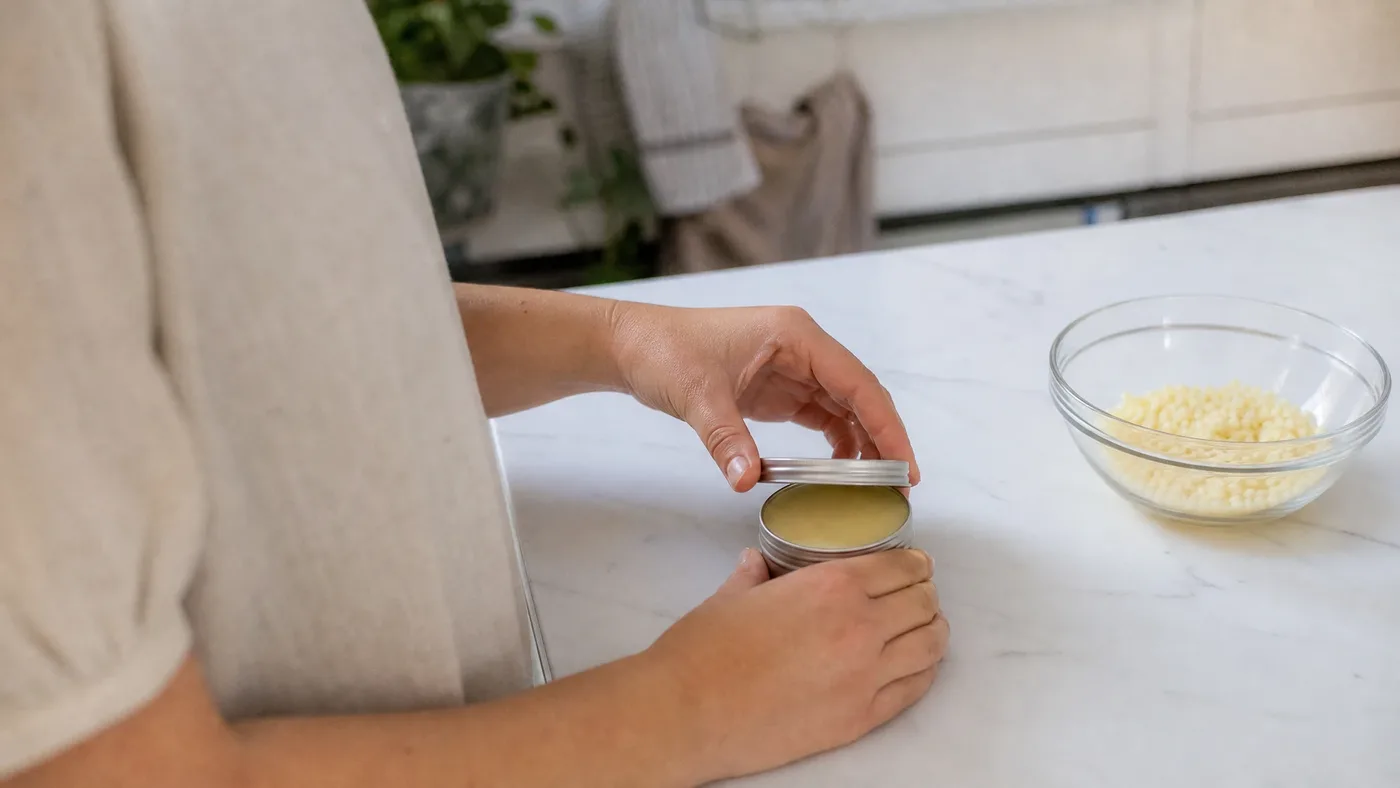
DIY Clove Oil Balm: Dose Arithmetic and Why We Cap It at 0.5%
This is a dose calculation for a clove balm, not a tested recipe: we have not made, worn or photographed one, and we sell no wax, butter or carrier oil to build it with. The number we would put at the top is 0.5% clove oil by weight, which is lower than the 2% our product pages allow, because the one published maximum we could verify for clove bud oil is 0.5%. A warming balm feels warm because the oil is irritating the skin, so the dose is the whole question.
Clove Essential Oil
Our own Clove Essential Oil, in sizes from 0.5 oz to bulk.
From $10.99
Shop Now →Which maximum wins
Our pages tell buyers to dilute both oils to 0.5% to 2% in a carrier oil and to patch test. The Tisserand Institute's eugenol article lists the topical maximum for clove bud oil as 0.5%, and says eugenol can be a skin irritant or allergen if not used in proper dilutions. Its page gives no figure for clove leaf oil. The two numbers meet at 0.5%, and 2% is four times the Tisserand figure. When a published maximum and a general range disagree, the lower one is the safer ceiling for a leave-on balm, so that is where this arithmetic stops. Our leaf oil has no verified maximum of its own, so, reasoning from the fact that it comes from the same tree and that we have no better figure, we would hold it to the same 0.5%.
For scale: our published GC-MS report for the bud oil lists 73.57% eugenol, so a balm at 0.5% bud oil carries about 0.37% eugenol and one at 2% would carry about 1.47%. We publish no GC-MS report for the leaf oil, so we cannot give the same figure for it.
The arithmetic, and why drops are the weak link
Dilution by weight is a one-line sum: oil grams = batch grams x 0.005. The table shows it for three batch sizes.
| Finished balm | Clove oil at 0.5% | Same oil in drops (20 to 40 per ml) |
|---|---|---|
| 30 g | 0.15 g | about 3 to 6 |
| 60 g | 0.30 g | about 6 to 12 |
| 100 g | 0.50 g | about 10 to 20 |
The drop column is wide on purpose. The Tisserand Institute's drop-size article reports that 20 drops weighed 0.66 g on average in three studies (1999, 2000, 2016), that studies counted about 20 to 40 drops per millilitre, and that its own dilution chart assumes 30 drops per ml. The 20-drops-per-ml convention that home recipes often use sits at the low end of that range, so a table built on it and one built on the Institute's chart already differ by half. We treated 1 ml as roughly 1 g, which is an approximation for any essential oil.
The consequence is concrete. In a 30 g batch, one extra drop weighing 0.033 g (Tisserand's average, 0.66 g over 20 drops) adds about 0.11 percentage points, taking 0.5% to roughly 0.61%. A drop at the large end of the range, about 0.05 g, takes it to 0.67%. A drop is never a precise measure, as the Institute says, even though it calls averages fine for ordinary use. For a skin-sensitiser we would weigh the oil on a scale that reads to 0.01 g, or make a larger batch so that rounding matters less. We have not done either; this is the sum, not a result.
Why a warming balm feels warm
Yang and colleagues (J Dent Res, 2003) reported that eugenol activates the vanilloid receptor VR1, the receptor capsaicin acts on, in cultured cells and in trigeminal neurons, and that two blocking agents abolished the effect. That was a laboratory study of eugenol alone. The Tisserand Institute's dilution guide says oils such as clove (eugenol) and cinnamon (cinnamaldehyde) tend to be irritant because their constituents activate TRP channels. Reasoning from both, the heat you feel is a sensory-nerve response that irritates, not a sign the balm is doing something to the tissue underneath. A balm that feels hot is warning you, and the AAD's advice for skin-care products is to stop one that stings or burns unless a dermatologist prescribed it. We make no claim that this sensation helps any muscle or joint, and no trial we have read shows that it does.
Patch testing, and where sources disagree on it
We say to patch test because it is on our product pages and is standard advice. The Tisserand Institute's irritation and allergy page is less enthusiastic: it says patch testing is not 100% reliable, that false positives and negatives occur, and that intensive testing can occasionally trigger a reaction that would not otherwise have happened. It also says that allergic reactions may persist for days or weeks and that sensitisation generally lasts for life. Our reading is that a patch test on a small area of intact skin is a sensible minimum and not a guarantee. If you have eczema, reactive skin or a history of fragrance allergy, ask a dermatologist before any clove product.
How likely is a reaction at all? In the IVDK data (Uter et al., Contact Dermatitis, 2010), clove oil was positive in 1.5% of patients patch tested with it at dermatology clinics in 2000 to 2008. Those were referred patients, so it is not a rate for everyone. A 2016 review (de Groot and Schmidt, Dermatitis) reported that most essential-oil reactions follow use of undiluted oils or high-concentration products, which is the reason for the low ceiling above.
Where this balm should not go
- Face, eyes, lips and mouth: our oils are for aromatic and cosmetic use and not for the mouth, so this is not a lip balm. See why we keep clove off faces.
- Broken, burnt, inflamed or freshly shaved skin.
- Children and babies: our bud page says to keep the oil away from children. Pets as well.
- Anyone who has reacted to clove, cinnamon, fragrance or dental products containing eugenol.
For muscle or joint pain, a pharmacist or physician is the person to ask. We sell neither a balm nor any product for pain.
The base, the shelf life and the label
The clove arithmetic does not depend on the base. How firm the balm sets depends on the share of wax, and we have no tested ratio to give, so use a formulating reference or your supplier's sheet and apply the oil sum to the finished weight. Our stated shelf life is for the unopened oil: typically 3 to 5 years for the bud oil and 4 to 5 years for the leaf oil, stored cool and dark. A balm has no such figure from us. Reasoning from how mixtures behave, it will not outlast its shortest-lived ingredient, so date it by your carrier oil's best-before date and not by ours.
If you give it away it is a home project. If you sell it, the FDA's rules apply. Its labeling summary requires an ingredient declaration on cosmetics produced or distributed for retail sale to consumers, a net quantity statement, the name and place of business of the marketer, and label warnings and directions for safe use where a product may be hazardous when misused. The FDA's personal-care Q&A adds that products intended to affect the body's structure or function, or aimed at a disease, are drugs even if they also change appearance, so a "muscle balm" claim moves a product out of the cosmetic category. The same Q&A says cosmetic companies are legally responsible for the safety of their products and ingredients. The page we read did not say how those rules apply to one-off person-to-person sales, so check with the FDA or a regulatory adviser if you plan to sell.
For the dilution mechanics behind this, read how to dilute clove oil, the carrier-oil shortlist and clove oil side effects. If you want clove in a grooming product at a similar dose, our beard oil piece sits next to this one.
Clove Essential Oil
Clove Essential Oil from our own shop, in sizes from 0.5 oz to bulk.
From $10.99
Shop Now →Sources & Further Reading
- Tisserand Institute. Eugenol: essential oil constituents in food, part 4. tisserandinstitute.org/eugenol
- Tisserand Institute. How big is a drop? tisserandinstitute.org/drop-size
- Tisserand Institute. Dilution for essential oils. tisserandinstitute.org/dilution-essential-oils
- Tisserand Institute. Irritation and allergic reactions. tisserandinstitute.org/irritation-allergic-reactions
- Yang BH et al., 2003. Activation of vanilloid receptor 1 (VR1) by eugenol. PMID 14514756
- Uter W et al., 2010. Contact allergy to essential oils: IVDK results 2000-2008. PMID 20946456
- de Groot AC, Schmidt E, 2016. Essential oils, part IV: contact allergy. PMID 27427818
- American Academy of Dermatology. Wrinkle remedies. aad.org/wrinkle-remedies
- FDA. Summary of cosmetics labeling requirements. fda.gov/summary-cosmetics-labeling-requirements
- FDA. Cosmetics safety Q&A: personal care products. fda.gov/cosmetics-safety-qa