
Clove Oil for Wrinkles: What the Evidence Shows and Doesn't
Clove oil does well in antioxidant lab tests, and that fact is the whole reason it shows up in anti-aging articles. It is not evidence that it changes wrinkles, and we do not recommend clove bud or clove leaf oil on the face. Eugenol, the compound that makes up most of both oils, is a recognised skin sensitiser, and the face is where a reaction is hardest to hide.
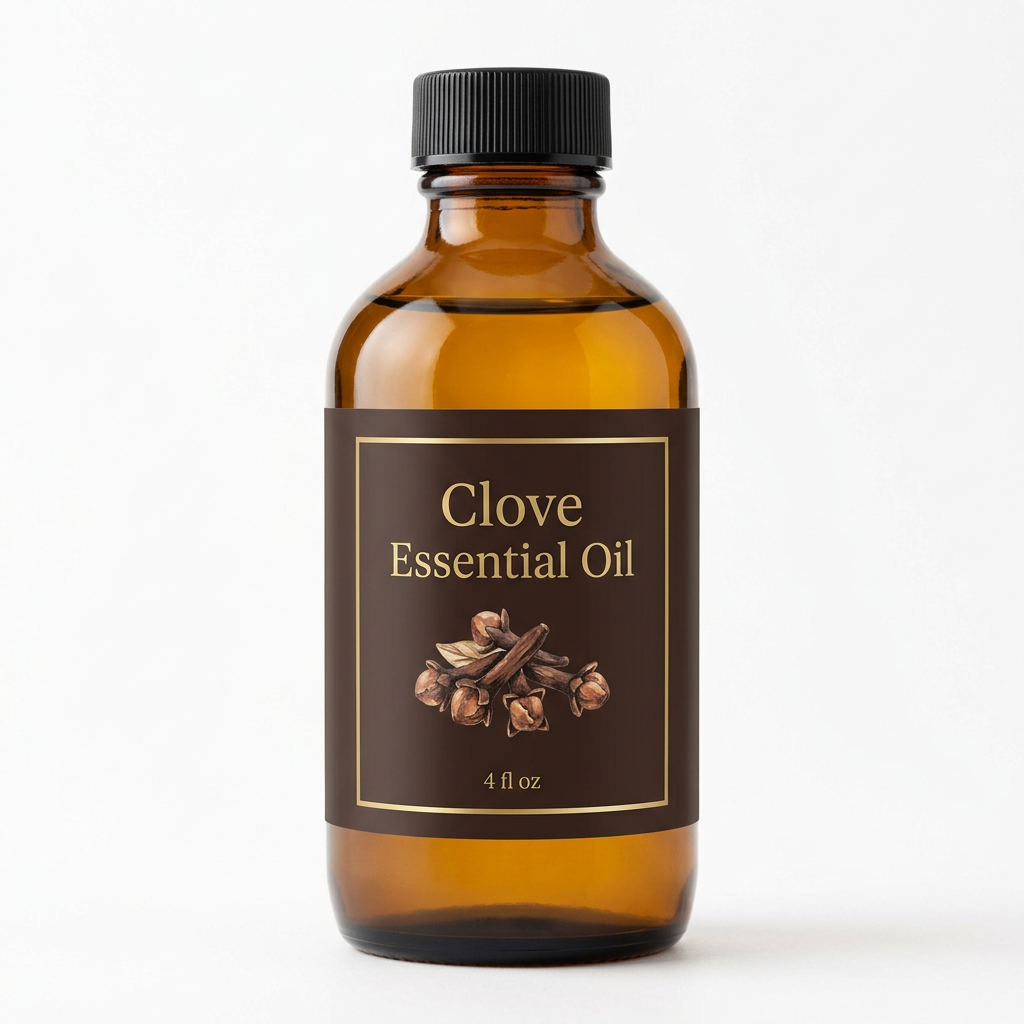
Clove Essential Oil
Our own Clove Essential Oil, in sizes from 0.5 oz to bulk.
From $10.99
Shop Now →What an antioxidant number does and does not tell you
The antioxidant results for clove are real. A 2012 review of eugenol (Kamatou, Vermaak and Viljoen, Molecules) collects them: clove oil with a DPPH IC50 of 8.85 micrograms per millilitre, eugenol alone at 46.6 micromolar, and eugenol at 5 to 25 microlitres inhibiting 41 to 93% of DPPH radicals and 39 to 62% of hydroxyl radicals. These come from test-tube assays on chemicals in solution. Nothing in them involves skin, wrinkles or a person.
The ORAC score, the number sellers quote most, has an official verdict. In 2012 the US Department of Agriculture removed its ORAC database, citing, as Nutraceuticals World reported, "mounting evidence that the values indicating antioxidant capacity have no relevance" to the effects of bioactive compounds in the body, routine misuse of the values to promote products, and results from different ORAC versions that "are not comparable". That is the USDA speaking about foods and supplements, so applying it to an essential oil is an inference. It still shows why a high lab score cannot stand in for a skin outcome.
What we looked for, and what exists
On 2026-10-23 we searched Europe PMC for clove oil or clove essential oil together with wrinkle, wrinkles or skin elasticity. It returned 96 records. We read the titles of the eight top-ranked results, and none was a human trial of clove oil on wrinkles. We did not go through all 96, so this means "we did not find one", not "none exists".
The closest thing we found is Geng and colleagues (Nutrients, 2024), from China Agricultural University and Mokpo National University. They fed isoeugenol, not clove oil and not eugenol, to female hairless mice exposed to chronic UVB light, and also tested it on cultured human dermal fibroblasts. The mice that received it had fewer wrinkles, less dryness and less collagen loss than the UV-exposed comparison group. Four things stand between that result and a face cream. The animals swallowed the compound in their diet; the molecule is isoeugenol, which the authors describe as the primary aromatic compound isolated from clove oil, while our published GC-MS report for the bud oil names eugenol, at 73.57%, as the lead compound; mice are not people; and no leave-on skin product was tested.
The worked number that decides it for us
Take the dilution our own pages give as the top of the range, 2%, and the 0.5% maximum for clove bud oil in the Tisserand Institute's eugenol article. Use our bud report's 73.57% eugenol. At 0.5% oil the finished product holds 0.005 x 0.7357 = 0.00368, or 0.37% eugenol, which is 3,680 parts per million. At our 2% upper figure it is 1.47%, or 14,700 ppm.
Now compare. The EU treats eugenol as a fragrance allergen. The European Commission's layperson summary of the scientific committee's perfume-allergy opinion places eugenol on its list A of the 13 most frequently reported, well-recognised consumer allergens, and describes limits of 0.001% for leave-on and 0.01% for rinse-off products, a "pragmatic administrative decision" made when there were insufficient data to set thresholds. 0.001% is 10 ppm. Reasoning from our own arithmetic, a face product at the Tisserand maximum carries about 368 times the leave-on concentration the EU uses as its reference point for naming a single allergen on a label. The comparison is ours; the EU figure is a labelling concentration, not a safety limit, and no regulator states a cut-off for eugenol on faces. It does make clear that the amount in a clove-oil product is not a trace.
The Tisserand Institute's dilution guide gives general ranges of 0.2 to 1% for sensitive or impaired skin and 0.5 to 1.2% for the face and underarms, and names clove (eugenol) among the oils that tend to be irritant. Where a general range and an oil's own maximum disagree, the lower number wins, which for clove bud is 0.5%. The same guide says allergic reactions can be lasting: you may never be able to use that substance again.
How common reactions are, and where sources disagree
In a German, Austrian and Swiss clinic network (Uter et al., Contact Dermatitis, 2010), 637 of 15,682 patients tested with essential oils between 2000 and 2008 reacted to at least one, and clove oil was positive in 1.5%. The Kamatou review quotes an older industry survey (Rothenstein et al., 1983) of 11,632 patch tests from fragrance companies concluding that eugenol and clove leaf oil have very low potential at concentrations found in consumer products. The two do not conflict: the clinic patients already had skin problems, and the 1983 data describe low concentrations in finished goods. Neither dataset describes a product at 0.37% eugenol applied daily to the face.
What does have evidence for wrinkles
The American Academy of Dermatology's wrinkle page says to use a sunscreen or facial moisturiser with broad-spectrum protection and an SPF of at least 30, and notes that moisturising "traps water in the skin, which can help reduce the appearance of some fine lines". It says most products take at least six weeks to work and sometimes up to three months, that you should stop a product that stings or burns unless a dermatologist prescribed it, and that a board-certified dermatologist is the person to see if results are lacking. For prescription options, a 2024 systematic review (Siddiqui et al., Am J Clin Dermatol) of 25 studies calls topical tretinoin the gold-standard therapy for photoaging while noting that its tolerability often limits use and that most comparison studies were of poor quality. That is a dermatologist's decision. We sell neither sunscreen nor tretinoin, and we sell only the two clove oils.
The claims boundary, if you make products
The FDA's wrinkle-treatment page says a product intended to remove wrinkles or increase the skin's collagen production is a drug or medical device even if sold as a cosmetic, while "moisturizing is a cosmetic claim". Cosmetics need no FDA approval before marketing, but the company is legally responsible for their safety. That is why a clove "anti-aging serum" cannot honestly be sold as the thing its buyers imagine, and why this site has never described either oil that way.
Who should skip this
Everyone looking for a facial anti-aging product. If you already use clove oil on the body at a low dilution, keep it off the face, eyes and any skin that is broken, burning or already reacting. If a product stings or reddens your skin, stop it, as the AAD advises. For persistent redness or a rash, see a dermatologist. For how clove behaves on skin at all, read clove oil for skin, clove oil side effects and how to dilute clove oil. What our oils are good for is scent: warm and sweetly spicy in the bud oil, bolder and smokier in the leaf oil.
Clove Essential Oil
Clove Essential Oil from our own shop, in sizes from 0.5 oz to bulk.
From $10.99
Shop Now →Sources & Further Reading
- Kamatou GP, Vermaak I, Viljoen AM, 2012. Eugenol: from the Maluku Islands to the international market place. Molecules. PMID 22728369
- Nutraceuticals World, 2012. ORAC database withdrawn (reporting the USDA statement). nutraceuticalsworld.com/orac-database-withdrawn
- Geng R et al., 2024. Dietary isoeugenol supplementation attenuates chronic UVB-induced skin photoaging in mice. Nutrients. PMID 38398805
- Tisserand Institute. Eugenol: essential oil constituents in food, part 4. tisserandinstitute.org/eugenol
- Tisserand Institute. Dilution for essential oils. tisserandinstitute.org/dilution-essential-oils
- European Commission, Scientific Committee. Perfume allergies (layperson summary). ec.europa.eu/perfume-allergies
- Uter W et al., 2010. Contact allergy to essential oils: IVDK results 2000-2008. PMID 20946456
- Rothenstein AS et al., 1983. Eugenol and clove leaf oil: consumer patch-test sensitization. PMID 6686576
- American Academy of Dermatology. Wrinkle remedies. aad.org/wrinkle-remedies
- Siddiqui Z et al., 2024. Comparing tretinoin to other topical therapies in skin photoaging: a systematic review. Am J Clin Dermatol. PMID 39348007
- FDA. Wrinkle treatments and other anti-aging products. fda.gov/wrinkle-treatments
- FDA. FDA authority over cosmetics. fda.gov/fda-authority-over-cosmetics