Clove Oil for Mold: What EPA Says and What the Labs Show
If you have mold in the house, the oil you put on it is the least important decision you will make. EPA's guidance puts the whole job in a different place: find the water, fix it, clean or remove the mold, and call a professional when the patch is large. We sell clove bud and clove leaf oil for aroma and cosmetic use. We make no mold-removal claim for either, and we are not going to give you a spray ratio for one.
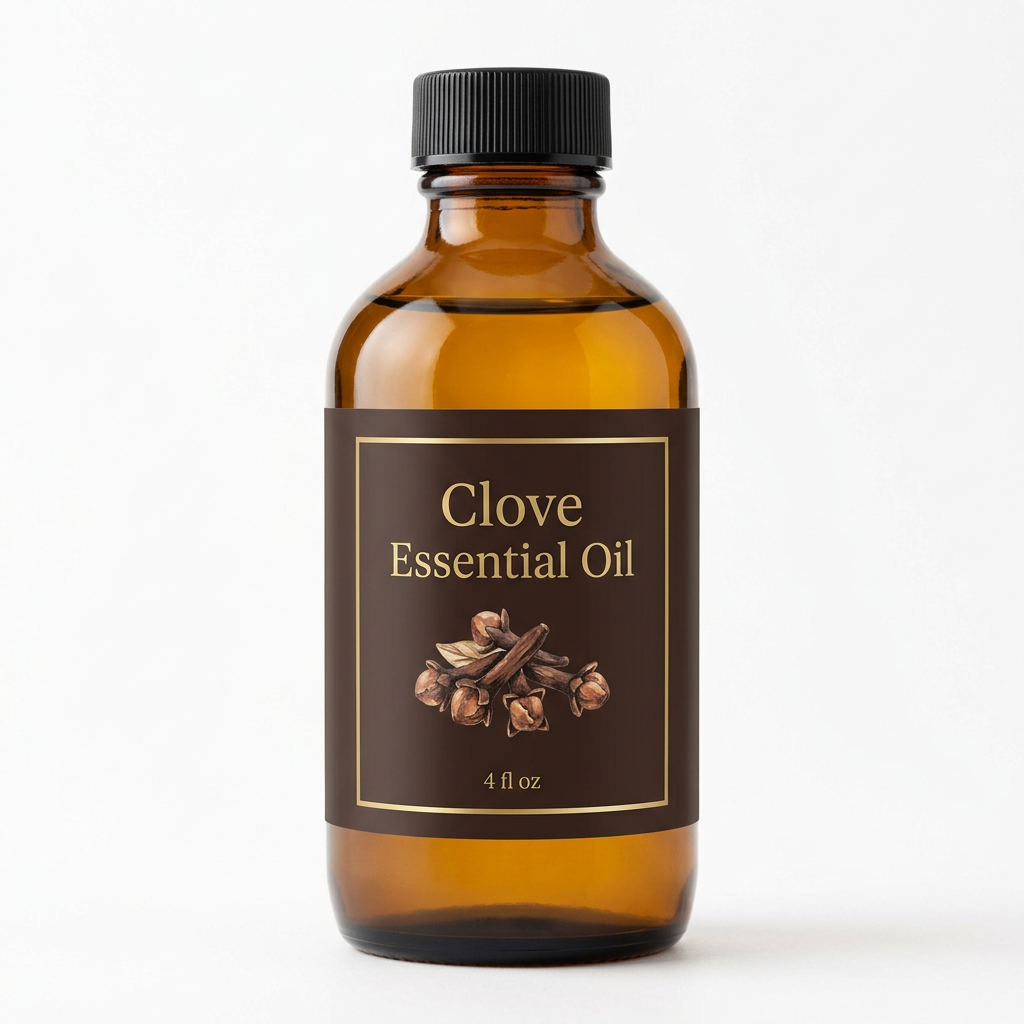
Clove Essential Oil
Our own Clove Essential Oil, in sizes from 0.5 oz to bulk.
From $10.99
Shop Now →What EPA says comes first
EPA's "A Brief Guide to Mold, Moisture and Your Home" is blunt about the order of operations. Its central statement is that the key to mold control is moisture control. If mold appears, clean it up promptly and fix the water problem, because cleaning alone usually lets it return. Water-damaged areas and items should be dried within 24 to 48 hours, and indoor relative humidity should be kept below 60%, ideally between 30% and 50% (EPA, brief guide).
The same guide says a biocide such as chlorine bleach is not recommended as a routine practice during mold cleanup, and that killing mold is not enough: dead mold can still cause allergic reactions, so it must also be removed. That second point is the one that undermines the whole "natural mold killer" idea before any oil is involved. An oil that inhibits growth does not take the mold away.
EPA's home cleanup page adds practical specifics: scrub mold off hard surfaces with detergent and water and dry completely; absorbent or porous materials such as ceiling tiles and carpet may have to be thrown away if they become moldy; and small patches of about 10 square feet or less can usually be handled by the household, while larger areas or significant water damage point to EPA's remediation guidance for bigger jobs (EPA, mold cleanup in your home). Reasoning from that threshold, 10 square feet is the line where EPA stops treating this as a household job. If someone in the household has asthma, allergies or a weakened immune system, ask a physician or the building's remediation professional before cleaning anything yourself.
What the clove oil lab data actually show
The studies that get quoted for "clove oil antifungal" are mostly dish or food-science studies. One we read in detail: Muñoz Castellanos and colleagues (International Journal of Microbiology, 2020) tested clove essential oil against two plant pathogens, Fusarium oxysporum and Aspergillus niger, on agar at 100 to 500 ppm. A. niger grew 7.23 cm across in the control and 0 cm at 400 ppm and above; F. oxysporum reached full inhibition only at 500 ppm. Then they sprayed wounded tomato fruit at 350, 400 and 450 ppm, with three replicates per treatment, and the text reports that the clove oil did not clearly inhibit either fungus on the fruit. The authors blamed matrix, pH and uneven distribution for the gap between dish and fruit. The paper also has internal inconsistencies between abstract, text and tables that we flagged while reading, so treat its figures as indicative (Muñoz Castellanos et al., 2020).
Put that in your own terms. 400 ppm is about 0.04%, a tiny dose in agar. Yet the same oil failed to clearly beat the fungus when it sat on a surface with its own chemistry. A wall, a grout line, a shower curtain or a bit of drywall is a stranger surface than a tomato. No source we read tested clove oil against the mold species that grow on indoor building materials in a real room. The strongest honest statement is that clove oil is an inhibitor of some fungi in laboratory media and an unreliable one on a real surface.
The regulatory angle
Clove oil is on the EPA's list of permitted active ingredients for exempt "minimum risk" pesticide products under 40 CFR 152.25(f). One of the conditions is that such a product must not bear claims to control or mitigate microorganisms that pose a threat to human health. Whether a particular mold claim crosses that line is a question for EPA or a state pesticide regulator, not for us (40 CFR 152.25). What matters here: our oils are aromatic-use products, not registered or exempt pesticide products with mold labels, and nothing on our site says otherwise.
Why we will not write the spray recipe
- The concentration problem. The Tisserand Institute gives a recommended topical maximum for clove bud oil of 0.5% and says eugenol can be an irritant or allergen when not properly diluted (Tisserand Institute). That is a skin figure, not a surface or air figure, but it shows how strong the material is. A water-based spray also needs an emulsifier, because oil does not dissolve in water, and we have no tested formulation to offer.
- Surfaces. Reasoning from the fact that clove oil is a concentrated spice oil, an undissolved droplet could mark a porous surface. We have not tested this on any material, so try a hidden spot of any surface first.
- Air and sensitive people. A phenol-heavy oil sprayed in a damp room is an inhalation question for asthmatics, children and pets. Our safety basics guide covers who should keep clove away.
The point is not that clove oil is dangerous when diffused as the label says; it is that any application beyond that is a larger decision than this article can make for you.
What an aroma oil may do in a clean room
Where clove belongs in a cleaning cabinet is scent: a spiced note in a cleaner you have already built around detergent and water. That angle is in our natural cleaning piece, with the same caution about what a scent does not do. For other non-fragrance hobby uses, see the garden shed guide, and for another evidence check on a pest-adjacent claim, our mosquito article.
The practical order of operations
- Find and stop the water source. Dry wet materials within 24 to 48 hours.
- Measure the patch. About 10 square feet or less: household cleanup per EPA. More, or with water damage: professional remediation.
- Scrub hard surfaces with detergent and water and dry them. Replace porous materials that stay moldy.
- Keep humidity between 30% and 50%.
- If you want your clean room to smell like clove, add the aroma after all of that.
Verdict: no oil, ours or anyone's, replaces moisture control, and the clove studies are too far from a real wall to rest a decision on.
Clove Essential Oil
Clove Essential Oil from our own shop, in sizes from 0.5 oz to bulk.
From $10.99
Shop Now →Sources & Further Reading
- US EPA. A brief guide to mold, moisture and your home. epa.gov/mold/brief-guide
- US EPA. Mold cleanup in your home. epa.gov/mold/mold-cleanup-your-home
- Muñoz Castellanos L, et al., 2020. In vitro and in vivo antifungal activity of clove and pepper essential oils and functional extracts against Fusarium oxysporum and Aspergillus niger in tomato. Int J Microbiol. pmc.ncbi.nlm.nih.gov/PMC7211242
- US EPA / eCFR. 40 CFR 152.25, exemptions for pesticides of a character not requiring FIFRA regulation. law.cornell.edu/cfr/text/40/152.25
- Tisserand Institute. Eugenol: essential oil constituents in food, part 4. tisserandinstitute.org/learn-more/eugenol