Does Clove Oil Repel Mosquitoes? What Two Studies Measured
Clove oil does repel mosquitoes in controlled tests, and the lab numbers are better than most people expect. The catch is the concentration those numbers come from: strengths far above what any authority recommends putting on skin. We sell clove bud and clove leaf oil for aroma and cosmetic use, we make no repellent or disease-protection claim for them, and this page is about what two studies actually measured.
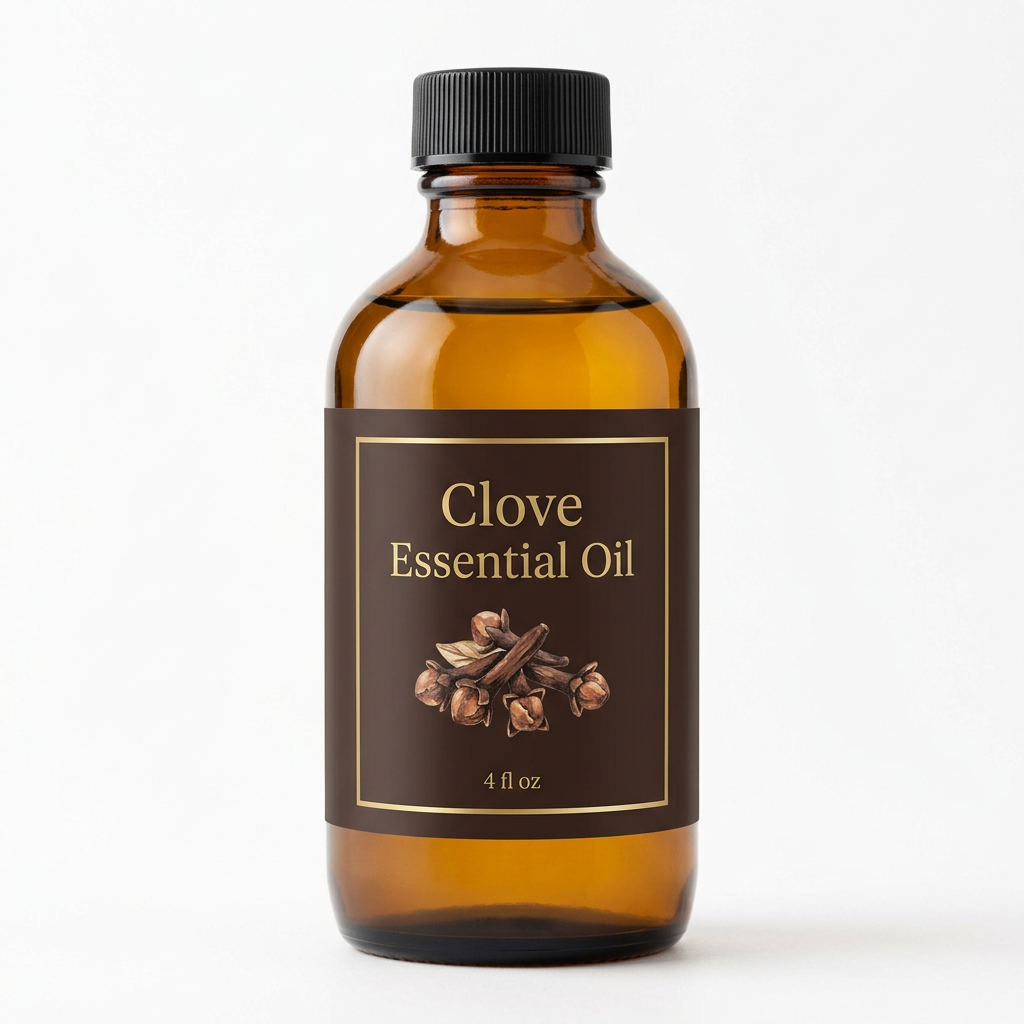
Clove Essential Oil
Our own Clove Essential Oil, in sizes from 0.5 oz to bulk.
From $10.99
Shop Now →Study one: the undiluted oil that lasted 2 to 4 hours
The study everyone cites is Trongtokit, Rongsriyam, Komalamisra and Apiwathnasorn, published in Phytotherapy Research in 2005, from Mahidol University in Thailand. They screened 38 essential oils on human volunteers against the yellow fever mosquito (Aedes aegypti) in laboratory conditions, applying 0.1 ml of oil per 30 cm² of forearm skin. The findings as reported in the abstract:
- At 10% or 50% dilution, no oil gave two hours of protection from bites.
- Undiluted citronella, patchouli, clove (Syzygium aromaticum) and makaen oils gave two hours of complete repellency.
- Those four were then tested against Culex quinquefasciatus and Anopheles dirus. Undiluted oil protected best, and clove gave the longest period of 100% repellency, 2 to 4 hours, across all three mosquito species (Trongtokit et al., Phytother Res, 2005).
Read the second bullet again. In that trial, 50% clove oil did not reach the two-hour mark. Only the neat oil did. We read the abstract, not the full paper, so we cannot tell you the volunteer numbers or the clove dilution results in detail.
Study two: a lotion base and a plateau
A newer paper took the opposite design: oils diluted in a lotion. Lopez and colleagues (Hansen laboratory, New Mexico State University; Insects, January 2025; supported by NIH grant R35GM144049) used an arm-in-cage assay adapted from an EPA test guideline, with 25 unfed Aedes aegypti females per cage and 4 to 5 human volunteers per group. Each application was 170 microlitres in an organic lotion base. Clove oil was tested at 1, 3, 4, 5 and 10%. The reported results:
- Protection rose sharply around 4%, with a fitted EC50 of 4.3%.
- 10% clove oil protected for about the same time as 5%, so the authors suggest 5% as the best concentration in that carrier.
- The paper cites the same group's earlier work reporting a mean complete protection time of 111.45 minutes for 10% clove oil, and 6 hours for DEET, when that earlier experiment was stopped.
- Eugenol alone, the main compound, gave a complete protection time statistically similar to clove oil at 10%; eugenyl acetate at 10% was not distinguishable from the lotion-only control (Lopez et al., Insects, 2025).
Both studies used one mosquito genus in the main protocol (Aedes), small human panels and short, controlled exposures. Neither is a field trial in a swamp or a forest at dusk.
What that means in a real bottle: the arithmetic
Reasoning from the numbers above, set them against the skin guidance. The Tisserand Institute gives a recommended topical maximum for clove bud oil of 0.5% and says eugenol can irritate or sensitise skin when not properly diluted (Tisserand Institute, eugenol). Our own pages say to dilute to 0.5% to 2% and patch test. The comparison:
| Source | Clove concentration | Result or limit |
|---|---|---|
| Trongtokit 2005 | Undiluted (100%) | 2 to 4 hours of complete repellency |
| Lopez 2025 (lotion) | 5% | Plateau near this strength |
| Our product pages | 0.5% to 2% | Dilution range for cosmetic use |
| Tisserand Institute | 0.5% | Recommended topical maximum, clove bud |
In 30 ml of lotion, 5% is 1.5 ml of oil, ten times the 0.15 ml you get at Tisserand's 0.5%, and 2.5 times the 0.6 ml at 2%. The undiluted figure is two hundred times Tisserand's. The effective strengths sit on the wrong side of the safety line, and we are therefore not publishing a "mosquito spray" recipe: the repellency data and the skin guidance do not overlap. That is a position, not a gap in the arithmetic.
The regulatory trap: repellent claims and the exempt category
Clove oil appears in Table 1 of 40 CFR 152.25(f), the EPA's exemption for "minimum risk" pesticide products, as a permitted active ingredient. One condition in that rule is that the product must not bear claims to control or mitigate microorganisms that threaten human health, which includes claims about insects or rodents that carry specific diseases, including ticks that carry Lyme disease (40 CFR 152.25, Legal Information Institute). The rule has more conditions than that one, and what a particular label may say is a question for EPA or your state pesticide regulator. What matters to a buyer: a bottle of aroma oil is not that, and we do not market ours as a repellent.
The CDC lists the EPA-registered active ingredients it recommends: DEET, picaridin, IR3535, oil of lemon eucalyptus, para-menthane-diol and 2-undecanone, and says it and EPA do not know how effective non-registered repellents are, including some natural ones (CDC, preventing mosquito bites). The page also advises against products containing oil of lemon eucalyptus or PMD on children under 3. EPA says registration means the company gave EPA technical information on a product's safety and its effectiveness against mosquitoes and/or ticks (EPA, find the repellent right for you). Clove oil is not on the CDC list. If a mosquito-borne disease is a concern where you live or travel, a travel clinic or physician is the person to ask, and an EPA-registered product is the answer on the CDC's page, not an essential oil.
Where an aroma oil may still fit
Diffusing clove oil outdoors on a porch is a scent decision. Neither study tested a diffuser, a candle or room air, so there is no basis here for expecting any effect on insects. For garden-shed uses and the limits of those, see our garden shed guide; for bites that have already happened, see our insect bites piece; for the broader picture, our myths and facts post.
Who should skip this idea entirely
Children, anyone pregnant or breastfeeding, anyone with eczema, a fragrance allergy or broken skin, and pet owners considering any essential oil on a pet or its bedding. See our side effects article for the skin-reaction picture. For a child, ask a pediatrician; for a pet, ask a veterinarian.
The verdict: the lab data are real, the strengths are impractical, and the registered alternatives exist for exactly this job.
Clove Essential Oil
Clove Essential Oil from our own shop, in sizes from 0.5 oz to bulk.
From $10.99
Shop Now →Sources & Further Reading
- Trongtokit Y, Rongsriyam Y, Komalamisra N, Apiwathnasorn C, 2005. Comparative repellency of 38 essential oils against mosquito bites. pubmed.ncbi.nlm.nih.gov/16041723
- Lopez AD, Whyms S, Luker HA, Galvan CJ, Holguin FO, Hansen IA, 2025. Repellency of essential oils and plant-derived compounds against Aedes aegypti mosquitoes. pmc.ncbi.nlm.nih.gov/PMC11765945
- Tisserand Institute. Eugenol: essential oil constituents in food, part 4. tisserandinstitute.org/learn-more/eugenol
- US EPA / eCFR. 40 CFR 152.25, exemptions for pesticides of a character not requiring FIFRA regulation. law.cornell.edu/cfr/text/40/152.25
- CDC. Preventing mosquito bites. cdc.gov/mosquitoes/prevention
- US EPA. Find the insect repellent that is right for you. epa.gov/insect-repellents