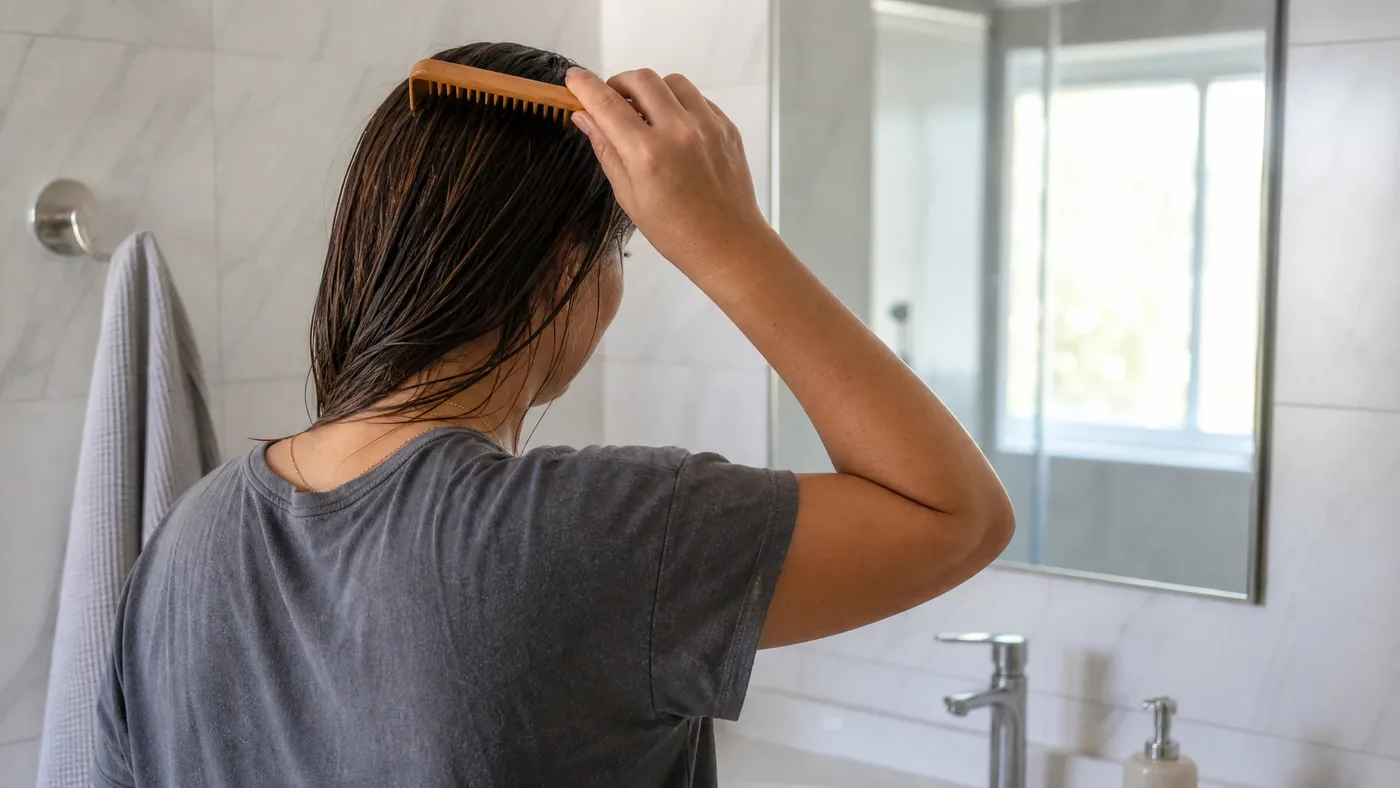
Clove Oil for Hair Growth: What the Evidence Does Not Show
No trial we could find has tested clove oil, clove water or eugenol on human hair growth, so the viral claim rests on borrowed evidence from other plants. We sell clove bud oil and clove leaf oil as aromatic and cosmetic oils, and this page is our honest verdict on the trend: we will not give you a scalp recipe, because the evidence that exists points to a skin-irritation risk and not to a hair benefit.
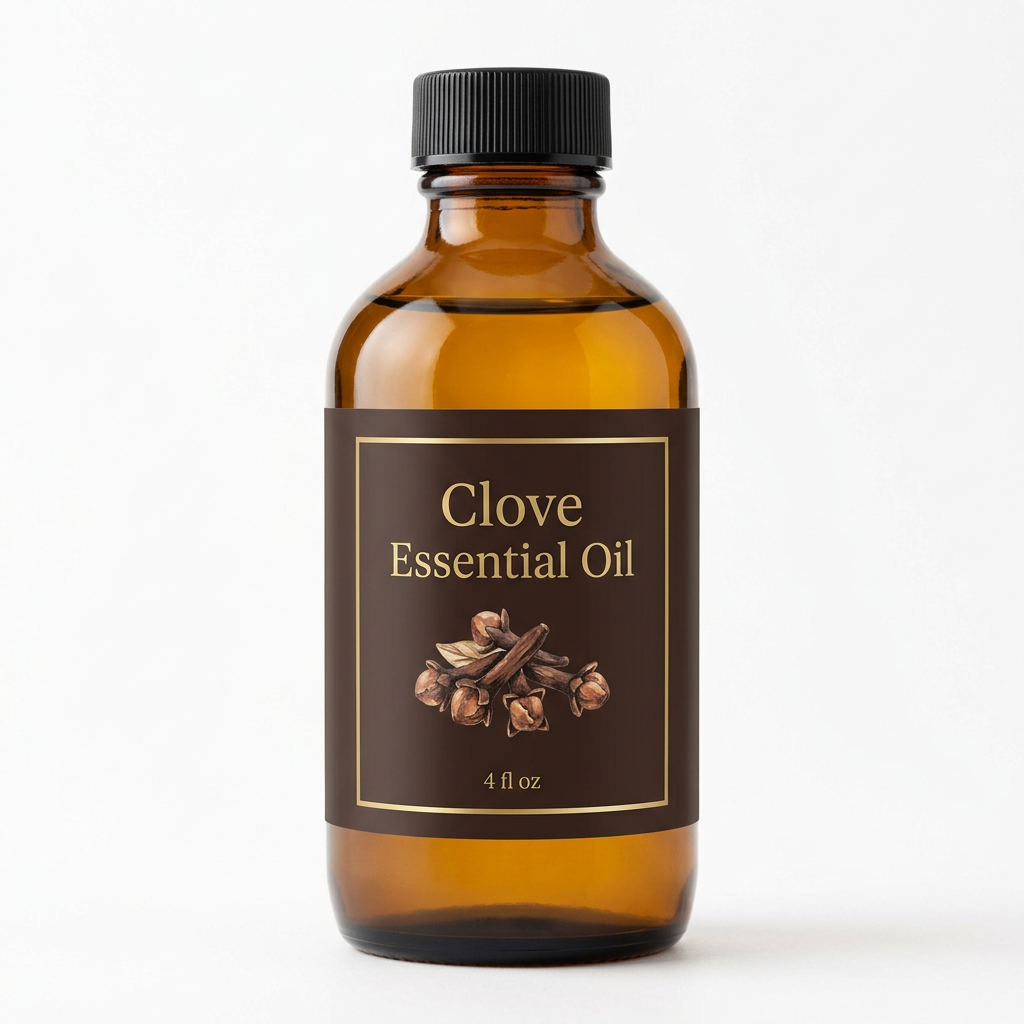
Clove Essential Oil
Our own Clove Essential Oil, in sizes from 0.5 oz to bulk.
From $10.99
Shop Now →What the search actually found
On 2026-10-23 we searched the Europe PMC literature index for clove, Syzygium, or eugenol together with hair growth, alopecia, or hair loss. The broad query returned 642 records, but nearly all were about nanocarriers for other drugs, veterinary skin trials, or antimicrobial assays. A narrower search for "clove" and "hair" or "alopecia" in titles returned only three records, all of them patents for cosmetic compositions (2000, 2008, 2011), not trials. Reasoning from that, the honest statement is "no human trial and no animal hair-growth study located", not "proven not to work". Absence of a trial is a gap, not a verdict on the plant.
Where the trend borrows its credibility
Two studies get cited for essential oils and hair, and neither is about clove.
- Rosemary oil. Panahi et al., Skinmed, 2015 randomised patients with androgenetic alopecia to rosemary oil (n = 50) or minoxidil 2% (n = 50) for six months. Hair counts did not change significantly at three months in either group, rose significantly at six months in both, and did not differ between groups. Scalp itching rose from baseline in both groups and was more frequent with minoxidil. The abstract does not describe blinding or a no-treatment arm, so it cannot separate the oil's effect from natural variation.
- Peppermint oil. Oh et al., Toxicology Research, 2014 used C57BL/6 mice, applying saline, jojoba oil, 3% minoxidil or 3% peppermint oil for four weeks. The peppermint group showed the largest increases in dermal thickness and follicle number and depth. It was a mouse study, so it says nothing direct about people.
Applying either result to clove is an inference with nothing under it: different plant, different chemistry. Clove bud oil is dominated by eugenol; our own published GC-MS report for the bud oil lists 73.57% eugenol and 12.82% eugenyl acetate. Rosemary and peppermint oils are different mixtures. A claim that "essential oils grow hair" generalises across mixtures that behave differently on skin.
Clove water is a different question, and it is also unstudied
Clove water is a water steep of whole cloves. Essential oil is the steam-distilled fraction, mostly volatile and oil-soluble compounds, so the two liquids are not the same material and a study of one does not transfer to the other. Our search turned up no hair study of either. We sell only the oils, not whole cloves or clove water, and we are not recommending a kitchen steep as a substitute; no source we read says it is better or safer.
How to read the next hair-growth claim
Reasoning from the two studies above, four questions sort most claims quickly. Was it people or mice? Was there a comparison against an accepted treatment, or only against nothing? How long did it run: in the rosemary trial nothing was significant at three months, so a claim of results in weeks has no support there. And was the concentration stated, so you can tell what was really applied? A claim that cannot answer these is a story. A mouse result in particular is a hypothesis about people, not a finding about them.
The cost side: eugenol and the scalp
The scalp is thin, vascular skin you cannot easily watch, and clove is a documented skin irritant and sensitiser. The Tisserand Institute's eugenol page says eugenol "can be a skin irritant or allergen if not used in proper dilutions" and gives 0.5% as the recommended topical maximum for clove bud oil, citing Essential Oil Safety, 2nd edition. Our own product pages give a wider 0.5% to 2% range. We cannot reconcile those figures for you, and on a scalp we would use the lower one as the ceiling.
The sensitisation record is real if mixed. A 1983 industry survey of 11,632 patch tests (Rothenstein et al., Food and Chemical Toxicology) on eugenol, eugenol-containing products and fragrance blends found one induced and one pre-existing sensitisation, and concluded the potential at consumer-product concentrations was very low. The data came from fragrance and formulation companies, and eugenol was tested at tiny concentrations (0.05% and 0.09% for the two reactions). Against that, a 1999 case report in Contact Dermatitis describes occupational allergic contact dermatitis from eugenol, cinnamon oil and clove oil in a physiotherapist (we read only the record, which has no abstract). The two do not contradict each other: low induction at low concentration in products is compatible with repeated, handled exposure sensitising an individual. Leave-on scalp use is repeated exposure.
Reasoning from the Tisserand ceiling, a worked number: 0.5% of a 30 ml carrier bottle is 0.15 ml of oil; 2% is 0.6 ml, four times as much. If the lower figure is the right ceiling for skin, a 2% mix on a scalp is four times over it. That is arithmetic, not a recipe, and we have not tested any scalp preparation.
Who should skip this entirely
- Anyone with a history of reacting to fragrance, cinnamon, balsam or dental eugenol products.
- Anyone whose scalp is already red, scaly, sore or itchy; irritation from the oil would be hard to tell from the underlying problem. See our scalp article.
- Anyone losing hair in patches, suddenly, with scarring, pain or a rash. These need a dermatologist; essential oils are not a workup.
What to do if hair loss is the real worry
The American Academy of Dermatology's hair-loss pages list many separate types, including alopecia areata, central centrifugal cicatricial alopecia, female and male pattern hair loss, frontal fibrosing alopecia and traction alopecia, plus causes such as tight hairstyles and some weaves or extensions (AAD, hair loss causes). Some of those are scarring types where time matters, and which type you have decides which treatment applies. That is a dermatologist's call, and we have no dermatologist on staff. Reasoning from the Panahi design, even the one oil with a trial was compared against minoxidil, an actual treatment, not against doing nothing.
If you still want clove in your routine, the straightforward use is the one we sell it for: aroma. Our clove bud oil and clove leaf oil are bottled undiluted for aromatic and cosmetic use, and a scented room is a less risky experiment than a scented scalp. Our dilution guide and carrier-oil shortlist cover skin use in general, and side effects covers what a reaction looks like. We sell no carrier oils or hair products.
Our verdict: skip clove oil on your scalp for hair growth. The upside is unstudied, the downside is documented, and a dermatologist can tell you why your hair is thinning.
Clove Essential Oil
Clove Essential Oil from our own shop, in sizes from 0.5 oz to bulk.
From $10.99
Shop Now →Sources & Further Reading
- Panahi Y et al., 2015. Rosemary oil vs minoxidil 2% for the treatment of androgenetic alopecia: a randomized comparative trial. pubmed.ncbi.nlm.nih.gov/25842469
- Oh JY, Park MA, Kim YC, 2014. Peppermint oil promotes hair growth without toxic signs. pubmed.ncbi.nlm.nih.gov/25584150
- Rothenstein AS et al., 1983. Eugenol and clove leaf oil: a survey of consumer patch-test sensitization. pubmed.ncbi.nlm.nih.gov/6686576
- Sanchez-Perez J, Garcia-Diez A, 1999. Occupational allergic contact dermatitis from eugenol, oil of cinnamon and oil of cloves in a physiotherapist. pubmed.ncbi.nlm.nih.gov/10617221
- Tisserand Institute. Eugenol: Essential Oil Constituents in Food Part 4. tisserandinstitute.org/learn-more/eugenol
- American Academy of Dermatology. Hair loss: causes. aad.org/public/diseases/hair-loss