Oil Pulling with Clove Oil: Weak Evidence, Added Risks
Oil pulling with coconut oil has weak evidence, and adding clove oil to it has none that we could find, plus a short list of documented harms. We sell clove oil, so this is not the verdict that moves bottles, but it is the one the sources support. We will not write a method for it, because our oils are labelled for aromatic and cosmetic use only, never for the mouth.
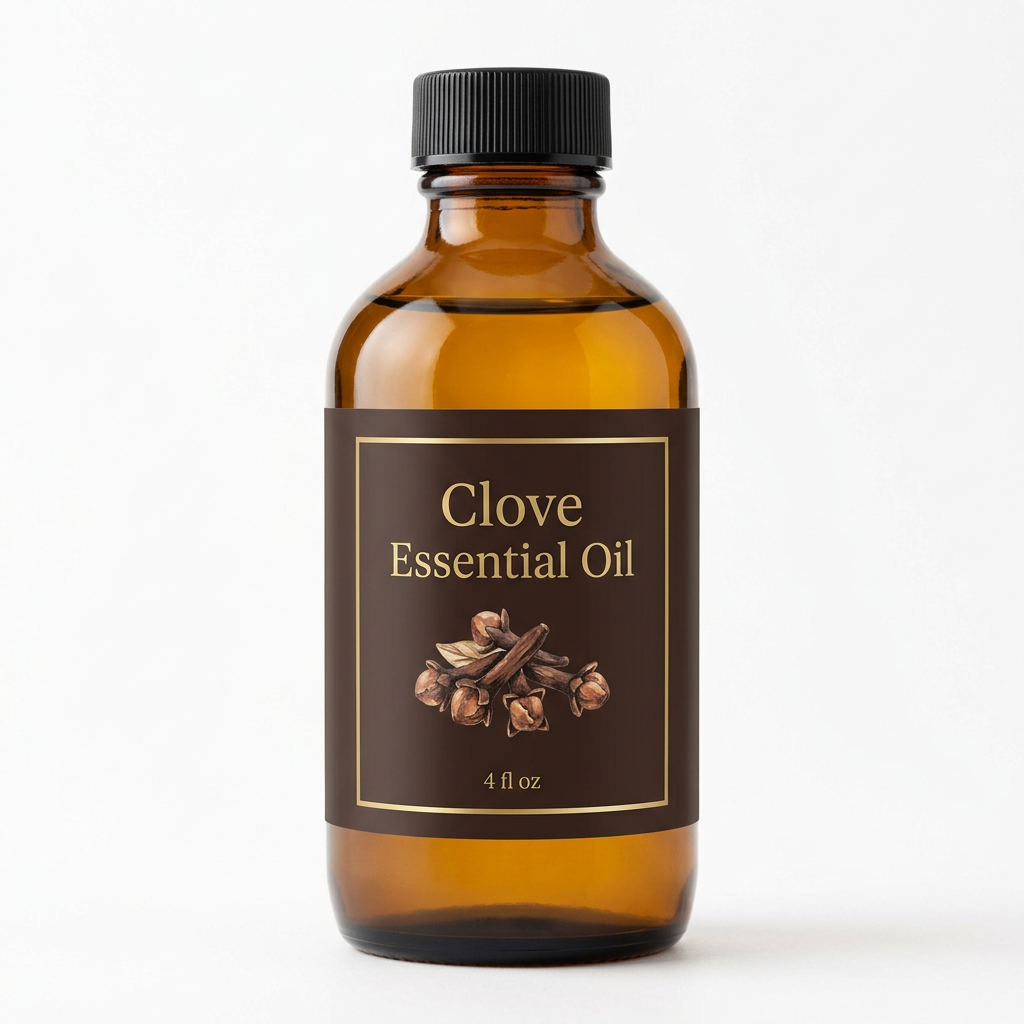
Clove Essential Oil
Our own Clove Essential Oil, in sizes from 0.5 oz to bulk.
From $10.99
Shop Now →Start with the arithmetic of the evidence
The best pooled look at the plain version, Woolley et al., Heliyon, 2020, searched six databases and found 42 potentially eligible studies. Only four were randomised controlled trials of coconut oil pulling, with 182 participants between them, so roughly 45 people per trial. They lasted 7 to 14 days. The review reported significant differences for salivary bacterial colony count (p = 0.03) and plaque index score (p less than 0.001), and one study found less staining than with chlorhexidine (p = 0.0002). The authors then said the data were insufficient for conclusive findings, study quality was mixed and the risk of bias was high. No meta-analysis was possible because the trials were too different.
Read that as: four small, short trials, different designs, a bias problem, and a conclusion of "limited evidence" that oil pulling "may" have a beneficial effect as an adjunct. That is a polite way of saying the question is open. Notice also what the trials measured. Plaque scores and bacterial counts over one or two weeks are stand-ins; none of them followed people for years to see cavities or gum disease.
Where the sources disagree
The American Dental Association is blunter than the review. Its MouthHealthy page says "there are no reliable scientific studies to show that oil pulling reduces cavities," that oil pulling has not been shown to whiten teeth or improve overall oral health, and that "the American Dental Association does not recommend oil pulling as a dental hygiene practice" (ADA MouthHealthy). It tells readers instead to brush twice a day for two minutes with fluoride toothpaste, to floss between teeth once a day and not to use tobacco.
These two positions are less opposed than they look. Woolley's team studied plaque and colony counts in short trials and called the evidence limited; the ADA's statement is about cavities, whitening and overall oral health and says the reliable studies are missing. Both agree the evidence is not good enough to replace anything. We side with the ADA on what to do and with the review on what was measured: a possible small adjunct effect on plaque, unproven for anything that matters long term.
The documented harm of plain oil
Oil in the mouth can end up in the lungs. In a 2015 report in BMC Pulmonary Medicine, Kuroyama et al. described two patients, a 66-year-old man with a dry cough and a 38-year-old woman with shortness of breath, who had ground-glass opacities on chest CT and were diagnosed with exogenous lipoid pneumonia after lipid-laden macrophages were found. Both had habitually done sesame oil pulling, by nose or mouth washing, for several months. The man improved with steroid therapy and bronchoalveolar lavage; the woman needed no intensive therapy. The authors noted this is rarely reported. Two other case reports link oil pulling and lipoid pneumonia, one in Kim et al., 2014 (recurrent) and one in Wong et al., 2018 (two cases).
A handful of patients across three reports is a set of case reports, not an incidence figure. We cannot tell you how common this is, and the authors say it is rare. The honest reading is that a long, repeated routine with a swishing motion has a documented, if uncommon, route to the lungs, and the benefit it is chasing is unproven.
Why adding clove oil changes the risk, not just the flavour
Everything above concerns a bland carrier oil. Clove oil is a different material, and these points are documented:
- Irritation. The UK product information for 100% clove oil dental solution, a licensed product for small, dentist-style use in a tooth cavity, says eugenol can irritate skin and mucous membranes, repeated use may cause gum damage, and patients may become sensitised (emc, Clove Oil BP SmPC). A prolonged swish bathes every mucosal surface, which is a bigger exposure than that label describes. That last step is our reasoning, not a finding.
- Swallowing. A 2005 case report in the European Journal of Pediatrics by Janes et al. describes a 15-month-old with fulminant hepatic failure after swallowing 10 ml of clove oil, with ALT above 13,000 U/l at 24 hours, who improved after N-acetylcysteine. The Tennessee Poison Center gives 5 to 10 ml as the amount at which small children have been affected and describes the oil as about 60 to 90 percent eugenol (Tennessee Poison Center, 2025). Our smallest bottle, 0.5 oz, is about 14.8 ml.
- No trial. We did not find a clinical trial of clove oil added to oil pulling, so any claim for it would be a guess. The coconut oil trials in Woolley's review tell you nothing about a clove-spiked version, and the lung and liver reports do not tell you it is common either.
Who should definitely skip it
Children, anyone with trouble swallowing or a weak cough reflex, anyone with a lung condition, and anyone who has ever reacted to eugenol, clove or Peru balsam. This includes pregnant people; we are not a source for what is appropriate there, so ask an OB-GYN or midwife. If the actual aim is whiter teeth, fresher breath or fewer cavities, a dentist can tell you what is driving the problem and the ADA's brushing and flossing routine is the baseline any experiment should be measured against. A trial result on a plaque score is not a reason to skip a dental check-up, because a dentist can see decay and gum disease that no rinse or oil will reveal. If oil has been swallowed in quantity, call poison control (US: 1-800-222-1222).
What we are glad to help with
Our bud and leaf oils are for scenting a room or, diluted to the 0.5% to 2% range on our product pages in a carrier oil with a patch test, for skin and craft use. If you are choosing a carrier oil for that, our carrier oil shortlist is the place to start. For the mouth questions, see why we do not give a DIY rinse recipe and the oral health overview.
The one-line verdict: coconut oil pulling is an unproven extra with a rare lung risk, and clove oil makes the mouth side riskier without making the evidence any better.
Clove Essential Oil
Clove Essential Oil from our own shop, in sizes from 0.5 oz to bulk.
From $10.99
Shop Now →Sources & Further Reading
- Woolley et al., 2020. The effect of oil pulling with coconut oil to improve dental hygiene and oral health: a systematic review. pubmed.ncbi.nlm.nih.gov/32923724
- American Dental Association, MouthHealthy. Oil pulling. mouthhealthy.org/all-topics-a-z/oil-pulling
- Kuroyama et al., 2015. Exogenous lipoid pneumonia caused by repeated sesame oil pulling: a report of two cases. pubmed.ncbi.nlm.nih.gov/26518258
- Kim et al., 2014. Recurrent lipoid pneumonia associated with oil pulling. pubmed.ncbi.nlm.nih.gov/24429325
- Wong et al., 2018. Exogenous lipoid pneumonia associated with oil pulling: report of two cases. pubmed.ncbi.nlm.nih.gov/30203635
- Janes et al., 2005. Essential oil poisoning: N-acetylcysteine for eugenol-induced hepatic failure. pubmed.ncbi.nlm.nih.gov/15895251
- Tennessee Poison Center, 2025. What is the main toxic component of oil of cloves? vumc.org/poison-control
- Electronic Medicines Compendium, 2014. Clove Oil BP dental solution, summary of product characteristics. medicines.org.uk/emc/product/4817