Four Thieves Oil Recipe: Legend, Real Recipes and Skin Maths
There is no authoritative four thieves oil recipe, because the original was never an oil. Every historical version we could read is herbs steeped in vinegar, and the plague story attached to it is a legend whose city and century change with the teller. We sell clove bud and clove leaf oil and nothing else in the blend people search for, and we are not going to hand you a protocol or a health claim for it.
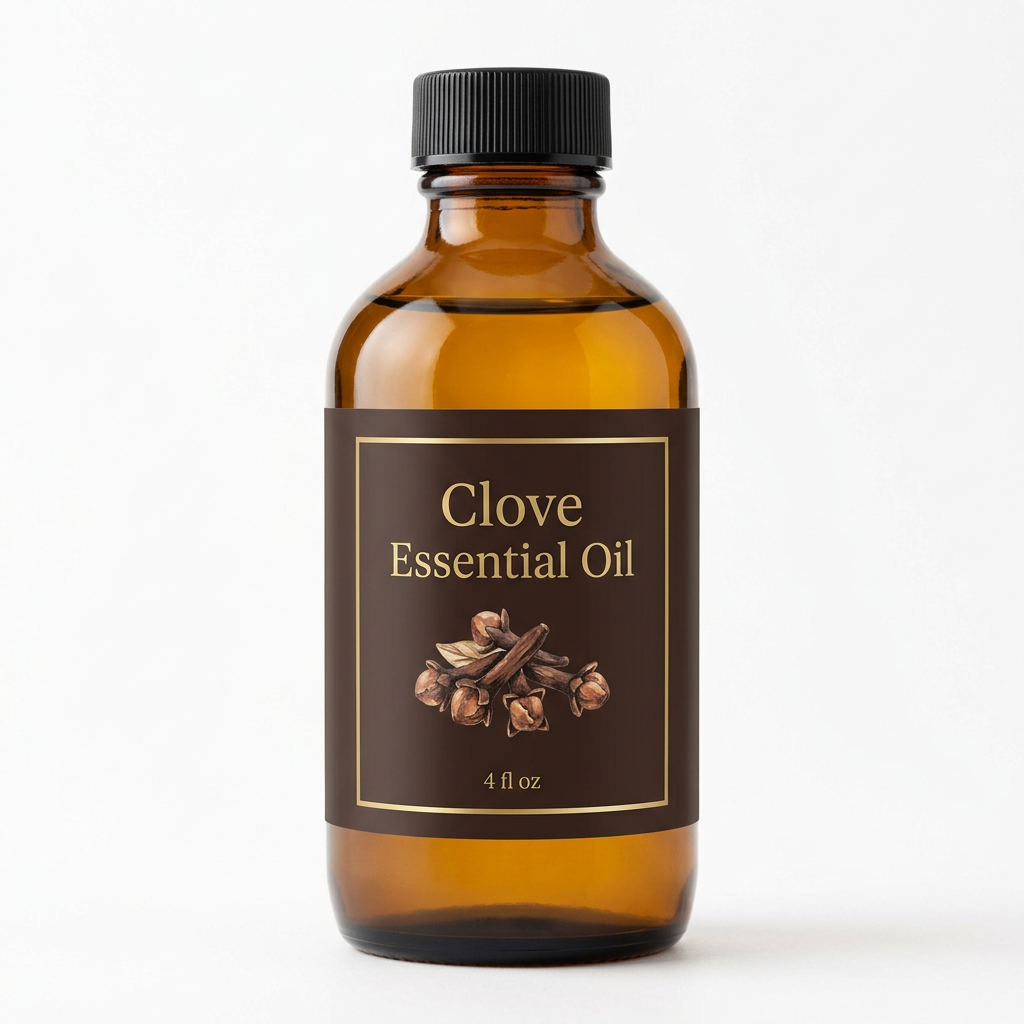
Clove Essential Oil
Our own Clove Essential Oil, in sizes from 0.5 oz to bulk.
From $10.99
Shop Now →What the legend says, and what could be checked
The standard story is that thieves robbed the homes of plague victims without falling ill, and then traded their recipe for leniency. Wikipedia's survey of the sources notes that the setting is Marseille or Toulouse and the date anywhere from the 14th to the 18th century, depending on who tells it, and that a version has the thieves already sentenced to bury the dead. On the podcast Gastropod's episode on vinegar, the host Nicola Twilley calls the story "almost definitely not true, but is fun anyway", and her guest says he cannot tell you who the four thieves were. Neither is a historian's monograph, and we did not find a peer-reviewed history of the legend, so our position is modest: the origin story is unverified, and no source we read documents it.
The dated paper trail is later than the legend. According to the Wikipedia survey, the earliest dated items are a 1741 French medical compendium that seems to credit the English physician George Bates (whose own recipe does not use the thieves name) and a 1760 anecdote about apothecaries in Cheapside advertising the vinegar, printed in a magazine in 1827. It also cites works from 1818 (Orfila) and 1825 (J. A. Paris, Pharmacologia). We could not open any of those books ourselves, so we are reporting a secondary summary of them, and a Google Books page we requested returned no text. The 1937 French aromatherapy book by Rene-Maurice Gattefosse is the usual source for the "original" recipe said to have hung in a Paris museum, and that, too, is a twentieth-century report of a notice said to date from the plague.
What was in it: three recipes, three different lists
The same survey gives the 1937 recipe as three pints of strong white wine vinegar with handfuls of wormwood, meadowsweet, wild marjoram and sage, fifty cloves, campanula root, angelica, rosemary, horehound and camphor, steeped for 15 days. A 1910 Scientific American version it cites uses rosemary, sage flowers, lavender, rue, camphor in spirit, sliced garlic, bruised cloves and distilled wine vinegar. Modern versions it describes usually use sage, lavender, thyme, rosemary and garlic, and it notes that four herbs are now traditional while earlier recipes often had a dozen or more.
Two things follow. Cloves, whole ones, appear in the old recipes, and that is the only clove connection we can document. And the clove, cinnamon, lemon, eucalyptus and rosemary combination in the search results is a modern essential-oil idea. We found no source that dates it, defines its proportions or ties it to the vinegar, so we call it a blend inspired by a legend and not a recipe with a history. Commercial blends sold under similar names differ from one another and may be trademarked, and we are not describing or imitating any of them.
Does any of it protect anyone?
We found no study showing that a vinegar or an essential-oil blend of this kind does anything for plague or any other infection, and we make no claim that clove oil or any blend supports immunity. The Wikipedia survey hedges the plausible explanations (that fleas, which carry the plague bacterium, may have been repelled by the herbs, or that the ingredients are antimicrobial) as ideas, not demonstrated effects. If you are worried about an infectious illness, see a physician; for travel or outbreak questions, a travel clinic or your health department.
The skin problem is real even if the legend is not
Many modern versions are meant for rubbing on skin, and that puts two sensitisers together. The Tisserand Institute's eugenol article gives topical maxima of 0.5% for clove bud oil and 0.6% for cinnamon leaf oil, and says eugenol can be a skin irritant or allergen if not used in proper dilutions. Its dilution guide lists clove (eugenol) and cinnamon (cinnamaldehyde) among oils that tend to be irritant, and gives an IFRA maximum of 2% for lemon oil to avoid phototoxicity. Its irritation and allergy page names cinnamon bark as more prone to cause allergic reactions, usually through cinnamaldehyde, and adds that allergic reactions may persist for days or weeks.
In clinics, Uter and colleagues (Contact Dermatitis, 2010) found clove oil positive in 1.5% of the patients patch tested with it (15,682 patients were tested with at least one essential oil, 637 reacted to one or more). That is a referred-patient figure, not a population rate.
Here is the worked sum, and it is our reasoning, not a published rule. Clove bud and cinnamon leaf oil both appear in the Institute's eugenol article, which lists their maxima side by side, so a conservative approach treats them as sharing one allowance: each oil's share of its own maximum is added, and the total must not exceed 1. In a 50-50 blend of the two, with total oil concentration t, the sum is (t/2)/0.5 + (t/2)/0.6 = 1.83t. Setting that to 1 gives t of about 0.55%, so the whole blend, not each oil, has to stay near half a percent. Add a third sensitiser and the room shrinks again. We have no verified maximum for cinnamon bark, so we give no skin recipe for any blend containing it, and we have not tested any such blend.
Diffusing is a different question, and we have no sourced dose
Our pages list orange and cinnamon among the oils that blend with clove bud, and sweet orange and cinnamon leaf among those for the leaf oil, and suggest diffusing as a use. We sell neither orange nor cinnamon oil. We found no authoritative drop count for a diffuser, so we do not invent one: follow your diffuser's maker, ventilate the room, and keep clove away from pets and children, as our bud oil page says. Our pieces on diffusing clove and blending with clove cover scent pairings, and safety basics covers the pet question. If a cinnamon comparison helps, see clove versus cinnamon oil.
If you want the history, not the blend
Clove has a documented past of its own, and it is more interesting than the thieves: see cloves and the spice trade and clove folklore and customs. If you want to make the old thing, a vinegar with whole cloves, that is a kitchen project with its own food-safety questions, and a food-safety source is the place to start. We sell oils labelled for aromatic and cosmetic use only, never for internal use, so they do not belong in it.
Clove Essential Oil
Clove Essential Oil from our own shop, in sizes from 0.5 oz to bulk.
From $10.99
Shop Now →Sources & Further Reading
- Wikipedia contributors. Four thieves vinegar (survey of historical sources and recipes). en.wikipedia.org/Four_thieves_vinegar
- Gastropod, Twilley N and Turkell MH. Sour grapes: the history and science of vinegar (transcript). gastropod.com/sour-grapes
- Tisserand Institute. Eugenol: essential oil constituents in food, part 4. tisserandinstitute.org/eugenol
- Tisserand Institute. Dilution for essential oils. tisserandinstitute.org/dilution-essential-oils
- Tisserand Institute. Irritation and allergic reactions. tisserandinstitute.org/irritation-allergic-reactions
- Uter W et al., 2010. Contact allergy to essential oils: IVDK results 2000-2008. PMID 20946456