Zanzibar and the Clove: How One Island Scented the World
There is a moment, standing in a Zanzibari clove plantation at harvest time, when the air becomes almost edible. The scent hits you before you see a single tree. It is warm, sharp, and faintly sweet, the kind of smell that lodges in memory and refuses to leave. That scent has a name in organic chemistry. It has a history measured in centuries of ocean voyages, colonial ambition, and the quiet labor of smallholder farmers. And it has a place in your essential oil cabinet that is worth understanding properly.
This deep-dive covers the full story: where Zanzibar clove history begins, what the oil actually contains at a molecular level, what current research observes about those compounds, how to source a quality product, and how to use it safely.

The Island That Became Synonymous With a Spice
Clove growing history did not begin in Zanzibar. The clove tree (Syzygium aromaticum, also known as Eugenia caryophyllata) is native to the Banda Islands in the Maluku archipelago of eastern Indonesia, a cluster of tiny volcanic outcrops that the Dutch once called the Spice Islands. For a long stretch of early modern history, those islands held a near-monopoly on the global clove supply. Portuguese traders muscled in during the sixteenth century, the Dutch followed and enforced their monopoly with brutal efficiency, and the French eventually smuggled seedlings out in the 1770s, breaking the Maluku stranglehold for good.
Zanzibar entered the picture in the early nineteenth century. Seyyid Said, the Sultan of Oman, recognized that the island's rich red soils and coastal humidity were nearly ideal for clove cultivation. He encouraged large-scale planting beginning around 1818, and within decades the clove island of Zanzibar had eclipsed its Indonesian predecessors in global output. By the 1870s, Zanzibar and the neighboring island of Pemba together supplied roughly 75 percent of the world's cloves. The archipelago's very identity became entangled with the spice: Zanzibar is sometimes called Kisiwa cha Karafuu in Swahili, the Island of Cloves.
That dominance has softened somewhat. Indonesia reclaimed its position as the world's largest clove producer during the twentieth century, driven largely by the kretek cigarette industry. Madagascar has also emerged as a significant source of clove oil specifically. But Zanzibar cloves retain a distinct reputation among buyers who track provenance carefully, and the island's clove growing history remains central to any honest account of the spice.
From Bud to Bottle: What Gets Distilled
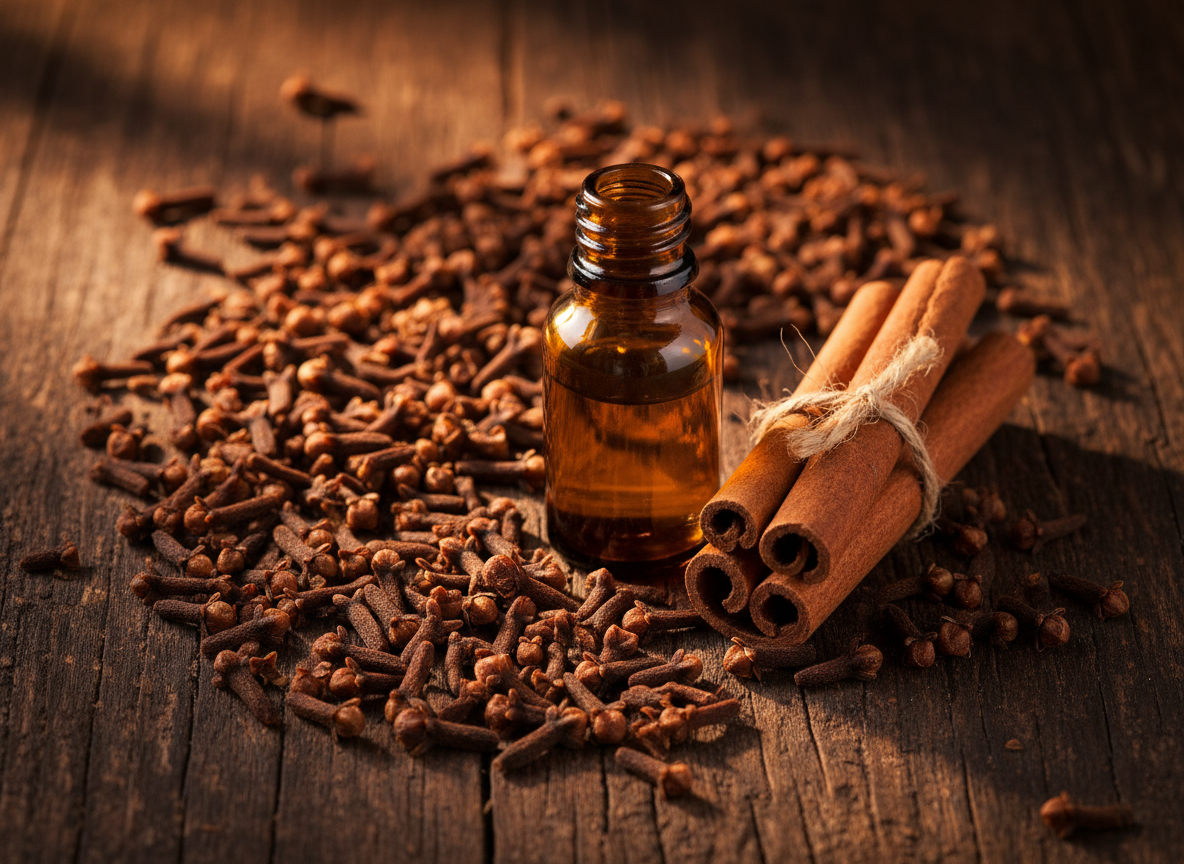
Clove essential oil is produced by steam distillation, and the plant part used matters enormously. Three grades exist in commercial trade:
- Bud oil: Distilled from the unopened flower buds, which are harvested by hand before they bloom. This is the grade most commonly sold for aromatherapy and cosmetic use. It has the most balanced aromatic profile and the lowest eugenol content of the three.
- Leaf oil: Distilled from fallen or harvested leaves. Significantly cheaper to produce because no hand-picking is required. Eugenol content is higher, sometimes exceeding 80 to 85 percent of total composition, and the scent is sharper and more phenolic.
- Stem oil: Distilled from the small woody stems. Eugenol content is the highest of all three grades, sometimes reaching 90 to 95 percent. Primarily used in industrial fragrance and as a eugenol extraction source.
A bottle labeled simply "clove oil" without specifying the part used is a sourcing red flag. For home use, bud oil is the standard recommendation.
Chemical Composition: What Is Actually in the Bottle
Clove bud oil has one dominant compound that shapes almost everything about its character: eugenol. In a quality bud oil, eugenol typically accounts for 72 to 90 percent of total volatile composition. That single fact explains the oil's warm, spicy-woody aroma, its intense sensory presence, and many of the safety considerations discussed below.
Beyond eugenol, several other compounds appear consistently in gas chromatography analyses:
| Compound | Typical Range in Bud Oil | Character Note |
|---|---|---|
| Eugenol | 72 to 90% | Warm, spicy, clove-like, slightly woody |
| Eugenyl acetate | 5 to 15% | Softer, slightly fruity-sweet modifier |
| Beta-caryophyllene | 5 to 12% | Dry, woody, faintly spicy sesquiterpene |
| Alpha-humulene | 0.5 to 1.5% | Woody, earthy, low-impact aromatic |
| Methyl eugenol | Trace to 0.3% | Sweet, rose-spice character |
Eugenyl acetate is worth noting. It is the compound most responsible for the sweetness that distinguishes good bud oil from the more austere leaf and stem grades. Higher eugenyl acetate content generally correlates with a more rounded, complex scent profile. When evaluating bud oils, some buyers specifically request GC/MS (gas chromatography/mass spectrometry) reports to confirm this ratio.
Beta-caryophyllene has attracted considerable independent research interest in recent years. It is a sesquiterpene found in many plants, including black pepper and cannabis, and some researchers have described it as a dietary cannabinoid because of its interaction with CB2 receptors. Research suggests it plays a role in the overall sensory complexity of clove oil, contributing the dry, woody backnotes that prevent eugenol from reading as purely medicinal.
What Current Research Observes

Clove compounds have been studied extensively in laboratory and in vitro settings. The volume of published research is large, and the findings are genuinely interesting. The challenge for a responsible writer is presenting those findings without overstating what they mean for a person using a diffuser or a diluted body oil at home.
Here is what the research literature observes, framed appropriately:
Eugenol and Oxidative Stress
Several in vitro studies have examined how eugenol interacts with markers of oxidative stress at the cellular level. Some research suggests eugenol may exhibit antioxidant activity in controlled laboratory conditions. Translating those observations to real-world outcomes for people inhaling or topically applying diluted clove oil is a significant leap that current evidence does not fully support. The findings are interesting as a starting point for further inquiry.
Beta-Caryophyllene and the Endocannabinoid System
Research published in journals including the Proceedings of the National Academy of Sciences has noted beta-caryophyllene's selective binding to CB2 receptors. Some researchers suggest this binding may be relevant to physiological processes, though the concentrations involved in aromatherapy use are far lower than those studied experimentally. People who enjoy clove oil in a diffuser report finding the scent grounding and warming, which is a reasonable way to describe a sensory experience without making any physiological claim.
Eugenol in Oral Care Contexts
Eugenol has a long documented history in dentistry, where zinc oxide-eugenol compounds have been used by practitioners for well over a century as temporary cements and pulp-calming materials. This professional application is supervised and uses specific formulations. It is worth noting because it contextualizes why clove is so closely associated with oral wellness traditions, not because it translates to home use claims.
Aroma and Emotional State
Some small-scale human studies have looked at how warm spice aromas, including clove, may support a sense of comfort or reduce perceived tension during stressful tasks. The methodology of such studies varies widely, sample sizes tend to be small, and findings should be read as preliminary observations. That said, the anecdotal record of humans reaching for warm spice scents during cold months or unsettled moments is quite old. You can read more about this cultural dimension in our piece on cloves in Victorian holiday traditions.
Safety Profile: The Details That Matter
Clove bud oil is one of the more potent essential oils in common use. Its high eugenol content demands respect. Here is what users need to know before reaching for the bottle.
Dilution Is Non-Negotiable
The International Fragrance Association (IFRA) and leading aromatherapy bodies recommend a maximum dermal use concentration of 0.5 percent for leave-on skin products. That translates to roughly 3 drops of clove bud oil per 100 ml of carrier oil. For rinse-off products the limit is slightly higher, around 0.5 to 1 percent, but conservative dilution is always the safer starting point. Do not apply undiluted clove oil directly to skin. Eugenol is a known skin sensitizer at higher concentrations, and sensitization reactions can be severe and long-lasting once they develop.
Patch Testing
Before using any clove-containing blend on the body, apply a small amount of the diluted preparation to the inner forearm. Wait 24 hours. If redness, itching, or irritation develops, discontinue use. This step is especially important for people with known sensitivities to phenolic compounds or those who have reacted to related spices in the past.
Mucous Membranes and Eyes
Keep clove oil away from mucous membranes and eyes entirely. Even well-diluted preparations can cause significant irritation in these areas.
Children and Specific Populations
Clove bud oil is generally not recommended for use on or around children under two years of age. Pregnant or nursing individuals, and those taking blood-thinning medications, should consult a qualified healthcare provider before using clove oil in any application. Eugenol has demonstrated some platelet-inhibiting activity in laboratory research, which is relevant context for anyone on anticoagulant protocols. This is not a reason to avoid the oil entirely; it is a reason to have the conversation with your provider first.
Oxidation and Shelf Life
Eugenol oxidizes over time, and oxidized eugenol is significantly more likely to cause sensitization than fresh oil. Store clove bud oil in a dark glass bottle, away from heat and light, and replace it after 12 to 18 months of opening. If the oil smells sharper, more astringent, or different from when you first opened it, it has likely begun to oxidize.
Sourcing and Quality Indicators
The clove oil market is not tightly regulated, and quality varies considerably. Here is what to look for when buying.
Specify Bud Oil
Insist on "clove bud essential oil" rather than generic "clove oil." Reputable suppliers will state the botanical name (Syzygium aromaticum), the plant part used (bud), the country of origin, and the extraction method (steam distillation). If any of these are missing from the label or product listing, that is a gap worth questioning before purchase.
GC/MS Testing
A published GC/MS report from a third-party laboratory is the gold standard for verifying composition. You are looking for eugenol in the 72 to 90 percent range for bud oil, with meaningful eugenyl acetate presence. Unusually high eugenol content (above 90 percent) in a product sold as bud oil may suggest the oil has been adulterated with the cheaper leaf or stem grade, or with synthetic eugenol.
Origin Matters, Modestly
Zanzibar and Pemba clove bud oils are often cited by perfumers for their particularly refined aromatic profile, with higher eugenyl acetate softening the phenolic edge. Madagascar produces high volumes of clove oil (mostly leaf grade) and has a strong supply chain, but bud oils from that origin vary. Indonesian bud oils are available and can be excellent when well-sourced. Origin is one factor among several; a GC/MS report from a reliable supplier tells you more than a country name alone.
Price as a Signal
Clove bud oil should not be extremely cheap. Bud harvesting is labor-intensive: the buds must be picked by hand before they open, usually twice a year, often by climbing or using long poles. Zanzibar's smallholder farming model means many individual families contribute to the supply chain. A price that seems implausibly low compared to market averages is worth investigating. You may be looking at leaf or stem oil, an adulterated product, or a blend.
Clove Oil in Your Home: Practical Starting Points
The most accessible and lowest-risk way to enjoy clove bud oil is diffusion. A few drops in a water-based ultrasonic diffuser fills a room with warmth without any skin contact concerns. It pairs naturally with orange, cinnamon bark (use cautiously), cardamom, and cedarwood for a spiced autumn or winter blend.
For a slow-burn home fragrance project with deep historical roots, the clove-studded orange pomander is a centuries-old tradition that uses whole clove buds rather than the essential oil. The resulting scent is slower and more diffuse than a diffuser, but it carries a remarkable sense of continuity with the past.
Body and massage applications are where dilution discipline matters most. Keep concentrations at or below 0.5 percent for leave-on skin use, patch test first, and avoid use near the face. When those guidelines are followed, clove bud oil in a carrier blend can be a genuinely pleasurable addition to an evening wind-down routine or a warming winter body ritual.
The spice trade that carried Zanzibar cloves across the Indian Ocean and into European harbors was driven by the same human instinct that puts clove oil in your diffuser today: the recognition that this particular scent does something to the atmosphere of a room that no synthetic compound quite replicates. The chemistry explains part of that. The centuries of association explain the rest.
For a wider view of how cloves shaped global commerce and culture, see our full piece on cloves and the spice trade. It is a longer read, and worth it.