What Therapeutic Grade Means for Clove Oil (Nothing Official)
There is no "therapeutic grade" of clove oil, or of any essential oil, because nobody with authority defines one. The phrase is a seller's adjective, and on a cosmetic-oil site it is worse than meaningless: it is the kind of word that points a regulator toward drug claims. What a buyer can actually ask for is a composition report, a botanical name and a plant part, and this article walks through what each of those proves and what none of them does.
Clove Essential Oil
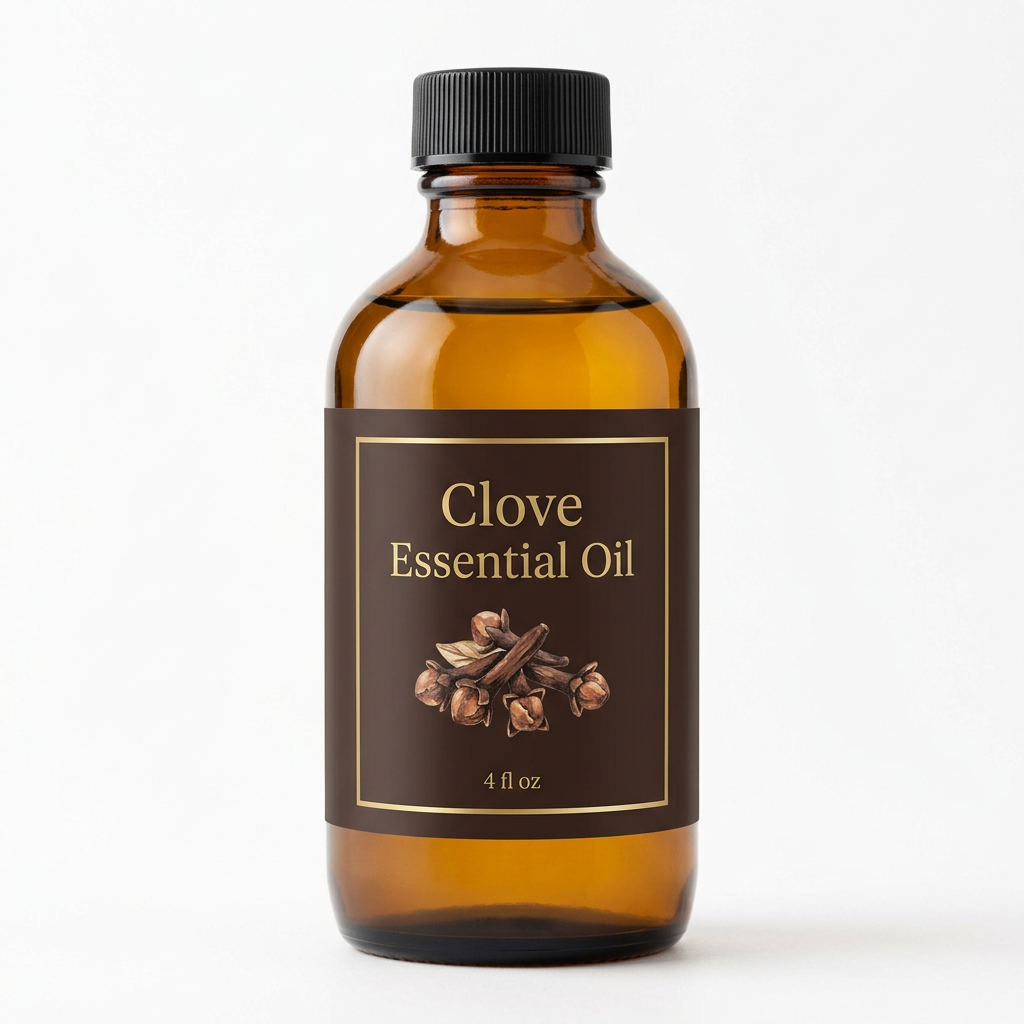
Our own Clove Essential Oil, in sizes from 0.5 oz to bulk.
From $10.99
Shop Now →What the regulators and standards bodies actually say
The FDA's aromatherapy page does not mention grades at all. It says a product's regulatory status depends mainly on intended use, judged from labeling and claims. A product meant only to cleanse or make a person more attractive is a cosmetic; one meant for a therapeutic use, such as treating or preventing disease, is a drug. The page lists "relieve colic, ease pain, relax muscles" as examples of drug claims and adds that coming from a plant does not exempt an ingredient. Reasoning from that, "therapeutic" attached to a bottle sold as an aromatic and cosmetic product is a claim about intended use, not a quality tier. That is one reason this site does not use it.
On the standards side, ISO 3142:1997 is titled "Oil of clove buds" and is listed as current; clove leaf oil has its own, separate ISO standard (3141, per the ISO listing we found). We could read only the catalogue entries, not the specification, because the text is sold. So we will not quote its eugenol limits. What the titles do establish is that the standards are written per plant part: bud oil and leaf oil are different commercial materials, which is how our two products are listed. Robert Tisserand, who writes on essential oil safety, makes the other half of the point on his own site (2010, with comments to 2013): ISO standards "were not created with therapeutic properties in mind, just good quality oils," and "there is no independent, industry standard that is known as 'therapeutic grade.'" He is one voice, writing on a personal blog, but the FDA page's silence on grades is consistent with him.
What does exist: a composition report
The same Tisserand post recommends asking suppliers for GC or GC-MS traces. That is the useful test, and here is what one looks like. Our /the-plant/ page publishes a Certificate of Analysis and GC-MS report for our clove bud oil. The report as we publish it says the analysis identifies 98.68% of the composition, led by 73.57% eugenol and 12.82% eugenyl acetate, with no adulterants, diluents or contaminants detected.
Worked through, those numbers say more than the headline:
- 73.57% + 12.82% = 86.39% of the oil is just two molecules. Of the 98.68% identified, eugenol is 74.55%.
- 98.68% identified leaves 1.32% unidentified. That is normal for a report; a claim of 100% identified would be the more suspicious number.
- The remaining 12.29% (98.68 minus 86.39) is split across everything else, which in clove bud oil literature typically means beta-caryophyllene and humulene. A 2021 review in Molecules (Haro-Gonzalez et al.) puts eugenol at "at least 50%" of clove essential oil, with 10 to 40% made up of eugenyl acetate, beta-caryophyllene and alpha-humulene.
Eugenol percentage also varies a lot between published samples, which is why one number is not a quality grade. A 2025 study of steam-distilled oils from Bali (Muderawan et al., Indonesian Journal of Chemical Research) found 65.29% eugenol in bud oil and 64.47% in leaf oil, with trans-caryophyllene at 20.06% and 27.19%. Our bud report's 73.57% sits above that Bali sample. We would not call either one "better": they are different oils from different places, and we cannot tell you which composition suits your use. We can tell you that a bud oil and a leaf oil can be close on eugenol and differ on caryophyllene, which is a difference of aroma and chemistry, not of grade.
What a GC-MS report does not prove
- That your bottle is the one tested. A report describes a sample. Ask any seller, us included, how a report ties to the lot you receive. Our page publishes one report for the bud oil; we will not claim more about batch matching than the page does.
- That nothing was added that GC-MS misses. A 2018 study (Vargas Jentzsch et al.) screened 19 commercial clove oil samples with a handheld Raman spectrometer and found benzyl alcohol in two and a vegetable oil in one. The vegetable oil needed multivariate statistics to spot. That is a small sample of unnamed products, so it tells you adulteration of clove oil has been documented, not how common it is.
- That the oil does anything for your body. Composition is chemistry. It says nothing about outcomes, and we do not claim any.
The leaf oil gap, and "pure" and "organic"
Our leaf oil's product page links no COA or GC-MS report. That means for the leaf oil we can tell you the product is described on the page as bottled undiluted with nothing added, and nothing more verifiable than that. If a composition report matters to your purchase, that is a reason to choose the bud oil, or to ask us for what exists before you buy the leaf oil. We would rather say that than imply a report we have not published.
On "pure": we do not use it as a quality claim, because nothing standard defines it. What you can check is the botanical name (Syzygium aromaticum), the plant part, whether the seller says anything is added, and whether a trace backs it. On "organic": no certification is documented for our oils, so we do not say it. A certified organic label would be a statement about farming inputs that a GC-MS trace cannot confirm either way; if you need that, look for a certificate from a named certifier. See our piece on organic versus conventional clove oil.
Who should skip this and what to do instead
If you are shopping for something to use for a health purpose, a composition report will not get you there, and neither will any grade. Our oils are labelled for aromatic and cosmetic use, never internal use, and the labels carry the dilution guidance of 0.5% to 2% and a patch test. For a health question see a pharmacist or physician; for the mouth, see a dentist.
For a purchase, the practical order is: confirm the plant part, ask for the report, read it with the arithmetic above, and ignore adjectives. Our guides on reading a GC-MS report, checking the label and choosing between bud and leaf go further into each step.
Clove Essential Oil
Clove Essential Oil from our own shop, in sizes from 0.5 oz to bulk.
From $10.99
Shop Now →Sources & Further Reading
- FDA, n.d. Aromatherapy. fda.gov/cosmetics/cosmetic-products/aromatherapy
- ISO, 1997. ISO 3142:1997 Oil of clove buds (catalogue entry, as listed by DIN Media). dinmedia.de/en/standard/iso-3142
- Tisserand R, 2010. Therapeutic grade oils: read all about it (post and comments). roberttisserand.com
- Haro-Gonzalez JN et al., 2021. Clove essential oil: extraction, chemical composition, food applications, and bioactivity. Molecules. PMID 34770801
- Muderawan IW et al., 2025. Chemical constituent and antioxidant activity of clove bud and leaf essential oils from Bali. Indonesian Journal of Chemical Research. ojs3.unpatti.ac.id/ijcr/11336
- Vargas Jentzsch P et al., 2018. Adulteration of clove essential oil: detection using a handheld Raman spectrometer. redi.cedia.edu.ec/document/16217