Can Clove Oil Fix a Cavity? What the Sources Show
No. Clove oil does not rebuild a cavity, and nothing in the research we found says it does. A cavity is a hole where acid has dissolved tooth, and the only thing that fills a hole in enamel is a dentist. We sell clove bud and clove leaf oil for aroma and cosmetic use, not for teeth, so this page is a myth check: three claims you will meet online, what the sources actually did, and what to do with a tooth you think has a cavity.
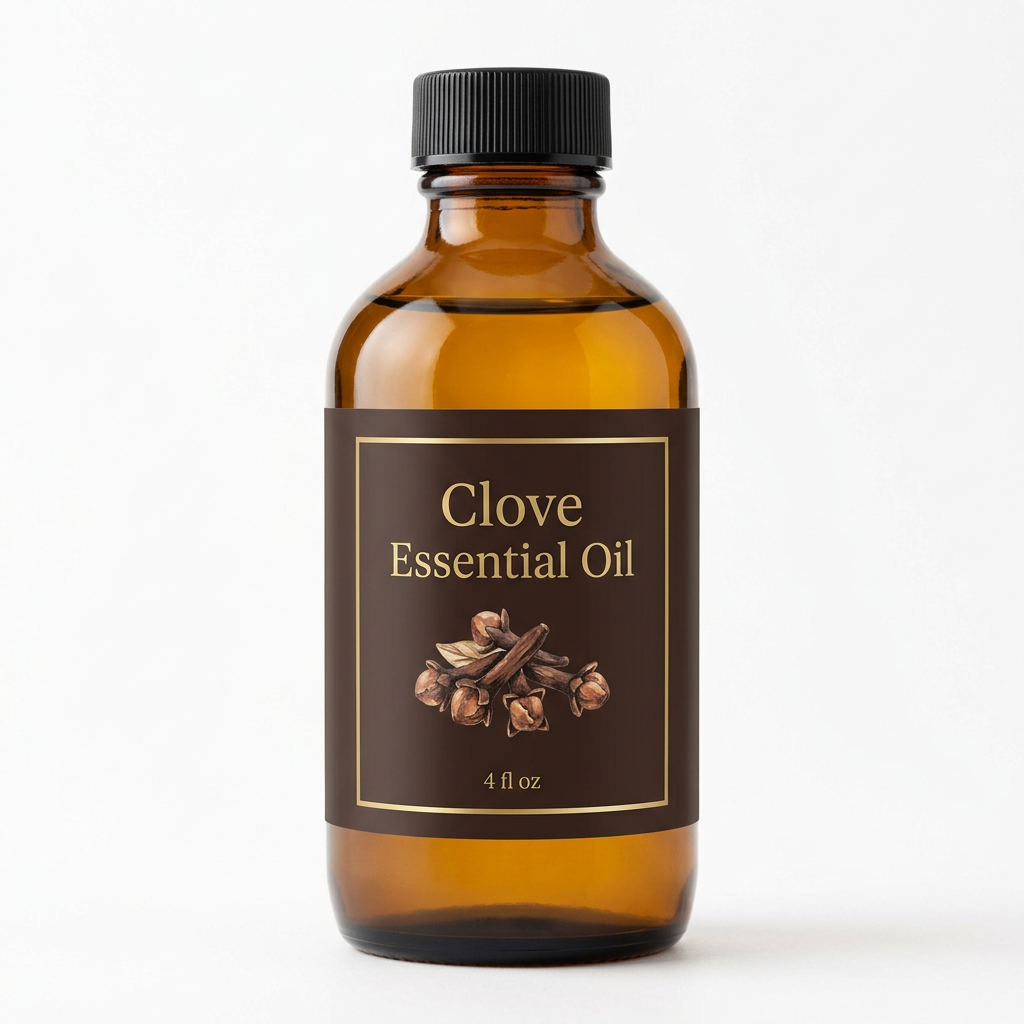
Clove Essential Oil
Our own Clove Essential Oil, in sizes from 0.5 oz to bulk.
From $10.99
Shop Now →Claim 1: "Clove oil can repair a cavity"
The CDC explains the mechanism plainly: bacteria stick to teeth, feed on what you eat and drink, and make acid that dissolves the outer enamel. Saliva neutralizes acid and helps repair enamel, but "if the repair isn't fast enough, bacteria get inside your tooth and make cavities." The CDC also says cavities get bigger unless the bacteria are stopped or removed. Small ones may be managed by a dentist with fluoride or other products to stop them growing, larger ones need a filling, and one near the nerve may need a root canal or extraction.
Look at what that list contains: fluoride, a filling, a root canal. An oil is not on it. Reasoning from the CDC's description, an oil sitting on a tooth cannot replace lost enamel, and it does not change the sugar-acid cycle that made the hole. The real contest is between how fast acid dissolves and how fast saliva and fluoride repair, and the best-evidenced lever we found is fluoride. A Cochrane review by Walsh and colleagues (2019) pooled 96 trials, about 65,300 randomized participants, and reported that fluoride toothpaste reduced caries compared with non-fluoride toothpaste; in adults, 1000 to 1100 ppm toothpaste lowered the decayed, missing and filled surface count by 0.53 (95% CI -1.02 to -0.04, moderate certainty). That number is modest per person, but it comes from a lot of data, which is what separates it from a lab dish.
Claim 2: "Studies prove clove kills the cavity bacteria"
There are studies, and what they tested is narrow.
- Bansal et al., Nigerian Medical Journal, 2019: a clove extract and a neem extract were compared with 0.2% chlorhexidine against Streptococcus mutans and Candida albicans in the lab. The clove minimum inhibitory concentration was 5.5 mg/mL for both organisms. Preparation: an extract, not essential oil; route: none, it was a dish.
- Gupta et al., Natural Product Research, 2026: a clove oil nanoemulsion (droplets about 44 nm) had an MIC of 0.4 mg/mL against S. mutans, inhibited biofilm formation by 82% and reduced established biofilm by 63%, in vitro only.
- Xu et al., Experimental and Therapeutic Medicine, 2013: eugenol (the main compound in clove oil, not the whole oil) reduced S. mutans acid production and adherence in the lab, and topical eugenol reduced the incidence and severity of carious lesions in rats.
Every one of those is a dish, a lab-made emulsion, or a rat. None is a human trial of clove oil preventing or stopping a cavity. That is the gap, and it is not a small one: lab MICs are measured in a tube where nothing is washed away, nothing competes with them, and there is no saliva. The rat study is the closest to a living mouth, and it used a single compound, not the oil, in a species whose teeth and diet differ from ours. Applying any of these to a bottle of our oil would be an inference we cannot support.
What a real answer would look like
The fluoride evidence above is a useful yardstick, because it shows the kind of study that settles a caries question: thousands of people, randomized, followed for long enough to count new decayed surfaces, with a comparison toothpaste. Reasoning from that standard, a trial of clove oil would need the same: a defined, standardized preparation, a control, and a count of new cavities over a period of years, with burns and allergies recorded as outcomes. We did not find one. Until one exists, the honest label for the clove-and-cavity literature is "interesting chemistry, unanswered clinical question".
Claim 3: "It is natural, so it can only help"
Clove oil is a concentrated source of eugenol, and our published GC-MS report for the bud oil lists 73.57% eugenol. Concentrated is the problem. A 2022 case report described a 30-year-old woman whose mouth ulcers worsened within two days of applying a clove oil concentrate and who was found to have shallow ulcers with redness on the cheek lining, soft palate and tongue, recorded as an oral mucosal burn. The Tisserand Institute gives a 0.5% skin maximum for clove bud oil and warns eugenol can irritate or sensitize. And swallowing is dangerous for children: Janes et al. (2005) reported liver failure in a 15-month-old after 10 ml.
For the record, the Cochrane result is also about toothpaste in the ordinary sense, brushed and spat out as labelled, so it speaks to a product made and tested for the mouth. That is the opposite of an essential oil that was never studied for it.
A short decision guide
- You see a brown or white spot, or a rough patch, but no pain. Book a dental check. Early spots are the stage where the CDC says fluoride or other products may stop growth, so earlier is cheaper and simpler.
- You have a visible hole, or food packs in one spot. A filling is the usual repair. Waiting means a bigger hole.
- The tooth throbs, wakes you at night, or your face is swollen. See a dentist the same day; if swelling is spreading or you have trouble swallowing or breathing, go to an emergency department. The infection is no longer a surface problem.
- You want to lower your risk. The evidence we found points to fluoride toothpaste and fluoridated water (the CDC reports that children who drink fluoridated tap water and brush daily with fluoride toothpaste have fewer cavities). Ask your dentist about your own risk.
What we will and will not do
We will tell you what clove smells like, how our two oils differ (our bud versus leaf comparison covers it), and how to use them for scent. We will not give drops, dilutions or frequencies for teeth, gums or the mouth, because our oils are labelled for aromatic and cosmetic use, and because the documented harms above are real. For broader context see clove oil myths and facts and our oral health overview.
If you came here wanting a way to avoid the dentist, the sources we read point the other direction: the sooner a cavity is looked at, the smaller the fix.
Clove Essential Oil
Clove Essential Oil from our own shop, in sizes from 0.5 oz to bulk.
From $10.99
Shop Now →Sources & Further Reading
- U.S. CDC. About cavities (tooth decay). cdc.gov/oral-health
- Walsh T et al., 2019. Fluoride toothpastes of different concentrations for preventing dental caries (Cochrane). pubmed.ncbi.nlm.nih.gov/30829399
- Bansal V et al., 2019. Antimicrobial effectiveness of neem and clove extract against S. mutans and C. albicans. pubmed.ncbi.nlm.nih.gov/32180657
- Gupta AD et al., 2026. Clove oil nanoemulsion against S. mutans. pubmed.ncbi.nlm.nih.gov/42228993
- Xu JS et al., 2013. Effect of eugenol on cariogenic properties of S. mutans and caries in rats. pubmed.ncbi.nlm.nih.gov/23837051
- Sulaksana SD, Soegyanto AI, 2022. Oral mucosal burn caused by a clove oil concentrate. jurnal.unissula.ac.id/18635
- Tisserand Institute. Eugenol. tisserandinstitute.org/learn-more/eugenol
- Janes SE et al., 2005. Essential oil poisoning: N-acetylcysteine for eugenol-induced hepatic failure. pubmed.ncbi.nlm.nih.gov/15895251