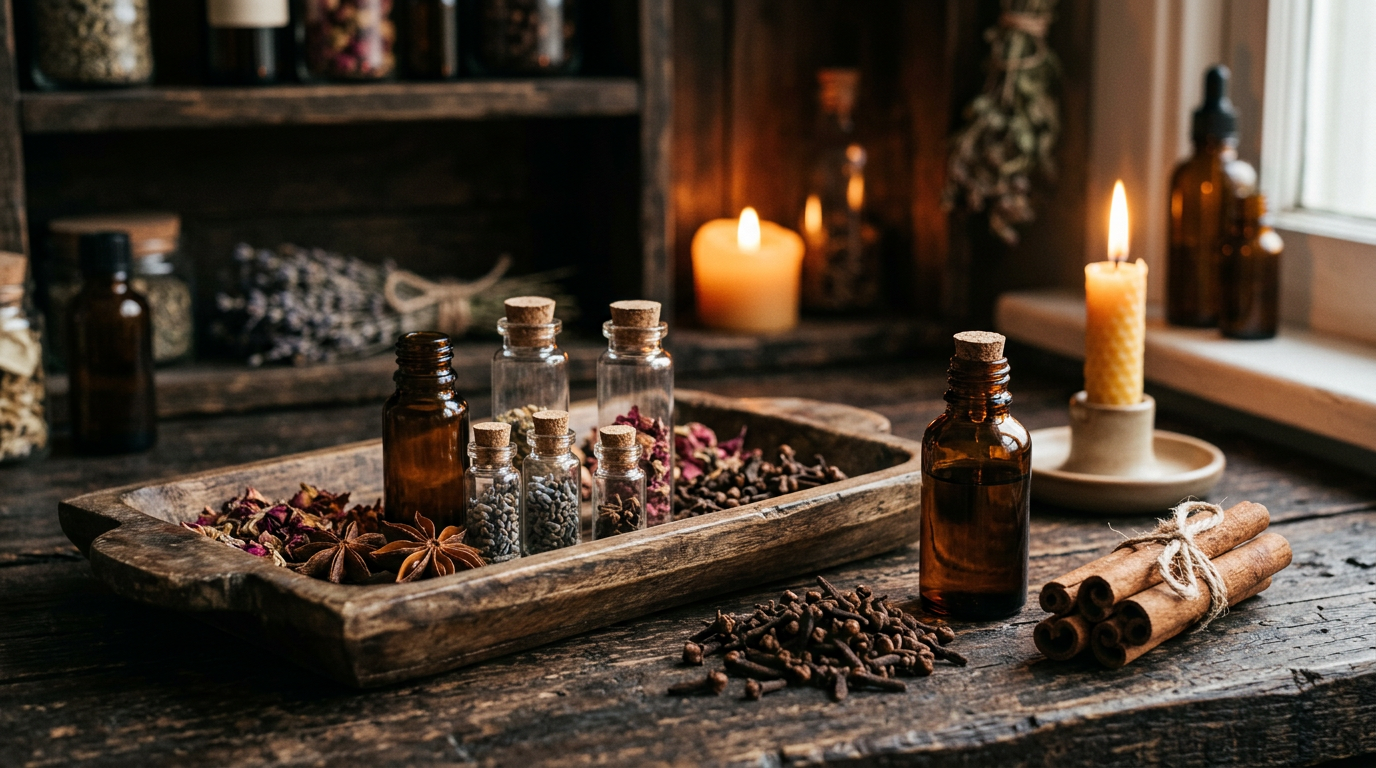
Spiced Ember: Our Signature Clove, Cedarwood, and Sweet Orange Blend
Some blends arrive fully formed, like a recipe that has always existed and you only needed to find it. Spiced Ember is one of those. Warm clove bud, dry cedarwood Atlas, and bright sweet orange lock together in the diffuser like three musicians who have played together for years. The result is a scent that feels both ancient and immediate: a firelit autumn afternoon, a kitchen with something slow-cooking, a living room where the windows have fogged with good conversation.
This guide walks you through the full blend from the ground up. You will find the rationale behind each ingredient, precise measurements in drops and milliliters, step-by-step instructions, safety notes you actually need, storage guidance, and three variations to take the blend in new seasonal directions. If you want a deeper foundation in pairing clove with other botanicals before you start, the complete guide to blending with clove oil is a good place to spend twenty minutes first.
Why These Three Ingredients Belong Together
Clove Bud Oil: The Heart of the Blend
Clove bud essential oil is the backbone of any serious spiced diffuser recipe. The bud expression (as distinct from clove leaf or stem) carries a rounded, slightly sweet quality alongside its characteristic sharp warmth. Eugenol is the dominant compound and the reason clove smells unmistakably like itself, but bud oil also contains small amounts of beta-caryophyllene and methyl salicylate that soften the overall impression. The result is a top-to-mid note that opens boldly and then settles into something rounder as it disperses.
Good clove bud oil comes primarily from Indonesia, Madagascar, and Sri Lanka. For a blend that leans cozy rather than medicinal, look for oil sourced from Maluku (the original Spice Islands) or Madagascar, where the aroma tends toward warm sweetness rather than clinical sharpness. And because clove bud is potent, it only needs a modest share of the total formula. A little carries the entire room.
Cedarwood Atlas: The Dry, Grounding Base
Cedarwood Atlas (Cedrus atlantica, sourced from Morocco and Algeria) is one of the great fixative base notes in natural perfumery. It is dry, slightly creamy, and distinctly woody without smelling like a pencil shaving. That dryness is what makes it the perfect counterpoint to clove's heat. Where clove is assertive and forward, cedarwood is patient. It lingers in the background, lending the blend staying power and a feeling of depth that lighter woods cannot quite match.
Atlas cedar contains a high proportion of atlantones and sesquiterpenes, which give it that characteristic smooth, long-lasting diffusion. In a home diffuser, it means the blend does not disappear after twenty minutes. It builds slowly and holds.
Sweet Orange: The Brightness That Ties It Together
Sweet orange oil (Citrus sinensis, cold-pressed from the peel) is the element most people underestimate in a spice blend. It reads as cheerful and familiar on its own, but in combination with clove it transforms. The limonene-rich brightness cuts through the heavier notes, keeps the blend from feeling heavy or oppressive, and adds a candied, slightly jammy quality that recalls mulled wine, spiced pastry, and winter markets. Orange also accelerates how quickly a diffuser blend fills a room, acting almost like a carrier wave for the heavier molecules behind it.
Cold-pressed sweet orange is the preferred form here. Steam-distilled versions are available but tend to smell flatter and less true to the fresh fruit. Note that sweet orange oil is phototoxic, so keep the safety section in mind if you choose to use this blend in a topical application rather than purely for diffusion.
The Spiced Ember Signature Blend Formula
Ingredients
| Ingredient | Drops (single session, 100ml diffuser) | Drops (10ml concentrate) | Milliliters (10ml concentrate) |
|---|---|---|---|
| Clove Bud Essential Oil | 2 drops | 10 drops | approx. 0.5ml |
| Cedarwood Atlas Essential Oil | 3 drops | 15 drops | approx. 0.75ml |
| Sweet Orange Essential Oil | 5 drops | 25 drops | approx. 1.25ml |
| Fractionated Coconut Oil (for concentrate dilution) | n/a | fill to 10ml | approx. 7.5ml |
Ratio summary: 20% clove bud / 30% cedarwood Atlas / 50% sweet orange. This keeps clove assertive but not dominant and gives sweet orange enough presence to keep the blend feeling lifted.
Step-by-Step Blending Instructions
For Diffuser Use (Single Session)
- Fill your diffuser reservoir to the recommended water line for your model.
- Add 2 drops of clove bud oil directly to the water.
- Add 3 drops of cedarwood Atlas.
- Add 5 drops of sweet orange.
- Run for 30 to 60 minutes in a well-ventilated space. Take a 30-minute break before running another session.
Making a 10ml Pre-Mixed Concentrate
Pre-mixing saves time and keeps your ratios consistent every session. A concentrate also makes a thoughtful gift, and a small 10ml bottle looks beautiful on a shelf.
- Start with a clean, dry 10ml amber or cobalt glass bottle with an orifice reducer (the small dropper insert that controls flow).
- Using a clean glass dropper or graduated pipette, add 10 drops of clove bud oil to the bottle first. Clove is the most potent note; adding it first lets you check the quantity before the other oils are in.
- Add 15 drops of cedarwood Atlas.
- Add 25 drops of sweet orange.
- Top the bottle up to the 10ml line with fractionated coconut oil (FCO). FCO is odorless, does not go rancid quickly, and mixes smoothly with essential oils.
- Cap the bottle, then gently roll it between your palms for 30 seconds. Do not shake aggressively; rolling is enough to blend without introducing air bubbles.
- Label the bottle with the blend name, date, and contents. Then set it aside for 24 hours. Letting a blend rest allows the aroma compounds to marry fully before you evaluate the final scent.
- To use: add 8 to 10 drops of the diluted concentrate to your diffuser water per session.
Safety Notes and Dilution Guidelines
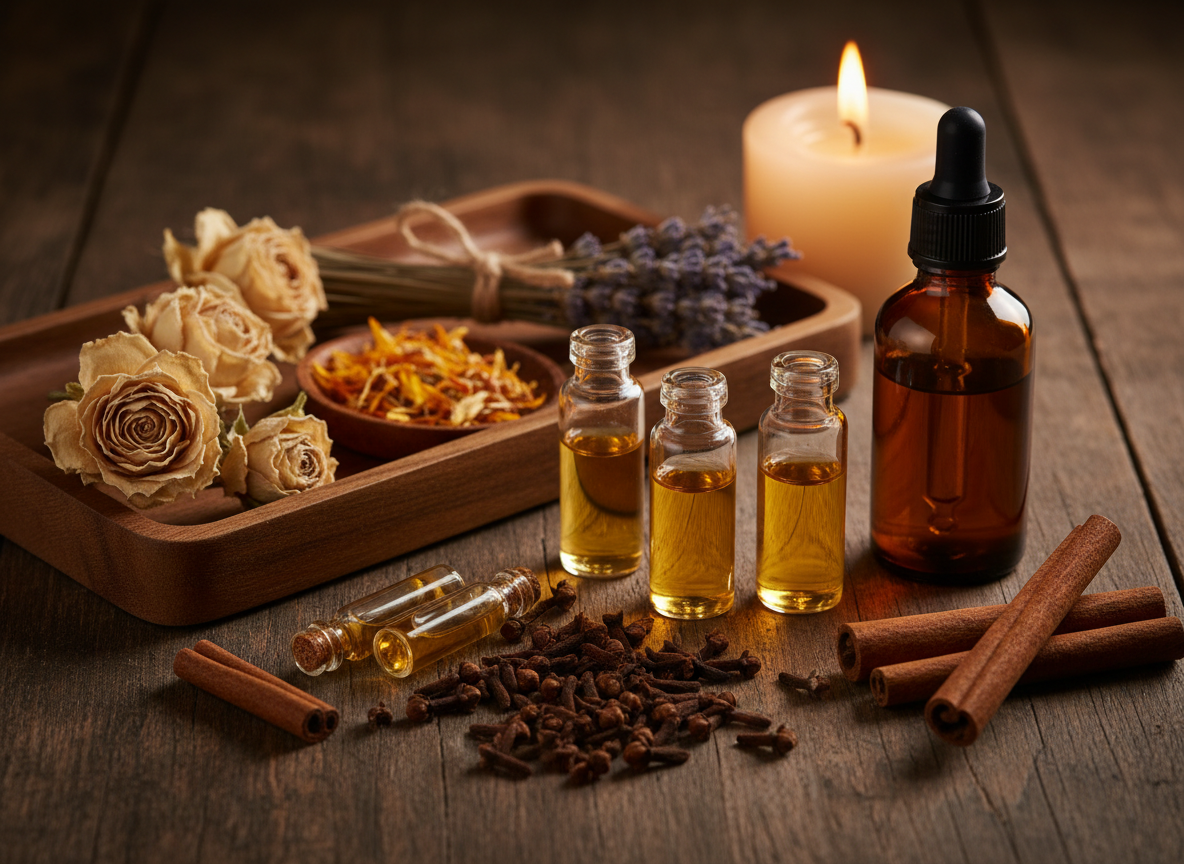
Clove bud oil is one of the more potent essential oils in common use, and it deserves careful handling.
- For diffusion only: If you plan to use Spiced Ember purely as a room scent, the formula above is appropriate as written. Keep the room ventilated and limit diffusion sessions to 60 minutes at a time.
- For topical use (e.g., applying the concentrate to pulse points): The 10ml concentrate with FCO produces an approximately 2.5% dilution of essential oils, which sits at the upper acceptable boundary for a body application. If you have sensitive skin, reduce the total essential oil count in the concentrate and increase the FCO accordingly, targeting a 1% dilution (about 6 drops total essential oil per 10ml carrier).
- Patch testing is non-negotiable with clove oil. Apply a small amount of the diluted concentrate to the inside of your forearm, cover loosely, and wait 24 hours before broader use. Clove can cause skin sensitization in some individuals, particularly at higher concentrations.
- Phototoxicity: Cold-pressed sweet orange has a low phototoxicity rating compared to other citrus oils, but if you apply this blend topically, avoid direct sun exposure on treated skin for at least 12 hours.
- Children and pets: Keep diffusion sessions short (15 to 20 minutes) around young children, and avoid diffusing in enclosed spaces where cats or small animals cannot leave the room. Consult a qualified veterinarian and a qualified healthcare provider before using essential oils around infants, young children, or anyone with relevant health considerations.
- Pregnancy: If you are pregnant or nursing, consult a qualified healthcare provider before using this or any essential oil blend.
Storage and Shelf Life
Essential oil blends are perishable, and how you store them determines how long they stay at their best.
- Store in a tightly sealed amber or cobalt glass bottle, away from direct light, heat, and humidity. A drawer or cabinet shelf works well.
- The limiting ingredient in this blend is sweet orange, which is a cold-pressed citrus oil. Citrus oils oxidize faster than resins and woods. Expect the concentrate to remain at peak quality for 6 to 9 months when stored properly.
- Clove bud and cedarwood Atlas are both considerably more stable and would last considerably longer on their own. Storing the pre-mixed concentrate in the refrigerator (in a sealed bag to contain any aroma) can extend its life toward the 12-month mark.
- Signs that a blend has turned: the sweet orange note will flatten or smell slightly soapy, and the overall aroma may take on a slightly metallic edge. If you notice either, make a fresh batch.
Variations on Spiced Ember
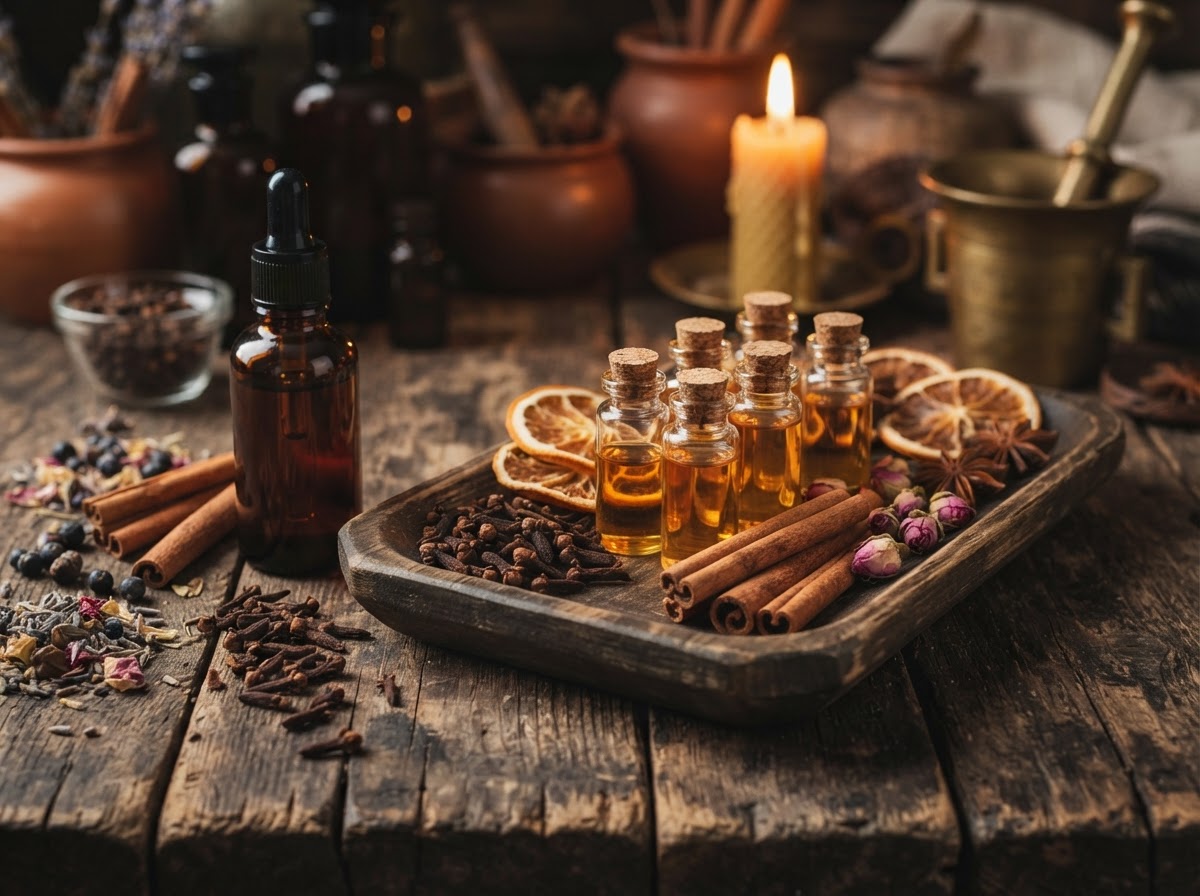
Variation 1: Ember and Vanilla (Deep Winter)
Add 2 drops of vanilla CO2 extract (or vanilla absolute, well-diluted) to the base formula per 10ml concentrate. Vanilla rounds out the cedar's dryness and pushes the blend toward something almost edible: a spiced holiday cake, a slow morning by the fire. If you love the idea of clove and vanilla as a dedicated pairing, the full recipe in our Velvet Spice clove and vanilla guide goes considerably deeper into that combination.
Variation 2: Ember and Cardamom (Bright Spice Market)
Swap 5 of the sweet orange drops for 3 drops of sweet orange and 2 drops of cardamom seed oil. Cardamom brings a cooling, almost floral spice note that pivots the blend from autumnal to something more evocative of a Moroccan souk or an Indian chai kitchen. The cedarwood anchors both directions equally well. This variation works beautifully in a reed diffuser (use the concentrate undiluted in the reed vessel, or as the manufacturer recommends).
Variation 3: Ember and Black Pepper (Dark and Dry)
Add 2 drops of black pepper essential oil to the concentrate formula. Black pepper oil has a sharp, almost smoky dryness that accentuates the woody register of the cedarwood and makes the clove read as more robust and less sweet. This variation suits a home office or a reading room in the evening. It has the assertive quality of a well-worn leather chair and a bookshelf that has seen years of use.
A Note on Sourcing Quality Ingredients
A blend is only as good as its components. For a clove signature blend built around bud oil specifically (not leaf, not stem), ask your supplier for the botanical name on the label (Syzygium aromaticum, bud), the country of origin, and the GC/MS report if one is available. These documents show the chemical profile of a specific batch and let you verify that what you are buying matches what the label claims.
For cedarwood, confirm you are getting Cedrus atlantica and not Juniperus virginiana (Virginia cedarwood) or Juniperus mexicana (Texas cedarwood), which are both sold under the "cedarwood" name but have noticeably different aromatic profiles. Atlas cedar is smoother, creamier, and more persistent. The others tend toward a sharper, more pencil-like quality that does not marry as well with clove.
If you find yourself enjoying the creative side of building blends like this one, the DIY clove sugar scrub project is a natural next step, taking clove bud's warm scent into a tangible, seasonal kitchen-shelf ritual.
Making Spiced Ember Part of a Seasonal Ritual
The best home fragrances become anchored to specific moments rather than diffusing aimlessly into the background. Consider using Spiced Ember on a consistent schedule: Sunday afternoons when the week is winding down, the hour before guests arrive, the stretch of time between dinner and bed when the evening finally has room to breathe. Repetition is what transforms a scent from pleasant to meaningful. After a few weeks, even the act of opening the bottle will shift something in the room before a single drop hits the water.
Keep the blend on a small tray with your diffuser, a box of matches, and a candle. Make the setup intentional. The ritual of choosing a scent and setting it diffusing is small but it signals something: the day is done, or the guests are arriving, or this hour belongs to you. Spiced Ember is designed to carry that signal clearly, warmly, and for a good long while.